
Last updated: November 2025
Feeling anxious is part of being human, but when worry starts affecting your everyday life, having the right coping skills makes a real difference. The good news? These aren’t just random techniques—they’re grounded in how your brain and nervous system actually work. When you understand why certain coping strategies help manage anxiety, you’re more likely to use them consistently and see results.
This guide explains the science behind effective anxiety management and gives you practical tools you can start using today.
What Are Coping Skills for Anxiety Therapy?
Coping skills are specific techniques that help you manage anxious feelings and reduce worry in the moment. Cognitive behavioral therapy teaches you to identify triggers and challenge negative thoughts that fuel anxiety, while other approaches focus on calming your body’s stress response.
These strategies work by interrupting the cycle between your thoughts, physical sensations, and emotions. When you’re anxious, your body activates fight-or-flight mode—your heart races, breathing speeds up, and muscle tension increases. Coping strategies signal to your nervous system that you’re safe, which naturally reduces anxiety symptoms.
Research shows that regular practice of these evidence-based techniques leads to better mental health outcomes. The key is finding which techniques work best for you and using them before anxiety becomes overwhelming.
Why Do These Coping Strategies Work?
Your nervous system has two modes: sympathetic (fight-or-flight) and parasympathetic (rest-and-digest). When you’re anxious, your sympathetic system runs the show. Effective coping strategies activate the parasympathetic system to help you feel calmer.
Here’s what happens in your body during anxiety. Your amygdala detects perceived threats and triggers stress hormones. Your heart pounds, breathing becomes shallow, and blood flows to your muscles for quick action. This response helped our ancestors survive genuine dangers, but today it often fires up over worries about work, relationships, or health.
Progressive muscle relaxation and deep breathing work by giving your body physical proof that you’re safe. When you deliberately slow your breathing or release muscle tension, you send signals through your vagus nerve that tell your brain to calm down. This isn’t just in your head—it’s a real physiological shift.
In our work with clients at Therapy Group of DC, we’ve seen how understanding the neuroscience of anxiety changes everything. When clients grasp that deep breathing isn’t just a distraction but actually shifts their nervous system, they’re more likely to stick with it during panic attacks. We often spend time in early sessions explaining the vagus nerve and fight-or-flight response because this knowledge builds trust in the techniques we teach.
What Are 5 Ways to Calm Down Anxiety?
Five evidence-based methods reduce anxiety in both the short and long term. Each approach targets different aspects of how anxiety shows up in your body and mind.
Practice Deep Breathing or Breathing Exercises
The 4-7-8 technique activates your parasympathetic nervous system almost immediately. Inhale through your nose for four counts, hold for seven counts, and exhale for eight counts. Brief respiratory interventions interrupt the shallow breathing pattern that maintains your stress response and provides calming effects.
Use Progressive Muscle Relaxation
This relaxation technique helps you identify and release muscle tension throughout your body. Start with your toes—tense each muscle group for five seconds, then release. Move upward through your legs, stomach, arms, and face. The contrast between tension and relaxation trains your body to recognize and let go of physical strain.
Try Grounding Exercises
The 3-3-3 rule anchors you in the present moment when anxious thoughts pull you toward future worries. Name three things you see, three sounds you hear, and move three body parts. This simple exercise shifts your attention from internal worry to external reality and helps you stop worrying about things outside your control.
Engage in Physical Activity
Exercise helps your body process stress hormones and release endorphins that naturally improve mood. Physical activity reduces anxiety by letting you experience sensations like increased heart rate in a safe context, which makes these feelings less triggering during panic. Whether it’s walking, yoga, or another form of exercise, movement supports both physical health and overall well-being.
Practice Mindfulness or Meditation
Mindfulness means paying attention to the present moment without judgment. Mindfulness-based approaches teach you to observe worry without getting swept away by it. Even five minutes of guided meditations can create mental space between you and your anxiety.
We recommend that clients experiment with all five of these techniques to discover what resonates most. Some people find grounding exercises incredibly effective, while others swear by progressive muscle relaxation. We understand that the best coping skill is the one you’ll actually use consistently, and that varies from person to person.
What Is the 3-3-3 Rule of Anxiety?
The 3-3-3 rule is a quick grounding technique that uses your senses to interrupt anxiety and bring your focus back to the present moment. When you notice anxious feelings building, identify three things you can see around you, three sounds you can hear, and then move three different body parts.
This technique works because anxiety pulls your attention toward perceived threats—usually worries about the future or regrets about the past. By deliberately focusing on your immediate sensory environment, you give your brain something concrete to process instead of abstract fears.
What makes the 3-3-3 rule effective is its simplicity. You don’t need any special equipment or privacy. Whether you’re in a meeting in Dupont Circle, on the Metro, or lying awake at night, you can use this strategy to ease anxiety within minutes.
Many people find that pairing the 3-3-3 rule with slow breathing creates an even stronger effect. The combination addresses both the mental spiral of anxious thoughts and the physical symptoms your nervous system produces.
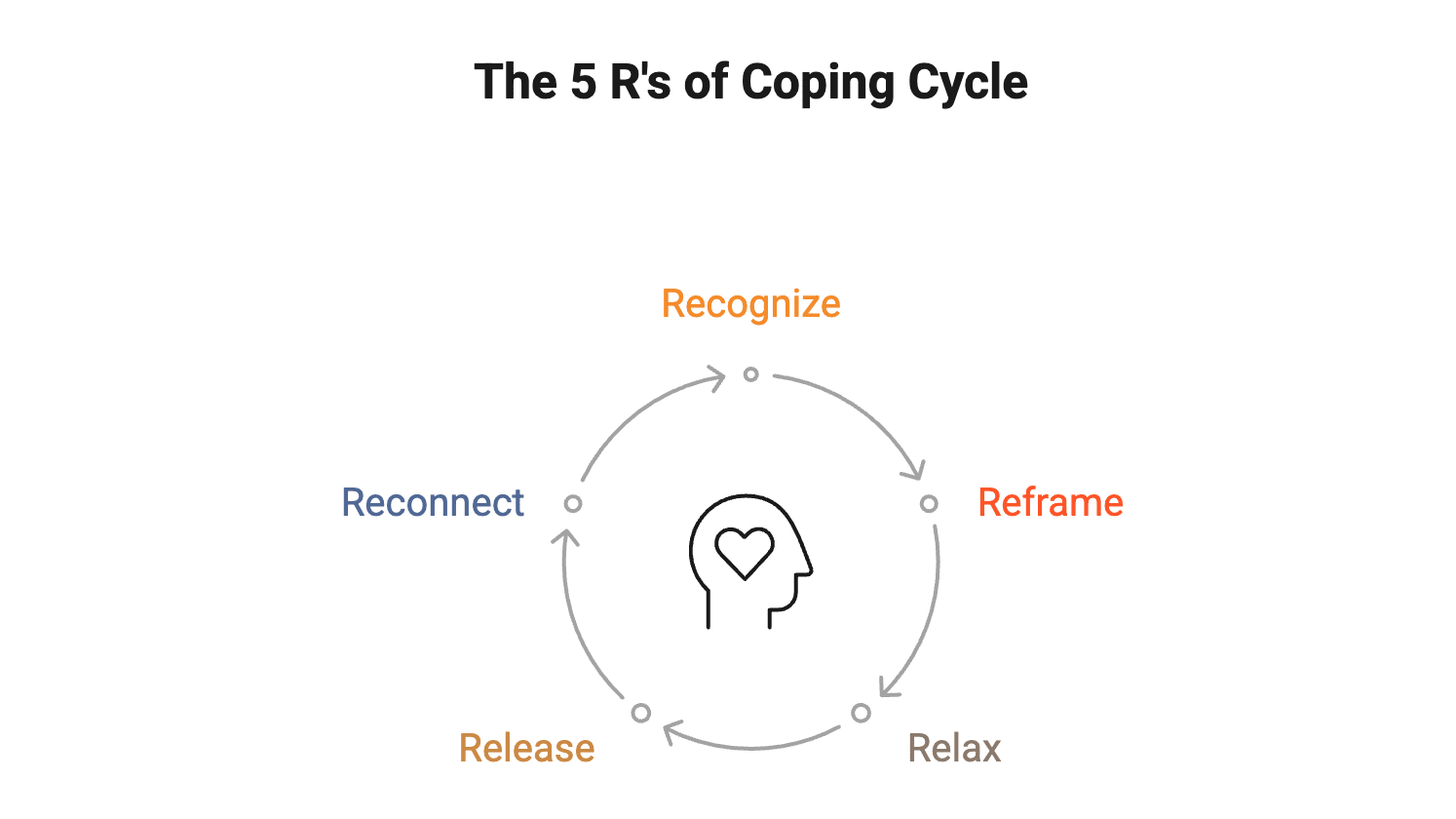
What Are the 5 R’s of Coping?
The 5 R’s provide a framework for managing stress and anxiety: Recognize, Reframe, Relax, Release, and Reconnect.
Recognize means identifying your anxiety triggers and noticing early warning signs. Does your chest tighten when checking email? Do certain situations consistently spike your worry? Awareness is the first step toward effective coping strategies.
Reframe involves challenging negative thoughts that fuel anxiety. Instead of “I can’t handle this,” try using positive affirmations like “This feels hard, but I’ve managed difficult things before.” Cognitive behavioral therapy teaches you to examine whether your anxious thoughts match reality.
Relax your body using relaxation techniques like deep breathing, progressive muscle relaxation, or guided imagery. Choose methods that create a sense of calm for you specifically—what works varies from person to person.
Release means expressing your feelings rather than bottling them up. Write in a journal, talk to t rusted friends or family, or work with a therapist. Keeping anxious feelings inside often intensifies them over time.
Reconnect to activities and relationships that support your mental health. This might mean setting boundaries to reduce stress, engaging in physical activity, or reaching out for support when you need it.
How Can You Build These Skills Into Everyday Life?
Coping strategies work best when they become healthy habits rather than emergency measures. Think of anxiety management like staying healthy—regular practice prevents problems and makes acute symptoms easier to handle when they arise.
Start with one or two strategies that feel most manageable. Maybe you practice deep breaths for two minutes each morning, or you do a body scan before bed to release muscle tension. Consistency matters more than perfection.
Create environmental cues that remind you to use your coping skills. Set a phone alarm for a midday breathing exercise at a specific time. Keep a note on your bathroom mirror about self-compassion. These small prompts help integrate anxiety management into your daily routines.
Pay attention to lifestyle changes that affect your baseline anxiety level. Getting enough sleep—at least seven hours per night—gives your brain the recovery time it needs to manage stress. Limiting caffeine can reduce the jittery sensations that mimic or worsen anxious feelings. Maintaining a balanced diet supports both your physical health and mental well-being.
The most common mistake we see is clients treating coping skills as emergency-only tools. They wait until they’re in full panic before trying to breathe or ground themselves. We encourage clients to practice these techniques daily when they’re calm, which builds neural pathways that make the skills more accessible during high anxiety. Think of it like muscle memory—the more you practice in low-stress moments, the more automatic it becomes when you really need it.
Some situations will challenge you more than others. When you face anxiety triggers, use smaller steps to work through them gradually. Exposure therapy shows that avoiding feared situations maintains anxiety, while facing them bit by bit helps your brain learn they’re manageable.
Consider joining support groups where you can connect with others who have similar experiences. Talking about your worries with people who understand reduces the sense of isolation that often accompanies an anxiety disorder.
If anxiety is affecting your relationships, work, or ability to handle everyday life, that’s a sign to talk with a mental health professional. Effective treatments exist, and getting help early makes a real difference. Some people benefit from therapy alone, while others find that combining coping strategies with professional support provides the most relief.
When Should You Seek Professional Help?
You don’t have to wait until anxiety feels unbearable to reach out for support. If your anxiety symptoms persist despite using coping skills, if worry stops you from doing things you value, or if you experience frequent panic attacks, professional help makes managing anxiety much more effective.
Therapists can teach you additional strategies and help you identify patterns you might miss on your own. Evidence-based treatments consistently show that with the right support, people experience significant improvement in their anxiety symptoms and overall functioning.
Getting Support in Washington, DC
If you’re looking for support with anxiety, the therapists at Therapy Group of DC are here to help. Schedule an appointment to get started.
Disclaimer: This article is for educational purposes only and is not a substitute for professional medical advice, diagnosis, or treatment. Always seek the advice of your physician or qualified mental health provider with any questions you may have regarding a medical or mental health condition. If you are in crisis or experiencing thoughts of self-harm, please call 988 (Suicide and Crisis Lifeline) or go to your nearest emergency room.