

Life in DC can move fast—and then freeze. Radical acceptance isn’t approval; it’s dropping the rope in a tug-of-war you can’t win so your energy returns for the step that actually helps. Here’s the simple, four-choice map to lower suffering without going numb.
Who is this for?
Washington, DC readers who want less suffering when life won’t budge—commutes, agency delays, relationship friction, health news, or big national events. All of us in DC are well aware that life is often full of hard and challenging times that are unavoidable and out of our control. This is a short, practical guide written in plain language.
What are the four choices when life hurts?
You can (1) solve the problem, (2) change how you feel/relate to it, (3) radically accept reality, or (4) stay miserable. This guide helps you choose wisely and act kindly toward yourself.
While radical acceptance encourages you to accept things as they are, it is not always appropriate to accept things in situations where active change is needed or when safety is at risk.
1) Can I solve the problem?
Start where you have leverage. Define the smallest, concrete target you can influence (call the insurer, reschedule, ask for a deadline shift). Then walk the mini‑loop: define → brainstorm → pick → plan → review. A tiny step counts.
DC examples: a WMATA delay on the Red Line; a billing error; a roommate noise issue.
2) Can I change how I feel or relate to it?
Sometimes the external facts are mixed or slow to change. In those moments, work your inner skills: name the emotion (labeling calms the body, e.g., when you feel anxious or overwhelmed), use mindfulness and paced breathing (in 4, out 6), add a compassionate line (“this is hard, and I can be kind to myself”). If your story is spiraling, try a lighter reframe that’s true and balanced.
- Emotion skills (labeling, paced breathing), cognitive reframe, self‑compassion.
- Use when: the facts are mixed or partially changeable; mood is amplifying distress.
3) Is this a moment for radical acceptance?
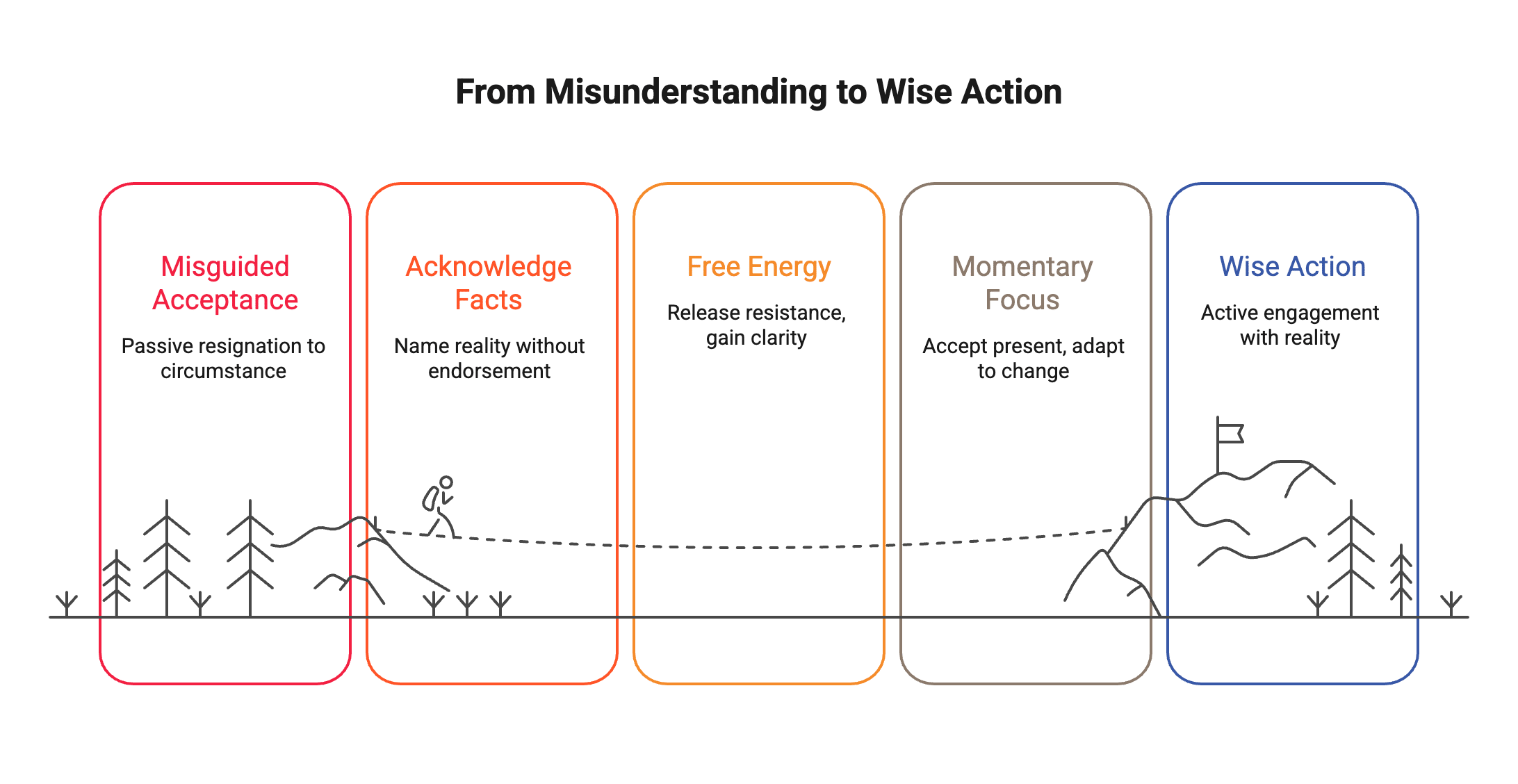
Radical acceptance means fully acknowledging the facts of this moment (which means accepting your current reality without judgment)—even when they’re painful—so you stop adding extra suffering. It is not approval, resignation, or passivity. It is the decision to face what is, so you can free up energy for wise action. Accepting things as they are can reduce suffering and promote emotional well-being.
4) What happens if I do nothing (stay miserable)?
When we fight reality, we get stuck in fairness traps (“this shouldn’t be happening”) and burn time ruminating; acceptance‑based approaches are linked with better coping and functioning. The lack of acceptance can lead to prolonged suffering from initial pain. No shame—brains do this. But staying in the tug‑of‑war keeps the rope taut. Dropping the rope opens space for problem‑solving and stance‑shifts, or acceptance.
How do I decide quickly? (A 20‑second flow)
Notice the trigger and body signals → Name the facts vs. the story → Choose one path (solve it / change your stance / radically accept) → Act one tiny next step. Then reassess.
How do I practice radical acceptance step by step?
Goal: reduce the extra suffering that comes from fighting reality, so you can act wisely.
- Name the facts exactly as they are (no predictions, no judgments).
- Name the feeling in one or two words (sad, angry, scared, disappointed). Recognizing and accepting certain emotions as they arise is a key part of the process.
- Pair an acceptance line with a slow exhale (4 in, 6 out).
- Half‑smile + open hands (a posture cue for willingness).
- Wise‑mind action: do the next right thing even while feelings are present; acceptance can lower shame, guilt, and anxiety enough for you to act.
Work to accept your emotions as they come up, even if they are difficult.
Copy‑ready acceptance statements
- “I don’t like this, and it’s reality right now.”
- “This is happening; I can choose my response.”
- “Fighting the facts is draining me; I’m setting the rope down.”
- “I can accept the moment and still work for change.”
- “It’s not fair, and it’s what is.”
- “I can let go of the ‘should’ and face what’s here.”
Common myths to clear up
- Myth: Acceptance means giving up. Reality: It frees energy to act wisely.
- Myth: Acceptance approves bad behavior. Reality: It names facts without endorsing them.
- Myth: Acceptance is forever. Reality: It’s for this moment; facts can change.
When should I not use radical acceptance?
- Safety issues, abuse, harassment, discrimination, or violations of your rights.
- After a traumatic event that requires careful processing or professional support.
- When effective problem‑solving is available.
- When medical/legal steps are urgent.
Framing: Acceptance reduces extra suffering; it never asks you to tolerate harm.
A 5‑minute routine to try today (save this)
This simple, structured practice draws on acceptance‑based self‑help routines (including meditation practices and mindfulness exercises) summarized in recent clinical overviews.
- Set a timer for 60 seconds and breathe slowly (in 4, out 6).
- Write two bullet‑point facts about the situation.
- Name one word for the feeling.
- Say an acceptance line aloud.
- Develop coping statements or mantras to utilize during difficult moments, such as “This feeling will pass.”
- Choose one tiny “wise‑mind” action (text, email, walk, water, boundary).
DC‑flavored examples (micro‑scenarios)
- Commute snarl on the Beltway: Notice the tension → accept the delay → cue your saved podcast (press play and let yourself unwind) → message that you’ll arrive at 9:10 → drive calmly.
- Federal job cuts rumor: Name the fact (uncertainty) → accept “I can’t know today” → limit doom‑scrolling to 10 minutes → draft two networking emails.
- Partner’s late return from the Hill: Accept the present reality → eat your planned dinner → leave logistics talk for a calmer time → take a short walk.
How therapy helps with acceptance (and change)
We teach and tailor these skills so they stick in real life. Therapists can help you spot when to solve, when to shift your stance, and when acceptance lowers the temperature.
We draw from DBT distress tolerance (practical tools for crisis moments), ACT (acceptance + values‑based action), and depth‑oriented work that explores patterns underneath the stuck places.
We’re an inclusive, collaborative practice in Dupont Circle.
Next step: Ready to practice with support? Request an appointment with the Therapy Group of DC.
Frequently Asked Questions About Radical Acceptance
What is radical acceptance and how does it help with emotional healing?
Radical acceptance is the practice of fully acknowledging the present moment and the facts of a situation without judgment or resistance. It empowers genuine change by reducing the deep and tenacious suffering that often emerges from fighting reality. Learning to practice radical acceptance can make room for self-care without shutting your feelings down. In difficult situations, it makes sense to experience strong emotions or reactions, and recognizing this can be the first step toward healing. This practice supports emotional healing by letting you face uncomfortable emotions with self-compassion instead of self-criticism. It can also help you move beyond harsh judgments of yourself and recognize your inherent worth.
How does radical acceptance relate to Buddhist teachings and meditation practice?
Radical acceptance draws heavily from Buddhist philosophy and Buddhist meditation traditions, including insight meditation community teachings. The influence of the Dalai Lama and other spiritual leaders has been significant in shaping radical acceptance practices, emphasizing compassion, mindfulness, and acceptance.
It is rooted in the Buddhist idea that, beneath our struggles and flaws, each of us has a basic goodness worth turning toward. Through spiritual awakening and the application of gentle wisdom from Buddhist tales and compassionate teachings, practitioners learn to accept their own life and suffering with kindness and develop authentic relationships both with themselves and others.
Tara Brach, a renowned meditation teacher and psychologist, integrates these Buddhist teachings with Western psychology to promote mindfulness, self-acceptance, and compassion. Tara Brach brings Buddhist teachings, mindfulness practices, and psychotherapy together in a relatable and compassionate way, offering practical guidance and personal stories that make these concepts accessible. These teachings are kept alive through their practical application in everyday life, fostering self-awareness and emotional healing.
For further reading, Tara Brach’s book Radical Acceptance is a widely recommended place to start.
Can radical acceptance be practiced in everyday life despite intense emotions?
Yes, radical acceptance offers practical coping statements and guided meditations to help manage intense emotions and negative emotions encountered in everyday life. By cultivating a wise mind and engaging in meditation practice, individuals can navigate modern society’s challenges, including self judgment and self hatred, with tender healing and radical compassion. Practicing mindfulness in natural surroundings can further support acceptance and emotional well-being by fostering a deeper connection with the environment and reducing stress. This approach helps release crippling self judgments and supports a spiritual path toward genuine peace and well-being.
Who can benefit from learning radical acceptance?
Anyone struggling with emotional distress, trauma, or the challenges of a never ending quest for self-improvement can benefit from radical acceptance. Mental health professionals often incorporate this practice to support therapy clients in overcoming suffering and fostering self-compassion. Forgive yourself and others; acceptance often requires letting go of bitterness and the desire to punish. Whether or not you have a meditation practice, radical acceptance is a skill that can help you meet your own life more fully.