

If you’re in your twenties or early thirties feeling stuck, confused, or questioning everything about your life direction, you’re far from alone. This guide is for young adults in Washington, DC experiencing a quarter-life crisis. You’ll learn what a quarter-life crisis is, the two distinct types psychologists have identified, and evidence-based ways to navigate this challenging period.
A quarter-life crisis refers to a period of uncertainty, anxiety, and self-doubt that typically occurs between ages 18 and 29. Many young adults describe going through some form of quarter-life crisis, making it a common challenge of early adulthood. Understanding which type of quarter-life crisis you’re experiencing helps you find the right support and develop skills that benefit you throughout your life.
This transitional period is a common time for mental health struggles to surface: across 192 studies, about 6 in 10 people with a mental health condition first had symptoms by age 25, and mood disorders such as depression most often began around age 20. The significant changes happening in your life—finishing school, starting careers, forming new relationships, and becoming more independent—can trigger feelings of being overwhelmed or lost.
Quick Navigation: If you’re wondering whether you’re experiencing a locked-in or locked-out crisis, jump to “The Two Types” section below. If you need immediate support options, skip to “Getting Professional Support.”
What Is Considered a Quarter-Life Crisis?
A quarter-life crisis is characterized by feelings of insecurity, uncertainty, disillusionment, loneliness, and identity confusion during your twenties or early thirties. This phenomenon was popularized by the 2001 book “Quarterlife Crisis: The Unique Challenges of Life in Your Twenties” by writers Alexandra Robbins and Abby Wilner, but mental health professionals increasingly recognize the quarter-life crisis as a genuine developmental challenge.
The quarter-life crisis typically affects individuals between ages 18 and 29, though some people experience this life crisis into their early thirties. Common signs of a quarter-life crisis include feeling directionless, career dissatisfaction, commitment issues with romantic relationships or life choices, loneliness, impulsive behavior, anxiety about the future, and a strong desire for significant change.
These feelings often emerge during major life transitions like graduating from college, entering the workforce, or navigating career changes in a high-pressure city like DC. The pressure to meet societal expectations—achieving financial independence, finding the ideal job, securing romantic partners, or establishing yourself professionally—can intensify the quarter-life crisis experience.
The Two Types: Locked-In Crisis vs. Locked-Out Crisis
Research on quarter-life crisis has identified two distinct experiences: the “locked-in” crisis and the “locked-out” crisis. Understanding which type of quarter-life crisis you’re experiencing can help clarify your path forward.
The Locked-In Crisis: Feeling Trapped in the Wrong Life
A locked-in crisis occurs when you feel trapped in unsatisfying circumstances during your quarter-life. You might have achieved what society defines as success—a stable job, a relationship, financial security—but feel profoundly unfulfilled. This type of quarter-life crisis often includes:
- Having a career that looks good on paper but leaves you feeling empty or disconnected from your values
- Being in a relationship that seems “right” but doesn’t feel authentic to who you are
- Living a life that meets family members’ expectations but not your own
- Experiencing deep soul searching about whether you’ve made the wrong choices
- Feeling like you’re living someone else’s life rather than your own
In contemporary society, particularly in achievement-oriented cities, the locked-in quarter-life crisis is common among college graduates who followed a prescribed path—the “proper” career track, the “right” graduate degree, the conventional timeline—only to arrive at a destination that doesn’t match who they’ve become.
The Locked-Out Crisis: Struggling to Achieve Your Goals
A locked-out crisis happens when you’re unable to obtain the life circumstances you desire during your quarter-life. Despite your efforts, you feel blocked from achieving financial independence, finding meaningful employment, establishing romantic relationships, or reaching other important milestones. This type of quarter-life crisis often includes:
- Struggling to find employment in your field despite your education and qualifications
- Facing barriers to financial independence due to student debt or job insecurity
- Experiencing repeated setbacks in romantic relationships or professional life
- Feeling left behind compared to peers who seem to have “figured it out”
- Dealing with external factors like economic conditions or limited opportunities in your chosen field
The locked-out quarter-life crisis can be especially painful in the twenty-first century, where social media constantly exposes you to others’ apparent successes, intensifying feelings of inadequacy and triggering the fear of missing out (FOMO).
Young people experiencing a locked-out life crisis often feel stuck or behind in life compared to their peers. This type of quarter-life crisis can trigger mental health issues such as depression and anxiety, particularly among young adults who struggle with persistent barriers to their goals. The sense of being excluded from the opportunities that emerging adulthood (the developmental period between ages 18-29) is supposed to offer makes this form of life crisis especially challenging in contemporary society.
As therapists working with young people in DC’s fast-paced professional environment, we see both types of quarter-life crisis regularly. The locked-in individual might be the policy analyst who realizes they don’t care about policy. The locked-out person might be the passionate nonprofit worker who can’t make rent despite working 60-hour weeks. Both experiences of quarter-life crisis are valid, and both benefit from professional support.
Why Quarter-Life Crises Happen: Internal and External Factors
Multiple factors contribute to why young adults experience a quarter-life crisis. Understanding these internal and external factors can help you make sense of your own experience.
Internal Factors That Contribute to Quarter-Life Crisis
Several internal factors contribute to quarter-life crisis experiences. Anxiety is a significant internal factor, as is the struggle with commitment to purpose or identity confusion about who you are and what you value. Declining self-esteem and intense identity questioning are common negative emotions during this life crisis period.
External Factors and Social Pressures
External factors also play a crucial role in the quarter-life crisis. The overwhelming number of choices available to emerging adults in the twenty-first century can lead to decision paralysis. Social comparison, particularly through social media platforms where people present curated versions of their lives, exacerbates feelings of inadequacy during a quarter-life crisis. Financial difficulties such as student debt and job insecurity add concrete stressors to the existential “what now?” moment many young adults face.
Cultural expectations can intensify the quarter-life crisis experience, particularly in settings where there’s pressure to achieve certain milestones by specific ages. The post-university transition, when college students move into the workforce and often relocate to a new city, represents a significant trigger for quarter-life crises.
Gender Differences in Quarter-Life Crisis Experience
Pressures around relationships, marriage, and family expectations can weigh especially heavily during this period. The quarter-life crisis phenomenon affects young adults across genders, but societal expectations around timeline milestones can create additional mental health stress for women in their twenties.
The College-to-Career Transition
Graduating college represents one of the most common triggers for a quarter-life crisis. The post-university transition involves leaving structured academic life, often moving to a new city, finding employment in competitive job markets, and establishing financial independence—all while your brain is still developing. College graduates frequently experience a conflict between their expectations for early adulthood and the reality they encounter, leading to feelings of being trapped or lost during this transitional period of life crisis.
Is Age 25 a Quarter of Your Life?
The term “quarter-life crisis” doesn’t literally mean you’re experiencing a life crisis at exactly one-quarter of your expected lifespan. While the average life expectancy would technically make “quarter-life” around age 20-25, the quarter-life crisis phenomenon actually extends across late adolescence through early adulthood—roughly ages 18 to 29, with some individuals experiencing this life crisis into their early thirties.
People in their late twenties and early thirties are prone to experiencing a quarter-life crisis due to transitional life stages. By this age, you may feel increased pressure to have achieved certain benchmarks, while simultaneously having enough life experience to question whether the path you’re on is truly right for you.
The concept differs from a midlife crisis, which typically affects middle-aged or older adults facing different developmental challenges. While there are similarities in the existential questioning both experiences involve, quarter-life crises are more common and grow out of the unique challenges of establishing an adult identity.
Evidence-Based Treatment Approaches
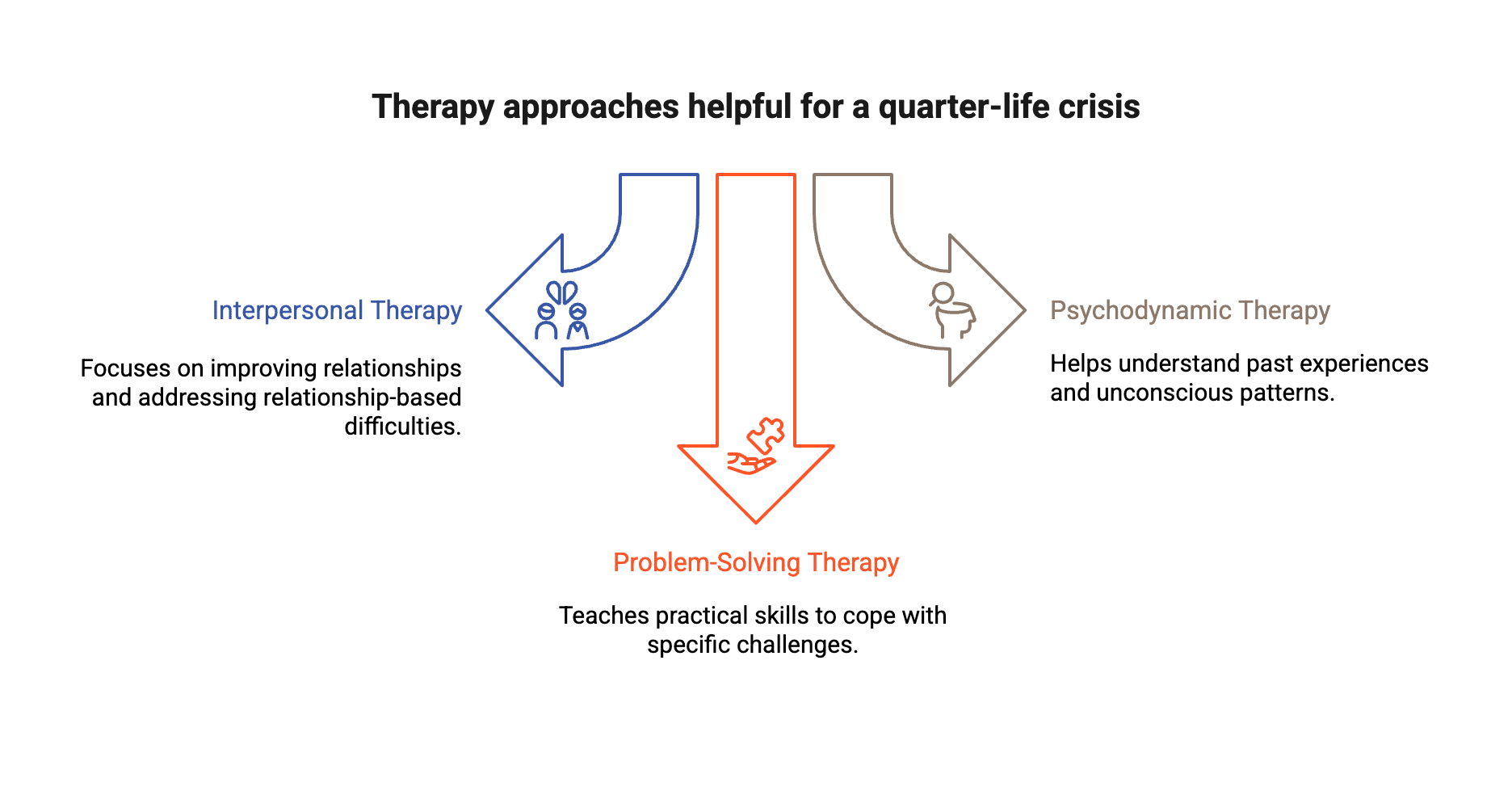
Here’s how evidence-based therapy helps young adults navigate a quarter-life crisis. Therapy for depression and life transitions often draws on these methods.
Interpersonal Therapy (IPT) for Quarter-Life Crisis
Interpersonal therapy (IPT) focuses on improving your relationships and addressing relationship-based difficulties during your quarter-life crisis. This approach addresses loss of important relationships, conflicts in current relationships, adjusting to changes in life roles (like transitioning from student to professional), and developing better social skills. Research on depression in young people recommends a stepwise approach: brief support first, then a specific talk therapy, with medication added only if needed.
Psychodynamic Therapy for Self-Discovery
Psychodynamic therapy helps you understand how past experiences and unconscious patterns affect your current feelings and relationships during your quarter-life crisis. In interviews with 15 university students who completed an online psychodynamic program for low mood, participants described getting better at observing themselves, accepting difficult emotions, recognizing unhelpful patterns, and relating to others in new ways.
Problem-Solving Therapy for Practical Challenges
Problem-solving therapy (PST) is a structured, short-term approach that teaches practical skills to cope with the specific challenges of a quarter-life crisis—whether you’re experiencing a locked-in or locked-out life crisis. This approach helps you identify and prioritize main concerns, break down overwhelming problems into manageable steps, develop solutions and coping strategies, and build confidence in handling future challenges.
Many therapy approaches for a quarter-life crisis are relatively short-term, though some people benefit from longer treatment. The type of therapy that works best depends on your specific quarter-life crisis situation—interpersonal therapy may help if relationship issues are central to your struggles, while problem-solving therapy might be better if you’re feeling overwhelmed by practical challenges during this life crisis.
In our practice, we’ve found that matching the therapy approach to your specific type of quarter-life crisis makes a meaningful difference. Locked-in clients often benefit from psychodynamic work to understand how they got here. Locked-out clients frequently respond well to problem-solving therapy’s practical focus on removing barriers and building momentum.
Practical Strategies for Navigating a Quarter-Life Crisis
Here are practical steps you can take while navigating your quarter-life crisis. Building social support is crucial for individuals experiencing a quarter-life crisis, as strong social networks tend to correlate with lower levels of mental health challenges like anxiety and depression.
Community offerings such as professional networking groups, volunteering opportunities, and recreational activities can help build social connections. In DC, resources include The Quarterlife Center (QLC), a specialized counseling center in Washington, DC that offers individual and group counseling specifically for young adults experiencing a quarter-life crisis. The DC Department of Behavioral Health provides a 24/7 Access HelpLine for mental health support.
Self-reflection can involve journaling to identify core values, strengths, and sources of joy during a quarter-life crisis. Discussing dreams and ambitions with close friends or seeking professional counseling provides a safe space to explore feelings about your quarter-life crisis and develop coping strategies without judgment.
Limiting social media use helps mitigate feelings of inadequacy and negative comparison during a quarter-life crisis. Stopping the habit of comparing yourself to others—recognizing that social media shows curated highlights, not reality—is an important step. Practicing self-care and building resilience through mindfulness practices, deep breathing, or other stress-reduction techniques provides the energy needed to navigate quarter-life crisis challenges.
Getting Professional Support
Seeking help for a quarter-life crisis is a sign of strength, not weakness. Many young adults experience these challenges during their quarter-life, and effective treatments are available. Whether you’re experiencing a locked-in crisis (feeling trapped in the wrong life) or a locked-out crisis (struggling to achieve your goals), therapy helps you face longstanding fears and develop new coping strategies.
Mental health professionals can offer a safe space for individuals to explore their feelings during a quarter-life crisis, helping you clarify your values and goals while developing healthy coping skills and a sense of life purpose during this transitional period.
Ready to Get Started?
If you’re experiencing a quarter-life crisis in Washington, DC, our compassionate team of therapists understands the unique challenges young adults face in this city. Connect with our Dupont Circle therapists who specialize in supporting young professionals through this transitional period.
Whether you’re feeling locked-in to the wrong path or locked-out from the life you want, you don’t have to navigate this alone. With the right support, you can move through this quarter-life crisis transition and develop skills that will benefit you throughout your life.
Frequently Asked Questions About Quarter-Life Crisis
Is a Quarter-Life Crisis Normal?
Yes—experiencing a quarter-life crisis is extremely common and represents a normal developmental stage of early adulthood. Many young adults go through some form of quarter-life crisis during their twenties or early thirties. Mental health professionals increasingly recognize the quarter-life crisis as a genuine challenge of early adulthood rather than a personal failing.
The quarter-life crisis often involves a period of deep soul searching where individuals question their goals, career paths, and life choices. This self-reflection, while uncomfortable, can be a catalyst for positive change and a more intentional life path. Recognizing that many of your peers are navigating similar feelings during their quarter-life can help reduce the isolation many young adults feel during this life crisis.
We hear this question constantly from young adults in DC experiencing a quarter-life crisis: “Am I overreacting?” The answer is almost always no. What looks like a quarter-life crisis from the outside often involves real suffering and genuine confusion about identity and direction. Your struggle deserves attention and support, not minimization.
How Long Does a Quarter-Life Crisis Last?
The duration of a quarter-life crisis varies widely among young adults. Some people experience an intense quarter-life crisis lasting several months, while others navigate this transitional period of their quarter-life over several years. Factors contributing to the length include the severity of internal factors (like anxiety or self-doubt), the presence of external factors (such as financial pressures or limited social support), and whether you seek professional help for your quarter-life crisis.
Mental health treatment can shorten the duration of a quarter-life crisis by providing coping strategies, clarifying values, and addressing underlying mental health issues like depression or anxiety. Whether you’re experiencing a locked-in or locked-out life crisis, early intervention tends to lead to better outcomes and faster resolution of your quarter-life crisis.
Can a Quarter-Life Crisis Lead to Positive Change?
A quarter-life crisis is often a catalyst for significant personal growth and positive life changes. While the quarter-life crisis experience feels overwhelming in the moment, many young adults report that their quarter-life crisis ultimately led them to greater self-awareness, better understanding of their values, and more authentic life choices.
The deep soul searching characteristic of a quarter-life crisis can help you identify what truly matters versus what contemporary society or family members expect from you. This transitional period of life crisis, though painful, often results in stronger commitment to purpose, improved mental health through addressing underlying issues, and development of resilience skills that benefit you throughout early adulthood and beyond your quarter-life.
Do I Need Therapy for a Quarter-Life Crisis?
While not everyone experiencing a quarter-life crisis requires therapy, seeking professional counseling can be transformative for young adults struggling with this life crisis. Consider professional help if your quarter-life crisis is:
- Interfering with your ability to function at work or maintain relationships
- Causing significant mental health symptoms like persistent anxiety, depression, or feelings of hopelessness during your quarter-life
- Leading to impulsive behaviors or major life decisions you might later regret
- Lasting more than several months without improvement
- Leaving you feeling isolated despite having social support from friends or family members
Professional treatment offers young adults a safe space to explore feelings during their quarter-life crisis, develop healthy coping skills, and gain clarity during this challenging phase of early adulthood. Many people find that therapy helps them navigate their quarter-life crisis more effectively than attempting to manage this life crisis alone.
This blog provides general information and discussions about mental health and related subjects. The content is not intended to be a substitute for professional medical advice, diagnosis, or treatment. Always seek the advice of your physician or other qualified health provider with any questions you may have regarding a medical condition.