Strengths and Weaknesses of Internal Family Systems Therapy: What Research Shows

Internal Family Systems (IFS) therapy shows promise for treating depression, trauma, and chronic pain, but the research base remains limited compared to more established approaches like cognitive behavioral therapy. Early studies suggest IFS therapy can reduce depressive symptoms, improve self-compassion, and help people process trauma—though outcomes vary between individuals and not all symptoms improve with treatment.
What Are the Benefits of Internal Family Systems Therapy?

IFS therapy helps people develop a more compassionate relationship with themselves by working with different “parts” of the mind—sub-personalities within the internal system—rather than trying to eliminate difficult thoughts and feelings. This parts-based approach views even challenging behaviors as having positive protective intentions.
The therapy process involves identifying these internal parts, understanding their roles, and helping the core Self—a calm, compassionate part characterized by curiosity and confidence—lead the internal system toward greater harmony. Through guided sessions that typically begin with an initial assessment of your parts and their relationships, an IFS therapist helps clients explore their inner world using techniques like visualization, dialogue between parts, and what’s called the “unburdening process” where parts release painful memories and beliefs.
Research has identified several potential benefits. A study of female college students with depression found that IFS therapy produced similar symptom reductions as cognitive behavioral therapy, suggesting it may be as effective as established treatments for certain conditions. The therapy’s focus on self-compassion and acceptance appears particularly helpful for people who struggle with shame or self-criticism.
For trauma, an online group-based IFS program showed promise in treating PTSD symptoms. About 53% of participants experienced meaningful improvement, with additional gains in emotion regulation and self-compassion. The approach allows people to work with traumatized parts of themselves without becoming overwhelmed by painful memories.
In our DC practice, we find that clients responding well to IFS often describe feeling less “at war” with themselves. The shift from trying to eliminate difficult parts to understanding their protective function can be profound for people who’ve spent years fighting internal battles.
Key Strengths of IFS Therapy
Builds Self-Compassion and Reduces Shame
One of IFS therapy’s core strengths is its emphasis on developing a compassionate relationship with all parts of yourself. Rather than viewing certain thoughts or behaviors as “bad” or pathological, IFS helps individuals understand what these parts are trying to protect them from.
The IFS model identifies three types of parts: Managers (parts that maintain control over mental and emotional state), Firefighters (parts that react when painful emotions threaten to surface, often using distraction or numbing strategies), and Exiles (parts that carry the burdens of trauma and painful experiences). In a typical IFS session, the therapist helps you identify which firefighter parts might be activated and guides dialogue between your Self and these protective parts. Understanding these roles reduces internal conflict and builds self-awareness.
This non-judgmental approach can be particularly valuable for people struggling with self-criticism or shame. By creating psychological distance between the core Self and difficult emotions, individuals can approach healing with curiosity rather than judgment. The research on IFS for PTSD found significant improvements in self-compassion alongside symptom reduction, suggesting the therapy builds emotional resilience over time.
Effective for Trauma and PTSD
IFS therapy provides a structured approach for processing trauma without forcing people to relive traumatic memories before they’re ready. The method allows individuals to work with “exiled” parts that carry trauma, while protective “manager” and “firefighter” parts maintain safety.
The online PTSD program demonstrated feasibility and acceptability, with most participants finding the treatment helpful. While more research is needed, these preliminary findings suggest IFS can be an effective trauma-focused therapy, particularly for people who haven’t fully benefited from other approaches.
For those dealing with post-traumatic stress disorder or complex trauma, our trauma and PTSD therapy services offer multiple evidence-based approaches, including IFS when clinically appropriate.
When working with trauma, we appreciate how IFS allows clients to approach painful experiences at their own pace. The parts-based framework provides natural safety mechanisms—protective parts can slow things down if healing work moves too quickly, preventing overwhelm.
Comparable Effectiveness for Depression
For depression treatment, IFS appears to work as well as cognitive behavioral therapy in preliminary research. The pilot effectiveness study with female college students found similar symptom reductions between IFS and established treatments, suggesting the parts-based approach may offer a viable alternative for certain individuals.
This is significant because different people respond to different therapeutic approaches. Having multiple evidence-based options increases the likelihood that someone will find an approach that resonates with them. If you’re exploring treatment options for depression, our depression therapy services can help you determine which approach might work best for your situation.
Improves Emotional Regulation and Coping Strategies
IFS therapy helps people develop better emotional regulation by teaching them to recognize when different parts are activated and to respond from the core Self rather than reacting from a triggered part. This self-leadership skill translates into more effective coping strategies in daily life.
The PTSD research specifically noted improvements in emotion regulation, suggesting that IFS helps people manage emotional struggles more effectively. By fostering communication between internal parts, the therapy reduces emotional numbing and helps people access a fuller range of feelings without becoming overwhelmed.
This enhanced emotional awareness supports better interpersonal relationships as well. When people understand their own internal system, they often develop greater empathy for others’ internal struggles, leading to more harmonious relationships.
Non-Pathologizing Framework
IFS therapy stands out for its non-pathologizing view of mental health. Rather than labeling symptoms as disorders to be eliminated, IFS conceptualizes them as protective strategies developed by different parts. This reframe can reduce stigma and help people engage more openly with therapy.
The model assumes everyone has a core Self with inherent qualities—known as the eight Cs: Confidence, Calmness, Creativity, Clarity, Curiosity, Courage, Compassion, and Connectedness. IFS focuses on helping this authentic Self lead rather than on fixing what’s “broken.” For many people, this perspective shift alone can be therapeutic.
Versatile Applications Beyond Mental Health
While most research has focused on depression and PTSD, IFS has shown benefits in unexpected areas. A randomized controlled trial found that IFS therapy helped reduce pain and improve physical function in people with rheumatoid arthritis, with benefits lasting up to one year after treatment ended.
Participants also experienced improvements in depression and self-compassion, suggesting the approach may help with the psychological aspects of chronic illness. This versatility makes IFS potentially useful for a range of mental health conditions where mind-body connections play a role, including substance abuse, eating disorders, and self-harm behaviors where protective parts often drive symptoms.
What Are the Cons of IFS Therapy?
Limited Research Evidence
The most significant limitation is that IFS has not been studied as extensively as therapies like cognitive behavioral therapy or psychodynamic therapy. Most existing research consists of pilot studies and feasibility trials rather than large-scale randomized controlled trials.
This means we have less certainty about how well IFS works, for which mental health issues it’s most effective, and which people are most likely to benefit. While early findings are promising, more rigorous research is needed before IFS can be considered a fully evidence-based treatment for most conditions.
Not All Symptoms Improve
Research suggests IFS doesn’t uniformly improve all symptoms. In the rheumatoid arthritis study, for example, IFS helped with pain and depression but didn’t significantly reduce disease activity or anxiety levels.
Similarly, in PTSD treatment, while many participants improved, outcomes varied considerably. Some people experienced substantial symptom reduction while others saw minimal change. This variability makes it difficult to predict who will benefit most from IFS therapy.
Requires Significant Time Commitment
IFS programs can be lengthy. The studied PTSD treatment involved 16 weeks of group sessions plus individual counseling. For people seeking shorter-term therapy or those with limited time or resources, this commitment may be challenging.
The internal work of IFS—learning to identify parts, develop self-leadership, and facilitate internal dialogue—takes practice and patience. It may not be ideal for people needing rapid symptom relief or those who prefer more directive, solution-focused approaches.
Individual Results Vary Considerably
As with any therapy, not everyone responds to IFS in the same way. Research studies show wide variation in outcomes, with some participants improving significantly and others experiencing minimal change.
Factors affecting success likely include readiness to engage with internal work, the nature of concerns, the relationship with a therapist trained in IFS, and whether the parts-based framework resonates with how someone thinks about themselves. There’s currently no way to predict with certainty who will benefit most.
Finding Qualified IFS Therapists Can Be Difficult
IFS requires specialized training beyond standard therapy education through the IFS Institute. Not all therapists are trained in this approach, which can make finding a qualified IFS therapist or family therapist with IFS training challenging depending on where you live.
Additionally, the quality and extent of IFS training can vary among therapists. Some may have completed extensive certification, while others may have only introductory training. This inconsistency can affect treatment quality and outcomes.
We recognize that specialized approaches like IFS aren’t right for everyone. In our practice, we match clients with therapeutic approaches based on their specific needs, preferences, and what they’ve tried before. Sometimes the best approach is the one that resonates with how you naturally think about yourself.
Strengths of Internal Family Systems Therapy Compared to Other Approaches
Internal Family Systems (IFS) grew out of traditional family systems therapy but focuses on the internal “family” of parts within one person rather than actual family relationships. This development from marital and family therapy traditions gives IFS a unique perspective that makes it accessible for individual therapy while retaining systems thinking.
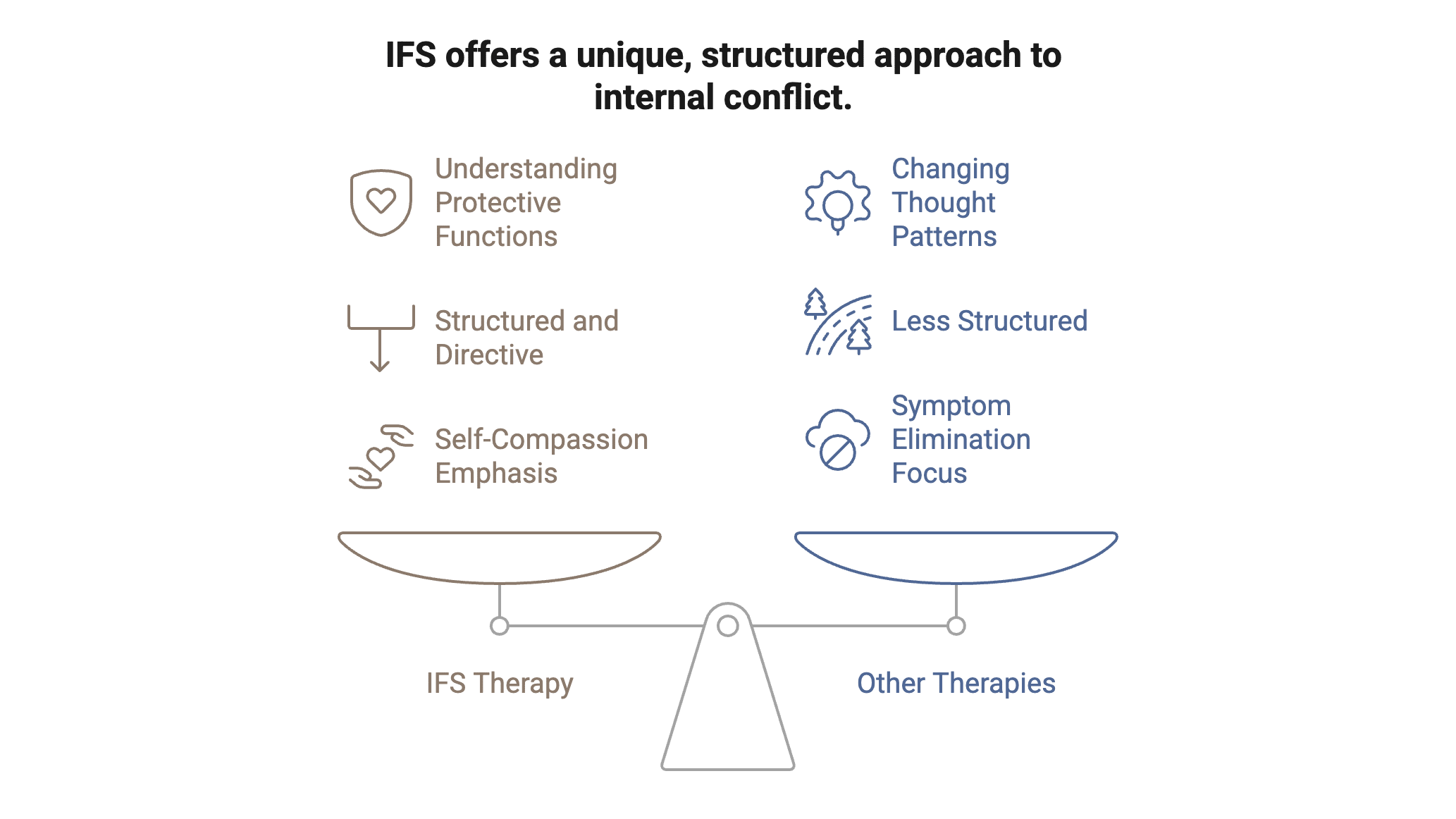
Compared to cognitive behavioral therapy, IFS places less emphasis on changing thought patterns and more on understanding the protective function of different mental states. While CBT might help challenge negative thoughts, IFS helps understand why those thoughts developed and what they’re trying to protect. For some individuals, this approach may resonate more deeply than symptom-focused interventions. If you’re comparing different approaches, our guide to types of therapy for anxiety explores how various methods work.
Compared to psychodynamic therapy, IFS can be more structured and directive for certain clients. While both explore internal conflicts and past traumas, IFS provides specific techniques for engaging with parts and facilitating internal dialogue. The framework may feel more concrete and actionable than traditional psychodynamic approaches, though individual preferences vary.
IFS may work best for people who:
- Struggle with self-criticism or inner conflict
- Haven’t fully responded to other therapies
- Find the parts-based framework intuitive
- Are dealing with trauma or complex emotional patterns
- Want an approach that emphasizes self-compassion over symptom elimination
- Experience relationship issues tied to internal struggles
For professionals dealing with work-related stress and relationship challenges, our therapy for professionals integrates approaches like IFS when appropriate.
Is Internal Family Systems Therapy Right for You?
IFS therapy offers a compassionate, non-pathologizing approach to mental health that shows promise for depression, trauma, and various other concerns. The emphasis on self-leadership and internal harmony resonates with many people, particularly those who feel “at war” with themselves.
However, it’s important to have realistic expectations about well-being outcomes. The research base is still developing, outcomes vary between individuals, and the approach requires time and commitment. IFS also may not provide rapid symptom relief for acute crises.
If you’re considering IFS therapy or seeking therapy for the first time, discuss it with a mental health provider who can help you weigh the potential benefits against other treatment options with more extensive research support. The right approach is one that fits individual mental health needs, resonates with how you think, and is delivered by a qualified therapist you trust.
For those seeking therapy in Washington DC, our Dupont Circle location offers convenient access to experienced therapists trained in multiple evidence-based approaches.
Find IFS Therapy in Washington DC
If you’re interested in exploring Internal Family Systems therapy or want to discuss which therapeutic approach might work best for your situation, our team at Therapy Group of DC can help. We offer evidence-based treatments tailored to your individual needs and goals, including approaches that support personal growth and emotional resilience.
Connect with our DC therapists →
This blog provides general information and discussions about mental health and related subjects. The content is not intended to be a substitute for professional medical advice, diagnosis, or treatment. Always seek the advice of your physician or other qualified health provider with any questions you may have regarding a medical condition.