Rage Bait: What It Means and Why You Can’t Stop Clicking

You’re scrolling social media during lunch, and two swipes later you’re furious at a stranger’s opinion about something you didn’t even care about five seconds ago. Rage bait is online content deliberately designed to elicit anger or outrage by being frustrating, provocative, or offensive, and it’s become so pervasive that Oxford University Press named it their oxford word of the Year for 2025. The term’s usage has tripled in the last year, reflecting a dramatic shift in how digital platforms drive engagement. But why does rage bait work so effectively on our brains—and why does it feel impossible to look away?
In our DC practice, we’re seeing clients struggle with what we call “political rage fatigue.” The constant exposure leaves people mentally exhausted but unable to stop checking their feeds. This pattern mirrors what we’ve observed with cancel culture and other forms of online outrage.
What Does the Term “Rage Bait” Mean?

Rage bait is content specifically crafted to make you angry enough to engage. According to Oxford Languages, rage bait content is typically posted to increase traffic to a particular web page or social media account. Unlike clickbait that aims for curiosity, rage bait has a more specific focus: triggering outrage sparks engagement through comments, shares, and scrolling.
The content takes many forms—outrageous food recipes, artificial intelligence-generated images designed to be upsetting, conspiracy theories, or inflammatory political opinions. Like related tactics such as aura farming, what unites all rage bait is its calculated intention: make you angry enough to respond.
Research shows this isn’t accidental. Studies from Beihang University found that users share angry content more than messages containing sadness, disgust, or even joy. When researchers analyzed millions of social media posts, anger consistently outperformed other emotions in driving shares and comments. Platforms have learned that anger keeps you on the screen longer—and longer screen time means more ad revenue.
In our DC practice, we’re seeing clients struggle with what we call “political rage fatigue.” The constant exposure leaves people mentally exhausted but unable to stop checking their feeds. This pattern mirrors what we’ve observed with cancel culture and other forms of online outrage.
Is Rage Bait the Word of the Year?
Yes—Oxford University Press selected “rage bait” as the Word of the Year for 2025, noting such a dramatic surge in usage that it reflects fundamental changes in online culture and digital wellbeing. According to Oxford Languages, the word rage bait exists alongside other oxford word shortlisted terms like “brain rot” and “aura farming,” showing an ongoing conversation about how new technologies reshape mental health.
The oxford word selection validates what mental health professionals observe in clinical practice: constant exposure creates a powerful cycle where outrage sparks engagement, algorithms amplify it, and users end up mentally exhausted but increasingly unable to disengage. This oxford word recognition isn’t just linguistic—it reflects measurable changes in how we interact online.
Why Your Brain Can’t Resist Rage Bait
Anger spreads automatically—even when you’re trying to ignore it. Researchers found that anger contagion occurs automatically. In their study, participants exposed to angry facial expressions reported feeling angry themselves whether they were mentally distracted or fully attentive. Happiness required attention to spread; anger did not.
This finding is crucial: you cannot think your way out of emotional contagion with anger. Your conscious effort to stay rational doesn’t protect you from catching the emotion.
The Neurochemical Hijacking
This automatic response has evolutionary roots. Your amygdala—the brain’s threat detection system—is hardwired to prioritize potential dangers. When you perceive a threat, the amygdala triggers dopamine release along with stress hormones like cortisol and adrenaline, creating an energizing sensation that feels rewarding.
Dopamine is the same neurotransmitter involved in reward, motivation, and pleasure—the same pathway activated by food, sex, and addictive drugs. Johns Hopkins researchers found that when moral outrage receives support, the brain’s dopamine pathways flood with positive reinforcement.
In online spaces, the risks of expressing outrage are much lower than in face-to-face interactions. But the dopamine reward remains strong. When your angry engagement gets likes or supportive replies, your brain experiences this as social validation, triggering another hit of dopamine. This creates an addictive feedback loop remarkably similar to substance addiction patterns.
Like any reward-seeking behavior, your brain builds tolerance. What neuroscientists call “learned emotional reinforcement” means that mild content no longer satisfies. You need increasingly extreme material to feel the same emotional response. This is how someone who once ranted about parking policies ends up sharing conspiracy theories. The pattern becomes: cue (inflammatory headline), craving (emotional anticipation), response (click, share, comment), reward (dopamine surge and social validation).
How Social Media Algorithms Amplify Rage Bait
Algorithms prioritize attention over wellbeing. Social media platforms prioritize high-engagement content—reactions, comments, and shares—giving divisive content the most visibility.
Internal Meta documents revealed that their algorithms explicitly rewarded “controversial” content to keep users engaged longer. Your angry response becomes free advertising.
Similar to aura farming and other engagement-gaming tactics, the manipulation exploits emotional vulnerabilities. More engagement means more revenue—which is why rage bait is designed to increase traffic by triggering outrage.
What’s the Difference Between Rage Bait and Clickbait?
Rage bait specifically targets anger, while clickbait aims for general curiosity. Clickbait might promise “You Won’t Believe What Happened Next.” Rage bait intentionally includes inflammatory content deliberately designed to elicit anger—skewed “facts” without context, cherry-picked quotes, false balance, or edge-lord humor that toes the line of hate speech.
The distinction matters because the psychological mechanisms differ. Curiosity dissipates once satisfied. Anger activates your threat response and creates a compulsion to act. Rage bait doesn’t just want your click—it wants your comment, your share, your prolonged engagement as you argue in the replies.
We often see clients who can identify clickbait easily but don’t realize they’re being manipulated by rage bait. The anger feels justified—the content really is offensive or wrong. But that justified anger is exactly what makes it so effective at hijacking your attention and time.
What This Means for Your Mental Health
Prolonged exposure creates chronic anger—a state where emotional reactivity becomes the norm. Research tracking social media users during the COVID-19 pandemic found that exposure to negative emotional content created “emotional contagion” with increasingly hostile sentiment that didn’t fade even after triggering events passed.
Constant exposure leaves users mentally exhausted, with increased anxiety, disrupted sleep, and difficulty relaxing offline. You might notice irritability bleeding into relationships or a sense of cynicism and existential dread.
The Polarization Effect
Research from Pew found that between 1994 and 2022, the percentage of Republicans and Democrats holding “very unfavorable” views of the other party increased from around 16-17% to over 50% for both groups. While multiple factors contribute to political polarization, the algorithmic amplification of rage bait plays a documented role in this dramatic shift.
Beyond individual mood, rage bait undermines democratic processes by fostering an “us versus them” mentality where compromise feels like betrayal. Emotionally charged content gets shared without critical evaluation, spreading misinformation and eroding trust in institutions.
The performative nature of online outrage shifts focus from substantive action to symbolic gestures. Online anger substitutes for real-world volunteering or donating—people feel they’ve already done something by posting. This normalizes hate speech, desensitizes people to important issues, and fundamentally damages public discourse.
In political hubs like DC, campaigns use rage bait to target groups pre-election and boost politicians’ profiles, creating a climate of fear that affects officials’ willingness to engage on controversial topics. The manipulation exacerbates divides, making common ground harder to find while eroding social cohesion.
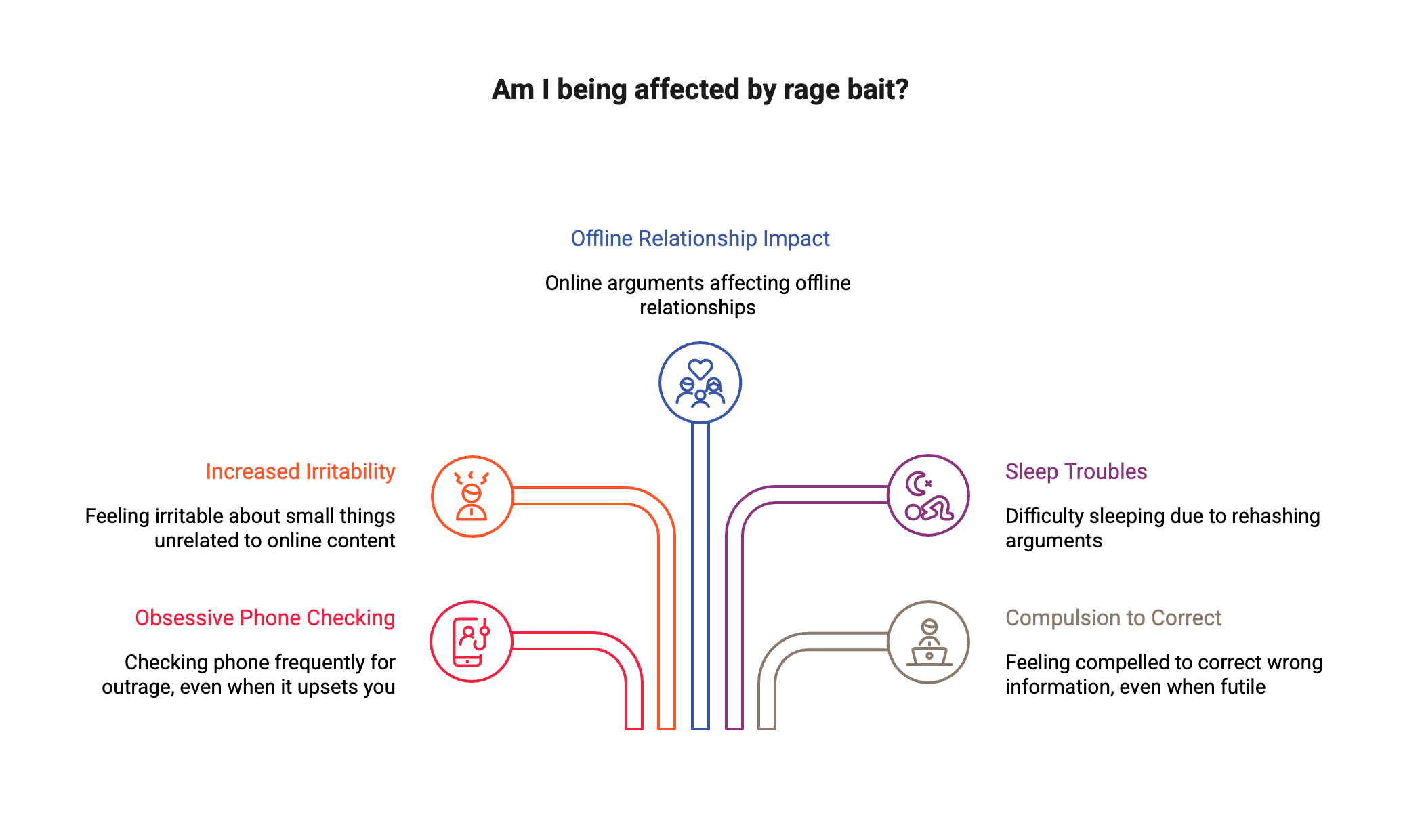
Signs Rage Bait Is Affecting You
The tech driven world has made this pattern harder to recognize because it feels like staying informed or standing up for what’s right. But there’s a difference between being engaged and being manipulated. Watch for these signs:
- You’re checking your phone obsessively for the latest outrage, even when you know it will upset you
- You feel increasingly irritable throughout the day, even about small things unrelated to what you saw online
- Online arguments are affecting offline relationships—you find yourself bringing up political debates at dinner or withdrawing from friends with different views
- You have trouble sleeping because you’re mentally rehashing arguments or composing responses
- You feel a compulsion to “correct” wrong information, even knowing it won’t change anyone’s mind
- Despite setting limits, you keep falling back into endless scrolling through inflammatory content
When working with clients on managing their relationship with social media, we focus on building awareness of the compulsion cycle—that moment between seeing rage bait and feeling the urge to engage. Creating even a five-second pause can break the automatic response pattern.
If several of these resonate, it’s worth examining your relationship with social media and considering whether rage bait has become a form of digital self-harm.
Why DC Is Particularly Vulnerable
Living in the nation’s capital creates unique vulnerabilities to this content. Many DC residents work in federal agencies or political roles where staying informed feels non-optional. When your career involves policy debates with high-stakes consequences, it’s harder to recognize when engagement has crossed from productive into destructive. The pressure to demonstrate political alignment through public expressions of outrage intensifies the manipulation tactics that rage bait employs.
Getting Help in DC
If constant exposure to rage bait is affecting your wellbeing, therapy can help break the cycle. Cognitive Behavioral Therapy (CBT) helps identify triggers and develop healthier response patterns. Mindfulness-based approaches strengthen your ability to notice when you’re being baited without automatically reacting. Trauma-informed therapy addresses the cumulative stress of prolonged exposure to hostile content.
Psychodynamic therapy explores deeper patterns driving compulsive engagement—how early experiences with conflict or social belonging might make certain types of outrage feel particularly compelling.
For many DC residents, some political engagement is necessary for your career. The goal isn’t to disconnect entirely, but to find a sustainable relationship with online content that doesn’t erode your mental health.
Ready to Break the Cycle?
Our clinicians specialize in anxiety, digital overwhelm, and the unique pressures of living in DC.
This blog provides general information and discussions about mental health and related subjects. The content is not intended to be a substitute for professional medical advice, diagnosis, or treatment. Always seek the advice of your physician or other qualified health provider with any questions you may have regarding a medical condition.