

If you say yes to stay safe—and regret it later—you’re not “too nice.” You might be fawning. Here’s how to change that.
What is “fawning,” in simple terms?
Fawning is a trauma‑shaped people‑pleasing reflex. Your nervous system tries to keep you safe by smoothing things over, reading the room, and agreeing fast. It’s one of the “four Fs” of threat responses—fight, flight, freeze, and fawn—patterns that grow out of the brain’s threat‑learning in early caregiving and later stress experiences, not personal weakness. Psychotherapist Pete Walker coined the term ‘fawning’ in relation to complex PTSD, categorizing it as one of these ‘four F’s.’
How is fawning different from being “nice” or “agreeable”?
Being kind is values‑based. Fawning is fear‑based. With kindness, you can say yes or no and still feel steady. With fawning, safety depends on keeping others pleased, so you over‑agree, over‑apologize, or hide your view. Over time, that erodes self‑trust and boundaries. Trauma‑informed care models and their trauma‑informed care principles describe how protective appeasement can show up in health and relationship settings when people don’t feel safe.
Red flags that point to fawning
- Chronic yes‑saying without checking your capacity
- Panic at the thought of disappointing someone
- Softening or hiding your opinions to avoid friction
- Taking blame to keep the peace, even when it’s not yours
Why does fawning develop?
Fawning is learned safety. In families, schools, relationships, or identities where pushback felt risky, appeasing others helped you avoid harm. Over time, your threat system pairs disagreement with danger and “people‑pleasing” becomes the automatic move. Work on complex trauma and relational patterns00821-2) explains why conflict feels high‑stakes and why boundaries feel scary at first.
Attachment history also matters. If approval felt like the ticket to love or safety, rejection sensitivity can wire in, making you scan for disapproval and rush to fix it. Studies linking early adversity to heightened stress reactivity help explain this loop.
Clinicians also note that in some settings, appeasement reduces perceived threat—a short‑term survival win that can become a long‑term habit. Health systems that aim for trauma‑informed systemstry to lower those threat cues so people don’t have to fawn to feel safe.
Where does fawning show up day‑to‑day?
Work: Overcommitting, writing extra‑soft emails, avoiding feedback, or doing silent rework to prevent conflict.
Relationships & dating: Mirroring tastes, skipping your needs, taking blame, or walking on eggshells to keep things “okay.” Fawning can create cycles of unhealthy relationships, including codependency, especially with narcissistic partners.
Friends & family: Being the fixer or default planner, smoothing every rough edge, managing others’ moods.
In therapy: Agreeing with suggestions you don’t actually want, or nodding along to avoid disappointing your therapist. Trauma‑informed communication points to power‑balancing and consent‑paced care so you don’t feel pressure to appease.
Why DC makes fawning tempting (and exhausting)
DC runs on relationships and reputation. High‑stakes workplaces, politics‑adjacent roles, and constant visibility can nudge anyone toward image management. Power dynamics—from interns to senior leadership—and client‑facing pressure make “keep it smooth” feel safer than “say what’s true.” Add the city’s culture of busy, and it’s easy to miss your own limits until you’re burned out.
Fawning behavior is psychologically driven by power dynamics, careerism, and stress, particularly in environments like Washington, D.C.
“Am I fawning?” — a quick self‑check
- Do I say yes before I check my capacity?
- Do I soften or hide my view to avoid conflict?
- Do I feel responsible for other people’s moods?
- Do I feel anxious until everyone seems pleased with me?
- Do I leave conversations unsure what I actually want?
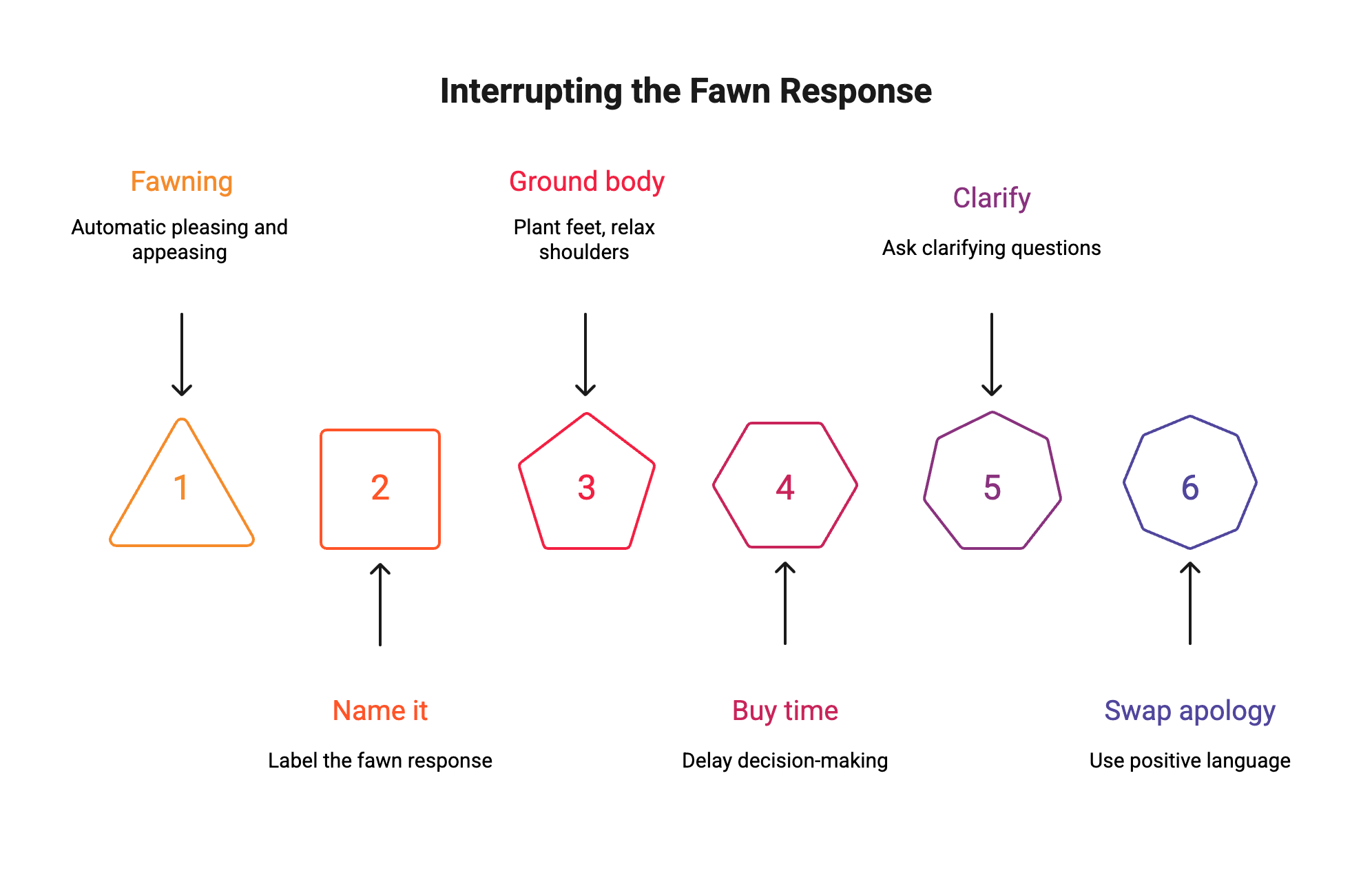
Interrupt the fawn in the moment (micro‑skills)
Tiny steps help you keep your voice when your body wants to please‑and‑appease.
- Name it, softly. “This is my fawn response.” A label lowers alarm and gives you a beat to choose.
- Ground your body. Plant your feet, drop your shoulders, unclench your jaw, and take a slow exhale for 6–8 seconds. Your body’s calmer state makes a steadier choice possible.
- Buy time on purpose. “Let me check and get back to you by 3 pm.” Time protects capacity and reduces knee‑jerk yeses.
- Ask one clarifying question. “What’s the actual deadline and scope?” Clarity often shrinks the urge to appease.
- Swap the auto‑apology. Try “Thanks for your patience” instead of “Sorry!” unless you truly need to apologize.
- Set a micro‑boundary. “I can’t take that on, but I can review two slides.”
- Use preference language. “I’d like to do X instead of Y.” Short, warm, direct.
- Repair when needed. “I said yes too quickly. Here’s what I can do instead.”
A developmental perspective on self‑regulation shows how small, consistent reps retrain stress responses, making fawning less necessary over time.
Build long‑term change (practice plan)
Long‑term change is about safety, clarity, and reps—not perfection.
- Safety first. Add daily nervous‑system calmers you’ll actually use: paced breathing, a short walk, music, or a check‑in with a steady friend. Safety lowers the brain’s “danger = disagree” link.
- Values inventory. List what matters most this season (health, family time, focused work). Let those values guide your yes/no so boundaries protect your real priorities.
- Assertiveness reps. Start small: send a preference text; ask for a different meeting time; share one dissenting point in a low‑stakes setting. Stack difficulty slowly.
- Boundary hygiene. Block your calendar, add “holding” phrases (“I’ll decide after I review my load”), and keep a running “capacity check” note.
- Relationship audit. Notice who respects your limits and who argues every “no.” Invest where boundaries are honored.
- Re‑pair the threat link. Practice calm disagreement in safe contexts so your brain updates the map. Work on appeasement and threat reduction explains why the appease‑for‑safety habit forms and how new experiences can reshape it.
- Track progress. Keep a tiny wins list: one honest no, one clear preference, one repair. Progress is noticing sooner and choosing steadier, not never fawning again.
How therapy helps at Therapy Group of DC
We take a non‑shaming, trauma‑informed approach. In session, we map your fawn cues, build nervous‑system steadiness, and practice honest, doable boundaries. Depending on fit, we may blend skills from CBT (to untangle fear‑based thoughts), emotion‑focused work (to name and regulate feelings), psychodynamic therapy (to spot old patterns in current relationships), and EMDR (to help the brain reprocess stuck threat memories).
The goal isn’t to turn you into a contrarian—it’s to keep your kindness and your voice. Our Dupont Circle team works with professionals, students, and public‑facing roles across DC. We offer daytime and evening appointments, in‑person and online.
Scripts you can borrow (keep, tweak, and use)
- No + alternative: “I can’t take that this week. If helpful, I can review on Tuesday.”
- Preference share: “I’d like to do X instead of Y.”
- Opinion hold: “I see it differently. Here’s my reasoning in two points.”
- Check‑in: “Before I commit, what’s the actual deadline and scope?”
- Repair: “I agreed too fast. Here’s what I can realistically do.”
Concluding Thoughts
Fawning is a protective strategy that once kept you safe. You can keep your warmth and your voice. If you’re ready to try steadier boundaries and calmer honesty, schedule with a therapist at Therapy Group of DC in Dupont Circle.
Frequently Asked Questions About Fawning as a Trauma Response
What is the root cause of fawning behavior?
Fawning behavior often originates from childhood trauma, including childhood abuse and complex trauma. It develops as a survival strategy or coping mechanism to avoid harm and find safety in stressful or dangerous situations, especially when primary caregivers were sources of perceived danger. Collective traumatic events can influence individuals’ political psychology, leading to fawning as a maladaptive response in polarized environments.
How does fawning differ from other trauma responses like fight, flight, or freeze response?
Fawning is considered the fourth F trauma response, distinct from fight, flight, and freeze. While fight and flight involve confronting or escaping danger and freeze involves immobilization, fawning uses people pleasing behavior to appease threats and avoid conflict, often at the expense of one’s own needs and authentic self.
What are some key symptoms of fawning behavior?
Key symptoms include chronic people pleasing tendencies, difficulty setting healthy boundaries, feeling guilty when prioritizing own needs, being overly agreeable, suppressing own emotions and values, and neglecting self care. These behaviors can lead to negative consequences such as emotional exhaustion and feeling disconnected from true selves. The fawn response can also lead to mental health challenges, including chronic stress, anxiety, and emotional exhaustion.
How can therapeutic interventions help with fawning?
Therapeutic interventions, including trauma-informed therapy, family therapy, and trauma-focused treatments, help individuals recognize the fawn trauma response, address the underlying complex PTSD or relational trauma, and develop skills like setting healthy boundaries, practicing self compassion, and reconnecting with their authentic self to improve overall mental health and well-being.
Why is it important to set clear boundaries when recovering from fawning?
Setting clear boundaries is crucial because it helps break the cycle of people pleasing trauma response, protects basic needs, and fosters self worth. Healthy boundaries empower individuals to prioritize their own well being and reduce undue stress caused by constantly accommodating others at their own expense.