

Field Notes · Couples & Relationships

Guide to Mental Load in DC

Mental load isn’t just doing household chores—it’s the thinking behind them. It’s the constant planning, anticipating, and monitoring work that runs in the background while you’re answering work emails, riding the Metro, or trying to fall asleep. In simple terms, mental load is the cognitive household labor that keeps home and family life moving.

What does “mental load” mean?

a woman feeling bogged down by the mental load of keeping things organized at home for her family

Mental load is the invisible layer of cognitive tasks—keeping track of the calendar, remembering to buy toilet paper, planning meals, noticing when the trash is full, and coordinating pickups and payments. Mentally managing household tasks includes keeping track of restocking needs, scheduling maintenance, and ensuring bills are paid. Because working memory has limits described by cognitive load theory, carrying too much at once can strain mood, focus, and decision‑making; sustained pressure can build allostatic load that affects both body and mind.

What does mental load feel like?

  • Feeling tired, snappy, or numb
  • Trouble concentrating or forgetting small things
  • Worry looping at night; sleep not feeling restorative
  • Less joy in hobbies or time with your partner/family

Ongoing or increasing mental load can lead to added stress, anxiety, and sleep deprivation.

These patterns mirror patient‑education research on working memory showing how overload crowds attention and recall.


Ready to get started?

Why does it build up in DC life?

Digital tools can elevate perceived mental workload—constant notifications, multi‑step portals, and endless to‑dos—documented in a review of digital health technologies. Add commutes, high‑stakes jobs, and caregiving, and it’s easy for one partner to end up with more cognitive labor on top of physical chores. Over time, the same strain shows up in a broad set of work‑related mental health factors.
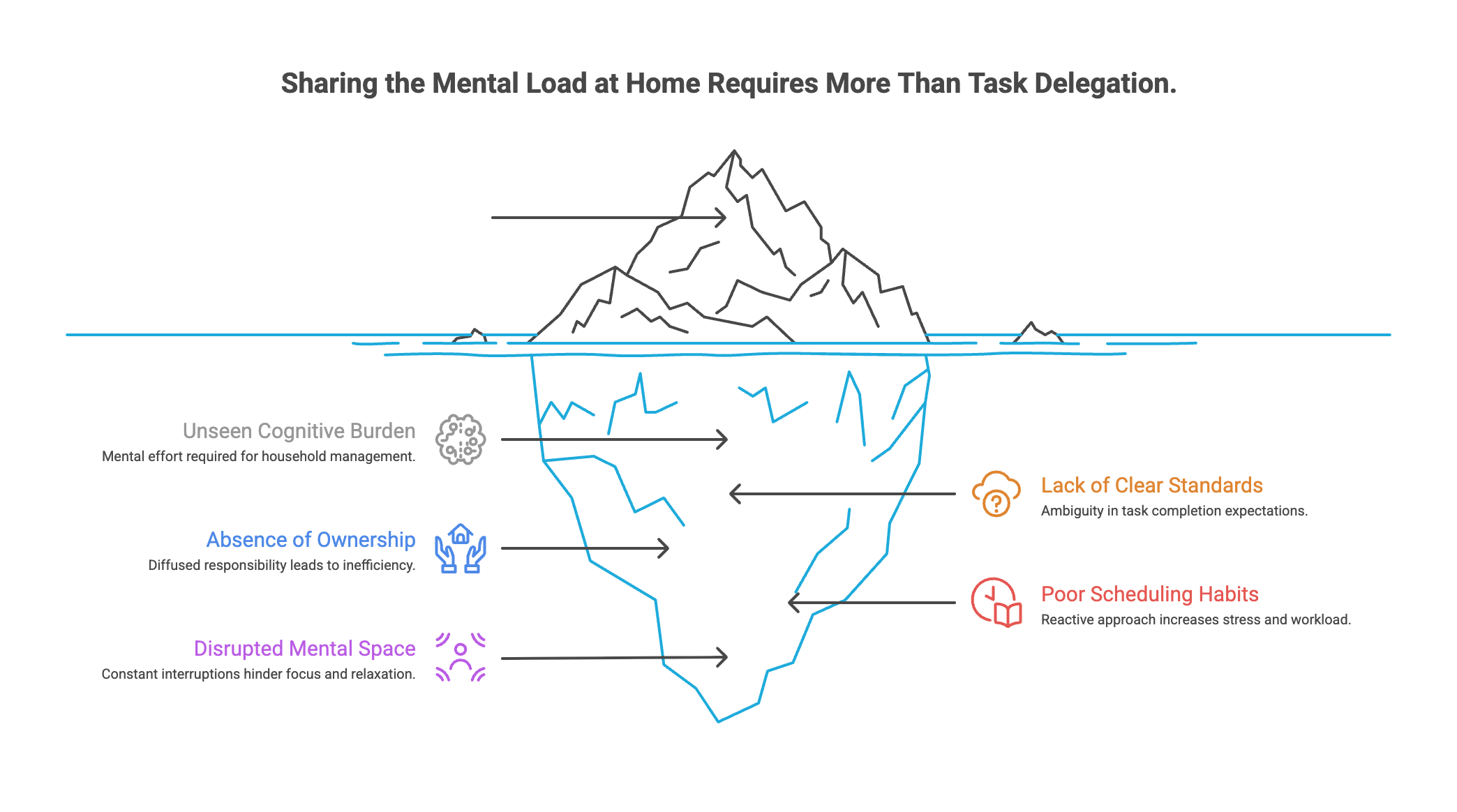
graphic showing what happens when mental load isn't shared at home

How do you share the mental load at home?

Use this five‑step reset to make the invisible work visible—and fair.

  1. 1. Map the whole picture. List household domains: meals, supplies, bills, scheduling, kid logistics, pets, elder care. Structuring tasks in behavior‑change program design reduces cognitive burden.
  2. 2. Set a minimum standard. Agree on what “done” means (e.g., pantry staples stocked, lunches prepped on Sunday). This prevents re‑work and resentment.
  3. 3. Assign one owner per outcome. Move from delegating tasks to owning results. If you own “meals,” you plan, shop, and cook—or arrange takeout. Clear ownership reduces back‑and‑forth and additional mental load.
  4. 4. Put it on a schedule. Ten‑minute Sunday check‑ins keep shared responsibilities current and stop last‑minute scrambles.
  5. 5. Protect mental space. Silence non‑urgent notifications; batch messages; build household “office hours” so the home manager isn’t “on call” 24/7.

What helps right now? Quick resets

  • Single‑task for 20 minutes. Pick one thing and finish it. Short bursts lower cognitive load.
  • Externalize the swirl. Use a shared list or whiteboard so the plan lives on paper, not in one person’s head; external aids support working memory.
  • Breaks are not a luxury. Brief rest improves performance and recovery.
  • Boundaries with devices. Turn off push alerts for non‑essentials; check messages twice a day, a practice supported by a digital workload review.
  • Use time intervals. Techniques such as the Pomodoro technique can help prevent mental fatigue and improve focus by using time intervals for work and breaks.

When should you consider therapy for mental load?

If the split feels unfair, or tensions spike each week, a few sessions can help you name the cognitive dimension of home life, set boundaries, and design a fair division of household labor. For some, individual therapy helps rebuild skills for focus, emotion regulation, and stress recovery; for others, a brief couples tune‑up aligns expectations and ownership.

The mental load can feel overwhelming, isolating, and deeply unfair, contributing to resentment and disconnection. At Therapy Group of DC in Dupont Circle, we help Washingtonians share the mental load, reduce stress, and protect time for what matters.


Ready to get started?

Frequently Asked Questions about Mental Load

What is the difference between mental load and mental labor?

Mental load refers to the invisible cognitive and emotional work involved in managing household life, such as planning, anticipating needs, and monitoring progress. Mental labor encompasses this mental load along with the physical execution of domestic work, highlighting both the thinking and doing aspects of household responsibilities.

How does cognitive household labor impact mental health?

Cognitive household labor, which includes anticipation and monitoring work, can lead to increased stress, burnout, and anxiety when unequally shared. Many women carry a disproportionate share of this invisible load, which negatively affects their mental health and relationship satisfaction.

Why is open communication important in sharing domestic responsibilities?

Open communication helps partners recognize the constant state of mental work involved in household management. Discussing tasks and emotional labor openly fosters understanding, allowing couples to become equal household partners and share the mental load more fairly.

How can emotional labor affect family life?

Emotional labor involves managing the feelings and experiences of family members, especially children, and is often intertwined with mental load. This ongoing emotional work can be exhausting and contribute to an imbalance in domestic labor if not acknowledged and shared.

What strategies can help reduce the invisible load of mental work?

Strategies include delegating tasks based on strengths, setting clear boundaries, practicing self care, and using organizational tools like the Fair Play system. These approaches help balance the anticipation and monitoring work, making household life more manageable for all involved.

Ready when you are.

Booking a first session is simple, and there’s no pressure to have it all figured out first.

Privacy Policy

Therapy Group of DC · Effective September 30, 2026

The short version

  • The only place this website collects personal information is the appointment scheduling assistant — and only what you choose to share there.
  • We use two analytics tools to understand what gets read: Google Analytics (which sets this site’s only cookies) and Ahrefs Analytics (which sets none). Google Analytics is linked to our Google Ads account so we can see whether any ads we run lead to appointment requests; ad personalization is off.
  • We don’t run social media pixels or remarketing, and we don’t sell your information or use it to target ads to you. There are no forms quietly collecting your details.
  • Questions, or want something corrected or deleted?

What this policy covers

This policy covers this website — therapygroupdc.com. It is not the privacy notice for therapy itself: if you become a client, your care is protected by federal and district health-privacy law, and you’ll receive our Notice of Privacy Practices as part of getting started. Nothing you read or click on this website creates a therapy relationship.

What we collect, and why

What you send us. If you email us, call us, or use the scheduling assistant (the “Make Appointment” button), we receive what you choose to share — typically your name, contact details, and what you’re looking for. We use it for exactly one purpose: responding to you and arranging care. The scheduling assistant is operated for us by WithTherapy, our scheduling provider, and the information you enter there goes to our practice and to the systems we use to manage appointments.

How the site gets used. Like most websites, we use analytics to understand which pages people read and where visitors come from — that’s how we decide what to write next. Google Analytics sets this site’s only cookies (named _ga and _ga_ZL758R38PL) and collects usage data such as pages visited, approximate location, and device type. Ahrefs Analytics collects similar aggregate usage data and sets no cookies at all.

Google Ads measurement. Our Google Analytics account is linked to our Google Ads account so we can see whether any ads we run lead to appointment requests. Because of that link, Google’s tag contacts Google’s advertising servers when a visit starts, which lets Google read a Google advertising cookie if your browser already has one; and when someone starts an appointment request, Google Analytics passes that event — not your name or contact details — to Google Ads. We have turned off ad personalization and Google’s signed-in-user matching (Google signals), and we don’t use any of this to build a profile of you or to show you ads elsewhere.

Accessibility preferences. The accessibility widget (accessiBe) lets you adjust how the site displays. If you use it, it stores your display preferences in your browser so they hold between visits.

What we don’t do

  • No social media pixels or buttons, and no advertising tags beyond the Google Ads link described above.
  • No remarketing — we will never follow you around the internet.
  • No selling or renting your information, ever, and no using it to target ads to you.
  • No comment forms, pop-up surveys, or newsletter capture.
  • Reading about a topic here tells us nothing about who you are — analytics reaches us as aggregate counts, not identified people.

The services behind the site

ServiceWhat it doesTheir policy
WithTherapyOperates the appointment scheduling assistantwiththerapy.com/privacy
Google Analytics 4Usage analytics, linked to our Google Ads account for ad measurement (ad personalization off)policies.google.com/privacy
Google AdsReceives appointment-request events from Google Analytics so we can measure our own ads; loads nothing on the site itselfpolicies.google.com/privacy
Ahrefs AnalyticsCookieless usage analyticsahrefs.com/legal/privacy-policy
accessiBeAccessibility widgetaccessibe.com/privacy-notice
VimeoPlays the video on our homepagevimeo.com/legal/privacy/policy
Google FontsDelivers the font for the scheduling button (loaded by the scheduling assistant)policies.google.com/privacy
CloudflareSecurity and content deliverycloudflare.com/privacypolicy
WP EngineHosts the websitewpengine.com/legal/privacy

Cookies

This site sets two cookies, both from Google Analytics (_ga, _ga_ZL758R38PL), used to distinguish visits in aggregate statistics. If you arrive here by clicking one of our Google ads, the same tag also stores two cookies (_gcl_aw, _gcl_gs) for up to 90 days recording that click, so the visit can be credited to the ad. Google’s advertising servers may also read a Google advertising cookie already set in your browser by other Google sites; this site doesn’t set one. You can block or delete them in your browser settings without affecting how the site works, or use Google’s opt-out browser add-on. If you use the accessibility widget, your display preferences are stored in your own browser, not sent to us.

Your choices and rights

You can browse this site without providing any personal information at all. If you have shared something with us — through the scheduling assistant, by email, or by phone — you can ask us what we hold, ask us to correct it, or ask us to delete it, by writing to . We’ll respond to reasonable requests promptly. Deletion requests may be limited where health-record or other law requires us to retain information.

Security and children

We use standard protections — encrypted connections (HTTPS) everywhere, and reputable providers for hosting and scheduling — and we limit what we collect in the first place, which is the best protection there is. This website is meant for adults and is not directed at children under 13; we don’t knowingly collect information from them.

Changes

When this policy changes, we’ll update it here and change the effective date at the top. We won’t quietly expand what we collect.

Who we are

District Psychotherapy Group PLLC (Therapy Group of DC)
1350 Connecticut Avenue NW, Suite 800
Washington, DC 20036 (USA)

Privacy contact: