

The relationship is over, but your brain didn’t get the memo — you still reach for your phone to text them, still plan your route to avoid (or maybe pass) their place, still replay the ending at 2 a.m. Moving on after a breakup is rarely quick or tidy, and if it’s flattened you and left you wondering whether you’ll feel like yourself again, you’re having one of the most common human experiences there is. Most people do recover, and research on what predicts emotional adjustment after a breakup shows some factors speed it up—like time and a social circle you’re happy with—while others quietly drag it out.
This guide is for adults in Washington, DC who want to know what actually holds up in research, not just the advice everyone repeats. Moving on isn’t only about managing sadness — breakups set off grief, relief, anger, and hope at once, and in a city this small, it gets more tangled when your ex still shares your work circle.
What actually helps, in short:
- Feel it, don’t fight it. People who let themselves grieve recover more cleanly than those who suppress.
- Cut the reminders. Mute or unfollow, and box up the photos. Constant cues feed rumination.
- Protect your routine. Rebuild structure fast so your days don’t revolve around their absence.
- Use your people. Social connection is one of the strongest predictors of bouncing back.
- Move your body and your attention. Active coping beats drinking, isolating, and replaying the ending.
- Give it real time. Most people feel meaningfully better in weeks to a few months, not on a set date.
The rest of this guide is how to actually do these when you’re in the thick of it.
How to accept the breakup and move on
Acceptance starts with letting yourself feel everything, without judging it or rushing it. People who acknowledge their feelings, instead of pushing them down, tend to recover more effectively. Sadness, emptiness, loneliness, even flashes of relief all belong here. Trying to skip the feeling stage usually stretches it out.
Grief after a breakup follows no fixed timeline. Distress often peaks in the first few weeks, then eases unevenly, depending on how long you were together, who ended it, and how much support you have.
Three things make acceptance easier:
- Stop monitoring your ex. Checking their posts resets the wound every time. Mute, unfollow, or take a full social break.
- Remove reminders gradually. Photos and gifts in your line of sight trigger rumination. Box them up — you don’t have to decide their fate today.
- Expect good days and bad days. Hopeful on Tuesday, crying over takeout on Thursday. That’s normal, not backsliding.
We often see clients treat a breakup like a work problem, something to solve fast and check off. But moving on isn’t a task to close. It’s a process to move through at its own pace, and the patience that takes is a skill worth building.
Acceptance isn’t approval or forgetting. It’s admitting the relationship is over so your energy stops pouring into a version of the story that isn’t coming back.
What is the 72-hour rule after a breakup?
The 72-hour rule means cutting off all contact with your ex for at least 72 hours after a breakup, so the initial shock settles before you say or do something you’ll regret. It isn’t a research-backed law, but the principle behind it — making space for emotional regulation — is sound.
Impulsive moves during peak distress — drunk texting, a 2 a.m. “closure” talk — rarely help and often reset the pain. A cooling-off window lets the stress response settle so you can think clearly. The specific number is arbitrary; the point isn’t the clock, it’s reaching enough distance to think straight about whether reaching out would fix anything real.
Put your phone on your side
Delay, don't decide
Name the real motive
Should you go “no contact”?
Many people extend this well past 72 hours, sometimes weeks or months, especially after a painful ending. If you’re healing from a toxic relationship, that distance matters even more, because it’s how you rebuild a sense of self that isn’t shaped by them.
No contact means no texting, no checking their socials, no showing up where you’ll see them, and no using mutual friends as informants. It isn’t punishment or a way to win them back — it’s how you build a routine that no longer orbits another person.
In our DC practice, the hardest version of no contact is the workplace ex — same office, same happy hours, same Slack channels. When full distance isn’t possible, we help clients set narrower boundaries: keep it logistical, skip the optional events for a while, and protect the hours right after work.
If you truly need to stay in contact, whether for shared kids, a lease, or a job, the goal shifts from zero contact to low-emotion contact: brief, practical, and boundaried.
How long does it take to get over a breakup?
There’s no universal timeline, but most people feel noticeably better within a few weeks to a few months — the daily ache eases well before the relationship fully fades from mind. Expecting to be “over it” by a set date only adds pressure.
Research on post-breakup adjustment points to a few factors that shape how fast you recover:
- Resilience. People with more optimism and steadier self-esteem tend to cope better after a breakup, and these can be strengthened over time, including in therapy.
- Support. Those who feel good about their circle of friends and family tend to have fewer painful feelings after a breakup. You don’t need a big circle, just a few people willing to listen.
- How you spend the time. Active coping — making plans, picking up interests, reframing thoughts — tends to work better than shutting down or pulling away.
“Better” doesn’t mean indifferent. It means the sharp, everyday pain has softened. None of these factors are fixed traits — they’re the things therapy for relationship transitions actually works on. If you catch yourself asking why am I still like this?, try trading it for a kinder, more useful question: what do I need today?
Struggling to move on from a breakup?
Our DC therapists help you process the loss and rebuild a life that's yours again.
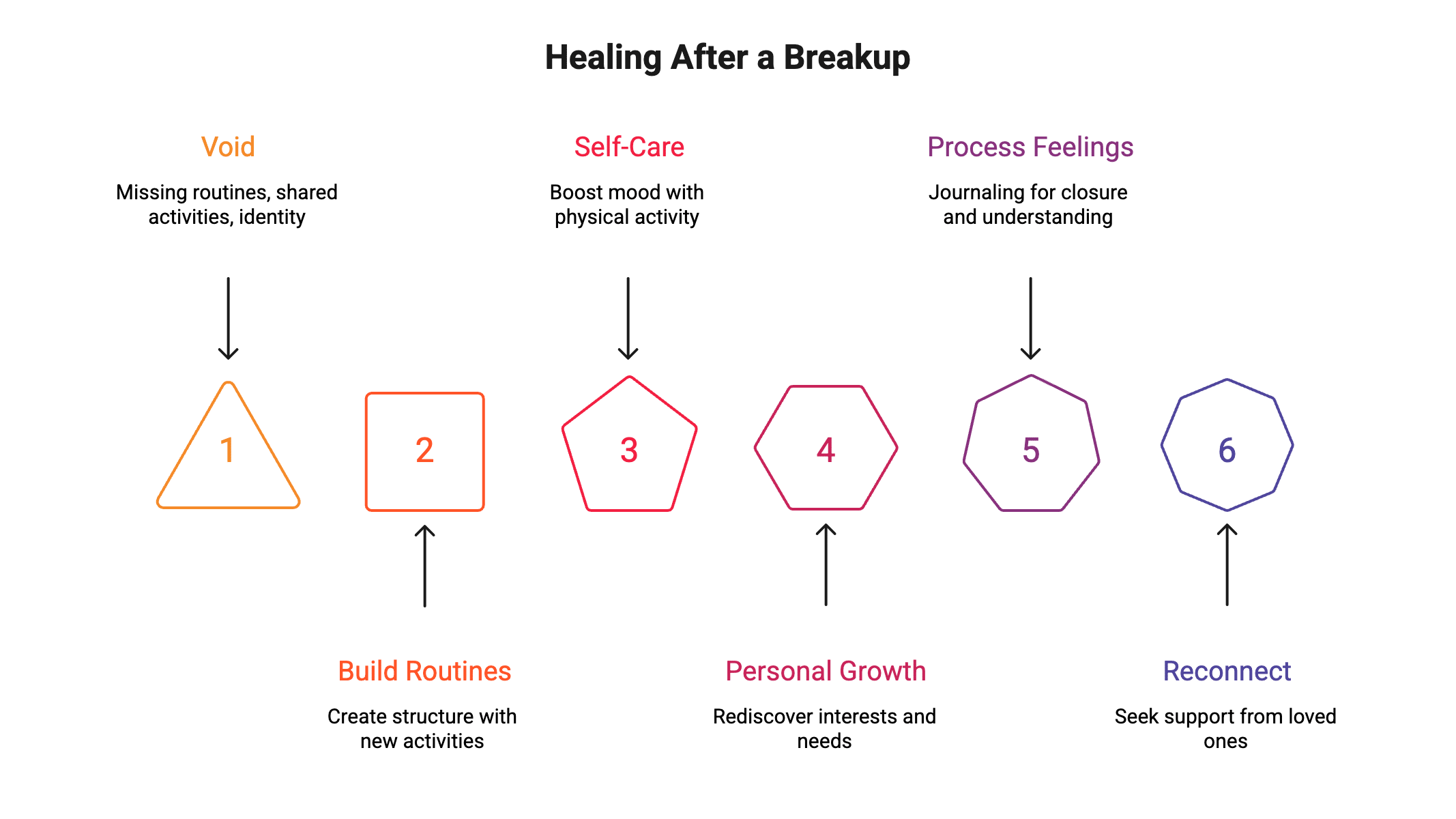
How to fill the void after a breakup
The emptiness after a breakup usually isn’t only about missing your ex — it’s the loss of routines, shared plans, and a piece of your identity at once. Breakups affect many areas of life, which is why the gap feels so wide.
- Rebuild structure immediately. If your old life ran on daily texts and weekend plans, replace those slots on purpose. Book things with friends. Add an anchor to your mornings.
- Move your body. Physical activity, even a regular walk, lifts mood and gives restless energy somewhere to go. DC’s parks and trails make this an easy default.
- Reclaim what you set aside. Ask what you shelved during the relationship, and start there.
- Write it down. Journaling or a single unsent letter can help you process feelings and find closure without contacting your ex.
- Reconnect with your people. Many of us withdraw after a breakup, but in research on coping with hard events, support from other people helped protect well-being.
When filling the void becomes avoidance
Be honest about the line between healthy distraction and outrunning your feelings. Staying constantly busy, jumping straight into a new relationship, or leaning on alcohol just delays the grieving process. Research on rumination after breakups found that people who tend to replay things over and over were slower to recover, so let yourself feel it without getting stuck in a loop. The aim is to grieve and move forward, not to pick one.
Coping with the hard moments
Recovery rarely falls apart over big decisions — it wobbles in small, predictable moments. Having a plan for those is half the battle.
When you still love them
Loving someone and being right for each other aren’t the same thing. Let yourself miss them without treating that longing as proof you should get back together.
When you see them on social media
One post can undo a good week. That’s how memory and reward wiring work, not weakness. Mute or unfollow rather than relying on willpower — removing the cue is far easier than resisting it a hundred times a day.
When the anger hits
Anger after a breakup is normal, and it’s often grief wearing a different face. Give it somewhere to go you won’t regret — a hard workout, a blunt journal entry, a vent with a friend — rather than a text to your ex.
When you feel relieved, and guilty about it
Relief is common and healthy, especially after a strained relationship. It doesn’t mean you never cared. Two things can be true at once: sadness that it ended, and relief that a hard chapter is closing.
When is it more than a breakup?
Most breakup pain eases with time and support, but persistent hopelessness, functional shutdown, or thoughts of self-harm are signs to reach out for help now, not later. While sadness is expected, some people develop depression or anxiety that benefits from clinical treatment.
Consider reaching out to a professional if you notice:
- Intense grief that doesn’t ease after several months
- Trouble functioning at work or keeping up with daily life
- Persistent thoughts that life isn’t worth living
- Using alcohol or drugs to cope
- Pulling away from friends and family completely
Some people experience post-traumatic stress symptoms after a relationship ends, even after an ordinary breakup. It can be especially hard when the relationship involved abuse or emotional manipulation like gaslighting. Those situations always warrant support.
Clients often wait too long because they think they should handle a breakup alone. Reaching out isn’t weakness. In our experience, it’s usually self-respect, and a few sessions of grief and relationship counseling can shorten a stretch that otherwise drags for months.
If you need support now
- 988 Suicide & Crisis Lifeline — call or text 988 anytime for free, confidential support if you’re in crisis or having thoughts of self-harm. If you feel in immediate danger, call 911.
- DC Access HelpLine — 1-888-793-4357 for immediate help and referrals to behavioral-health providers in DC.
- DC Victim Hotline — 1-844-443-5732 for free, confidential help related to domestic violence.
Moving forward
Moving on after a breakup takes time, and being patient with yourself is part of what works, not a nicety. The evidence points the same way again and again: seek support, resist rumination, rebuild routine, and let yourself grieve.
The bottom line: the pain is real, but for most people a breakup is a stretch you move through, not a place you stay. If you want help doing it well, therapy gives you a place to process the loss and rebuild — our therapists in Washington, DC work with relationship transitions, grief, and resilience.
You don't have to move on from this alone.
Our Dupont Circle therapists can help you process the loss, quiet the rumination, and rebuild a life that feels like yours again.
Last updated: July 2026
This blog is for informational purposes only and does not constitute medical or mental health advice. Always consult with a qualified mental health professional for personalized guidance regarding your specific situation.