

Introduction: Not Emotionally Available: What It Really Means (and What It’s Not)
“Emotionally unavailable” gets used everywhere—but what does it really mean? If you’ve been told you’re not emotionally available, or you’re worried a partner is, you’re not alone. The phrase can sound harsh or permanent, like a fixed trait. It isn’t. In plain English, emotional availability is your capacity to notice feelings, put them into words, and respond to another person in a way that builds closeness.
Researchers use this term to describe observable, learnable skills that support healthy relationships, not a life sentence. In this guide, we’ll cover a clear definition, what counts as a sign, what doesn’t, why it happens, and small first steps that make connection feel safer—and more real. We’ll also name when outside support helps.
Section 1 — What “Emotionally Unavailable” Actually Means
Being emotionally unavailable means it’s hard to access, share, or respond to emotions enough to build and keep closeness. That can look like going blank during conflict, steering talks back to logistics, or cracking jokes when things get real.
In research language, emotional availability is a set of skills and behaviors between people—tuning in, responding, repairing—that support healthy bonds. Most of this research looks at parents and young children. A broad overview of emotional availability treats it as something you can see in how people respond to each other—and describes programs built to strengthen it.
Think of it like a muscle group you can train: attention to your inner world, words for feelings, and responsiveness to others. None of this requires perfect eloquence. It asks for enough openness that both people feel seen and safe.
Key idea: This is about capacity and skills, not character flaws. Labels can shut people down. Skills give you a place to start.
Section 2 — What It’s Not
Not introversion. Liking quiet or alone time doesn’t mean you’re unavailable. Many introverts share deeply—just in smaller doses.
Not simply having fewer words. Some people grew up with limited emotional language. That’s a teachable gap, not a dead end. A concise conceptual framework for emotional availability emphasizes that availability shows up in behavior—how we respond and engage—not vocabulary size.
Not just a disagreement style. You can debate ideas and still be emotionally present. The difference is whether you can pause, name what you feel, and respond to your partner’s feelings.
Not the same as low bandwidth. New parenthood, grief, burnout, or medical stress can temporarily shrink anyone’s capacity. That’s a season, not an identity.
Bottom line: If you’re willing to notice, name, and respond—even awkwardly—you’re already practicing availability.
Section 3 — Common Signs
- Conversations stay on plans, jokes, or facts when emotions show up.
- You (or your partner) go numb or shut down in conflict.
- Big feelings trigger retreat: ghosting for a bit, canceling plans, or keeping things “casual.”
- Mixed signals after closeness (warm one day, distant the next).
- Struggling to respond when someone shares something vulnerable—changing the subject or offering only fixes.
Reality check: These signs sit on a continuum. Many people do some of this some of the time. The pattern and impact matter most.
Section 4 — Why This Happens
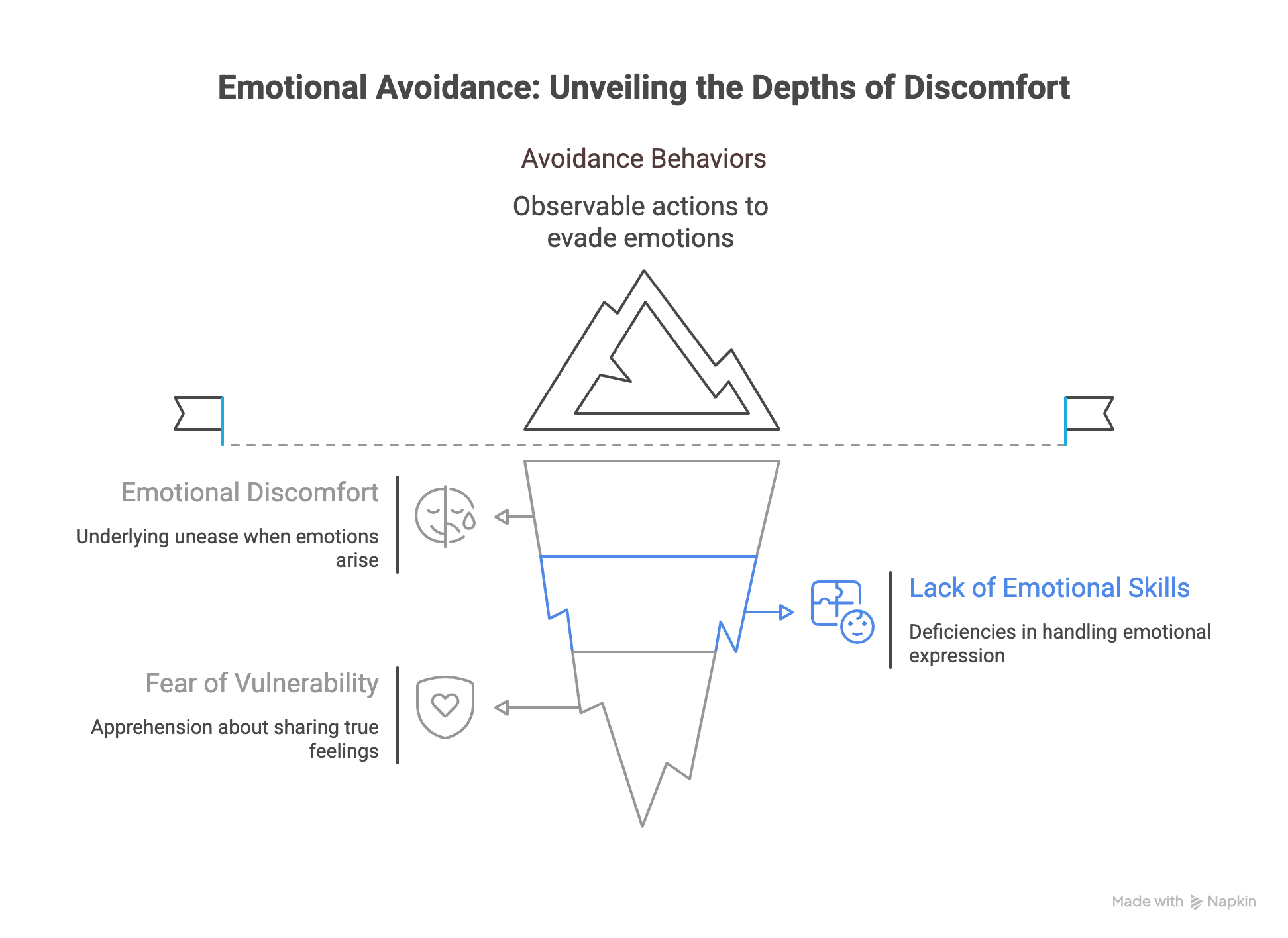
We learn emotional availability the way we learn any interaction pattern—through experience and practice. Early relationships teach us how safe it feels to share, and how likely others are to respond. Emotional unavailability is commonly rooted in life experiences, such as childhood neglect or past relationships. Those past dynamics can shape current habits, but availability can still change with support. Over time, protective strategies that once helped—staying guarded, keeping control, staying busy—can start to block closeness.
There’s also the “right‑now” layer: high stress at work, poor sleep, substance use, or untreated anxiety and depression can flatten access to feelings. Both history and context matter, which is actually good news—it means more than one doorway into change.
In short: if you learned to keep feelings at arm’s length, you can also learn to bring them a step closer, at a pace that fits.
Section 5 — A 5‑Minute Self‑Check
Ask yourself:
- Do I change the subject or joke when emotions show up?
- In conflict, do I go blank, shut down, or disappear?
- Do I keep relationships vague to avoid tougher talks?
- When someone shares a feeling, do I offer fixes instead of first reflecting it?
- Do I feel unsafe or “too much” when I try to share?
How to use this: If you said “yes” to several, you’re spotting skills to build—not a broken trait. Taking gradual steps to open up can prevent overwhelming feelings of discomfort.
Section 6 — First Steps to Become More Available
1) Name one feeling per day. Keep it simple: sad, mad, glad, worried, tired. Write it in your notes app.
2) Slow the tape. Before reacting, pause 10 seconds. Breathe in for 4, out for 6. Then respond.
3) One‑step‑deeper sharing. Add a single feeling line to any update: “The meeting ran long—and I felt discouraged.”
4) The three‑beat reply. When someone shares a feeling: (a) reflect what you heard, (b) validate something about it, (c) ask a small follow‑up (“Want a hug or just company?”).
5) Weekly connection ritual. Fifteen minutes, same time each week, phones away. A walk, tea on the couch, or a no‑agenda check‑in.
6) Repair after a miss. If you shut down, circle back: “I went numb earlier. I’d like to try again—are you open to it?”
Section 7 — When It’s Something Else
Emotional availability sits inside a larger picture. Some people have alexithymia (trouble identifying and describing feelings). Others are neurodivergent or come from cultures where emotions are expressed differently.
Developmental research reminds us that context—history, stress, health, and environment—shapes how availability shows up, and that different paths can still lead to better connection.
Translation: If labels haven’t fit, you’re not an outlier—you may just need a tailored route.
Section 8 — When to Try Therapy
Consider professional support if you notice:
- Repeat shutdowns during conflict or after closeness.
- Persistent numbness or difficulty naming any feelings.
- The same pattern across relationships.
- A partner asking for more connection, and you feel stuck.
- Repeat shutdowns during conflict or after closeness.
- Persistent numbness or difficulty naming any feelings.
- The same pattern across relationships.
- A partner asking for more connection, and you feel stuck.
What therapy helps with: building a usable feelings vocabulary, practicing slower, steadier responses, learning repair after misses, and widening your window for closeness. Working with a therapist allows you to explore the underlying causes of emotional unavailability.
Local Help — Therapy Group of DC
You don’t have to white‑knuckle this alone. At the Therapy Group of DC in Dupont Circle, we offer inclusive, evidence‑based individual therapy to build emotional skills and couples therapy to strengthen connection and repair. We’ll help you set small, doable targets, then practice them between sessions.
Next step: Request an appointment. We’ll match you with a clinician who fits your goals and schedule.
Closing
Emotional availability is learnable. Start with one tiny practice this week—a 10‑second pause or a one‑step‑deeper sharing line. Small reps, repeated often, change how you relate. If you want guided help, we’re here in DC to make those reps easier and more effective.
Frequently Asked Questions about Emotional Availability
What does it mean to be an emotionally unavailable partner?
An emotionally unavailable partner is someone who struggles to engage deeply on an emotional level, often avoiding vulnerability, intimacy, or commitment. This inability to connect emotionally can impact relationship satisfaction and lead to feelings of distance or frustration. Setting clear boundaries is essential for protecting your emotional health in a relationship with an emotionally unavailable partner.
How can emotional unavailability affect romantic relationships?
Emotional unavailability can limit emotional intimacy and connection, making it difficult to build fulfilling relationships. Partners may feel unheard, unsupported, or disconnected, which can cause misunderstandings and emotional hurt over time. Making time for each other—and staying present when feelings come up—helps rebuild that connection.
Can emotional availability be improved or overcome?
Yes. Emotional availability is a set of learnable relationship skills. With self-awareness, communication, and sometimes therapy, individuals can develop greater emotional vulnerability and deepen their emotional connections. One place to start: treat your partner’s feelings as just as important as your own.
What role does therapy play in addressing emotional unavailability?
Therapists can help identify underlying causes such as past experiences or trauma, teach emotional support strategies, and guide individuals or couples through relationship work to build emotional depth and healthier communication.
How can I recognize if I am emotionally unavailable?
Signs include difficulty expressing feelings, avoiding deeper conversations, feeling uncomfortable with emotional vulnerability, or prioritizing your own needs over your partner’s. Reflecting honestly and seeking feedback can help increase awareness.
Why is emotional intimacy important in relationships?
Emotional intimacy fosters trust, empathy, and a sense of safety, which are essential for sustaining a healthy and fulfilling relationship. Without it, partners may feel lonely or disconnected, even if other aspects of the relationship seem fine.
What are some first steps to becoming more emotionally open?
Starting with small actions like naming your feelings daily, practicing active listening, and making time for your partner can build emotional availability gradually. Over time, these steps help create a deeper level of connection and intimacy.