
Field Notes · Life Transitions & Identity

Brave Conversations: A Women’s Mental Health Summit

There’s been a surge in celebrities openly advocating for less stigma around mental health and discussing help-seeking. Public figures are using their high visibility to raise awareness of mental health and the benefits of therapy.

Outside of public view, our daily work in our therapy offices in Washington DC is helping people to improve their mental wellbeing and to combat shame, judgment, and stigma. We’ve come to learn that if we’re determined to address mental health, we must start in our communities and provide tangible resources to those in need of help. Celebrity advocacy for mental health awareness is noteworthy. It can start important conversations about mental health de-stigmatization, especially for women. Our hope at the Therapy Group of DC is that we can build on those discussions.

Women and Psychological Distress

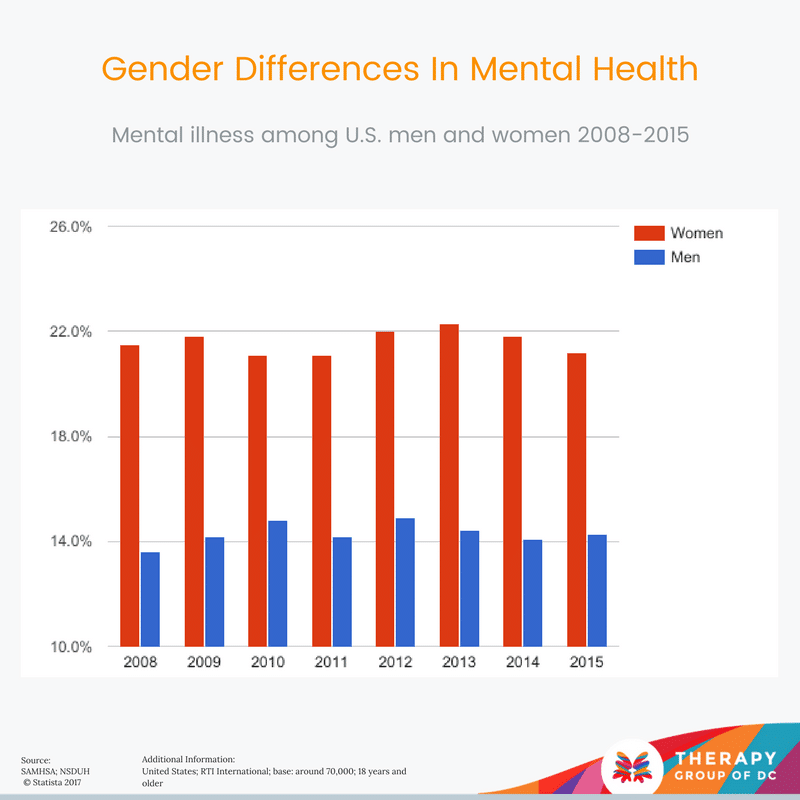
In the United States, women in every age group are more likely than men to experience serious psychological distress, according to a 2015 report from the National Center for Health Statistics, part of the Centers for Disease Control and Prevention.

This chart of Substance Abuse and Mental Health Services Administration (SAMHSA) data reveals the same gender dichotomy. 


According to leading researchers and authors, women are prone to internalizing their mental illnesses, leading to higher rates of depression, eating disorders, and anxiety and sleep problems. In case you’re curious, men are more apt to externalize leading to higher rates of substance abuse, anger, and aggressive behavior.

Women and Mental Health Treatment and Therapy

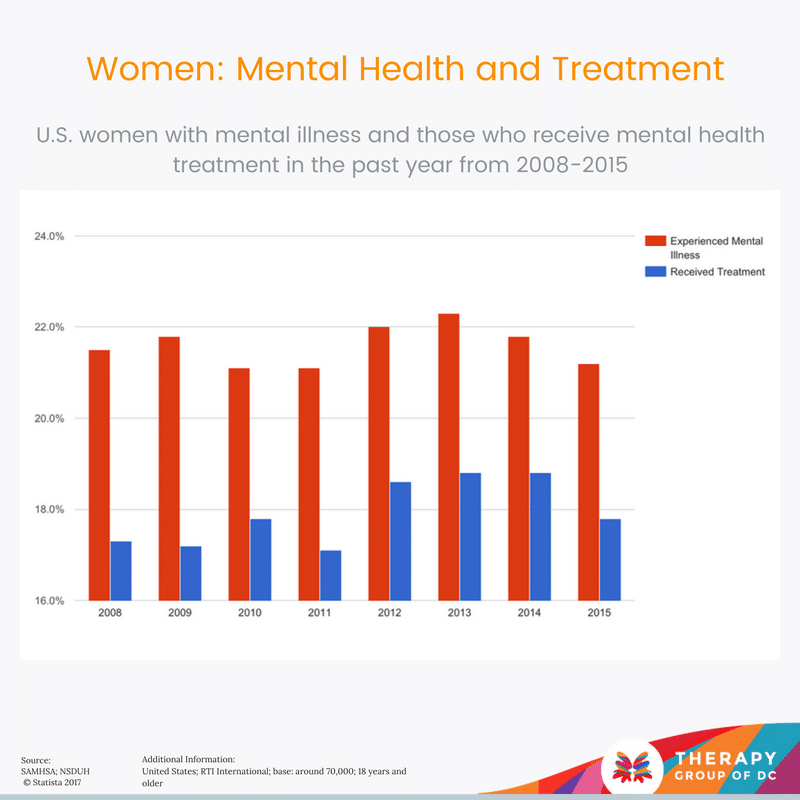
According to SAMHSA and it’s National Survey on Drug Use and Health, it was estimated that 21.2 percent of women in the U.S. had some sort of mental illness in 2015. During that same year, an estimated 17.8 percent of U.S. women received mental health treatment or counseling, down from recent years. 

We’re curious to see 2016 figures when they are released. We’ll then be better able to ascertain if rates of receiving mental health treatment are on a new downward trend, or if 2015 was an anomaly. Either way, as this chart shows, many women struggle with mental health concerns, such as diurnal symptoms of depression (that is, what people call morning depression or nighttime depression), who don’t receive treatment like therapy.

Thinking Local: Mental Health for Women in Washington, DC

We’re aware that Washington, DC is a magnet for political go-getters and other professionals with high-stress careers. Added to those stressors, it seems that almost everyone, regardless of political affiliation, needs body armor and loads of emotional resilience just to get through their Twitter and Facebook feeds these days. Lastly, DC is also home to a large underserved population without access to affordable mental health care.

As therapists in DC, we task ourselves with how can we start to make things better for everyone. We don’t have all the answers, but raising awareness, starting conversations, and building connections is a good place to start.


Ready for an appointment?

This is My Brave

To that end, our practice was proud to sponsor of Leading Ladies #LiveBrave: A Women’s Mental Health SummitThe summit featured keynote speaker Elizabeth Vargas from ABC’s 20/20 and female storytellers from diverse backgrounds. The event provided a platform for women to share personal stories of resilience and hope through poetry, music, comedy, and essay.

With the increased emphasis on women’s rights and responsibilities, an event promoting women’s mental health and well-being was most deserving of our positive attention.

This is My Brave works to de-stigmatize mental illness. It encourages educating, seeking help, and having a dialogue about living with mental health without shame or self-imposed judgment.

We’re Here to Listen

We are a collection of accepting therapy experts and specialists – we often refer to ourselves as therapy nerds –  with individual styles and strengths dedicated to making our community better. Everyone is welcome here. Let us know if we can be of help.

Ready when you are.

Booking a first session is simple, and there’s no pressure to have it all figured out first.

Privacy Policy

Therapy Group of DC · Effective August 29, 2026

The short version

  • The only place this website collects personal information is the appointment scheduling assistant — and only what you choose to share there.
  • We use two analytics tools to understand what gets read: Google Analytics (which sets this site’s only cookies) and Ahrefs Analytics (which sets none). Neither is connected to advertising.
  • We don’t run ad trackers, social media pixels, or remarketing. We don’t sell or share your information for advertising. There are no forms quietly collecting your details.
  • Questions, or want something corrected or deleted?

What this policy covers

This policy covers this website — therapygroupdc.com. It is not the privacy notice for therapy itself: if you become a client, your care is protected by federal and district health-privacy law, and you’ll receive our Notice of Privacy Practices as part of getting started. Nothing you read or click on this website creates a therapy relationship.

What we collect, and why

What you send us. If you email us, call us, or use the scheduling assistant (the “Make Appointment” button), we receive what you choose to share — typically your name, contact details, and what you’re looking for. We use it for exactly one purpose: responding to you and arranging care. The scheduling assistant is operated for us by WithTherapy, our scheduling provider, and the information you enter there goes to our practice and to the systems we use to manage appointments.

How the site gets used. Like most websites, we use analytics to understand which pages people read and where visitors come from — that’s how we decide what to write next. Google Analytics sets this site’s only cookies (named _ga and _ga_ZL758R38PL) and collects usage data such as pages visited, approximate location, and device type. We have Google’s advertising and cross-site features turned off. Ahrefs Analytics collects similar aggregate usage data and sets no cookies at all.

Accessibility preferences. The accessibility widget (accessiBe) lets you adjust how the site displays. If you use it, it stores your display preferences in your browser so they hold between visits.

What we don’t do

  • No advertising trackers, conversion pixels, or social media buttons.
  • No remarketing — we will never follow you around the internet.
  • No selling, renting, or sharing your information for advertising, ever.
  • No comment forms, pop-up surveys, or newsletter capture.
  • Reading about a topic here tells us nothing about who you are — analytics reaches us as aggregate counts, not identified people.

The services behind the site

ServiceWhat it doesTheir policy
WithTherapyOperates the appointment scheduling assistantwiththerapy.com/privacy
Google Analytics 4Usage analytics (advertising features off)policies.google.com/privacy
Ahrefs AnalyticsCookieless usage analyticsahrefs.com/legal/privacy-policy
accessiBeAccessibility widgetaccessibe.com/privacy-notice
VimeoPlays the video on our homepagevimeo.com/legal/privacy/policy
Google FontsDelivers the font for the scheduling button (loaded by the scheduling assistant)policies.google.com/privacy
CloudflareSecurity and content deliverycloudflare.com/privacypolicy
WP EngineHosts the websitewpengine.com/legal/privacy

Cookies

This site sets two cookies, both from Google Analytics (_ga, _ga_ZL758R38PL), used to distinguish visits in aggregate statistics. You can block or delete them in your browser settings without affecting how the site works, or use Google’s opt-out browser add-on. If you use the accessibility widget, your display preferences are stored in your own browser, not sent to us.

Your choices and rights

You can browse this site without providing any personal information at all. If you have shared something with us — through the scheduling assistant, by email, or by phone — you can ask us what we hold, ask us to correct it, or ask us to delete it, by writing to . We’ll respond to reasonable requests promptly. Deletion requests may be limited where health-record or other law requires us to retain information.

Security and children

We use standard protections — encrypted connections (HTTPS) everywhere, and reputable providers for hosting and scheduling — and we limit what we collect in the first place, which is the best protection there is. This website is meant for adults and is not directed at children under 13; we don’t knowingly collect information from them.

Changes

When this policy changes, we’ll update it here and change the effective date at the top. We won’t quietly expand what we collect.

Who we are

District Psychotherapy Group PLLC (Therapy Group of DC)
1350 Connecticut Avenue NW, Suite 800
Washington, DC 20036 (USA)

Privacy contact: