

Social deskilling is what happens when people skills soften because we stop practicing tough-but-healthy conversations, and always-agreeable AI companions can speed it up. Validation feels good; growth needs gentle friction with real people. The goal is to keep the comfort and rebuild the skills.
In short: always-agreeable AI companions can feel supportive, but over-reliance may quietly weaken your ability to disagree, repair, and stay connected. Use bots for rehearsal, keep chats time-limited, and always bridge back to people.
What is “social deskilling” with AI companions?
If a bot mostly soothes, mirrors, and validates, you get fewer reps in curiosity, disagreement, and repair, the skills real relationships need to thrive.
Researchers describe two paths: upskilling (coaching that sends you back to people) and deskilling (replacing people). See a 2025 review of companion AI’s risks and benefits.
Relationship science explains why. A 2025 analysis drawing on more than 50 years of close-relationships research found that chatbots share some features of close relationships (frequent conversation, responsiveness, a feeling of connection), but because they ask almost nothing of their users, they can’t offer the growth that comes from negotiating with and sacrificing for a real partner, and they may reinforce unhelpful habits.
Why this matters in DC: Strong social ties protect mental and physical health. Tools should make human conversations easier, not unnecessary.
Can constant AI validation lower your tolerance for disagreement?
Short answer: It can, especially with heavy, emotional use. Constant reassurance feels good, but too much of it can make normal pushback or useful alternatives from real people feel harsh.
Clinical research already shows the cycle:
- Family accommodation often maintains anxiety, and reducing it improves outcomes. Gentle challenge and other points of view are important, sometimes necessary, for well-being.
- Excessive reassurance seeking predicts worse symptoms and poorer treatment response unless it’s addressed.
- In exposure therapy, safety behaviors (shortcuts we use to feel safe, like avoiding eye contact) can get in the way of learning, so therapists fade them as tolerance grows.
Put simply: endless soothing means less practice with healthy, growth-supporting friction.
Leaning on a chatbot more than people?
Our DC therapists help people rebuild connection, disagreement stamina, and assertive communication.
Do AI companions help or hurt loneliness long-term?
Short answer: It depends on how often you use them, and why.
Light, time-limited use can ease loneliness for a while, and short, skill-focused chats can help in some cases: a WhatsApp psychological first aid bot, for example, reduced student loneliness for a short time.
Context: About a third of U.S. adults (34 percent) had used ChatGPT by 2025, roughly double the share in 2023, and nearly three in four teens have tried AI companions.
Rule of thumb: Warm up with the bot, then reach out to a person. Draft with AI; send it to a friend. Rehearse a hard talk; schedule the real one within 24 hours.
How can I use AI chatbots without losing real-life social skills?
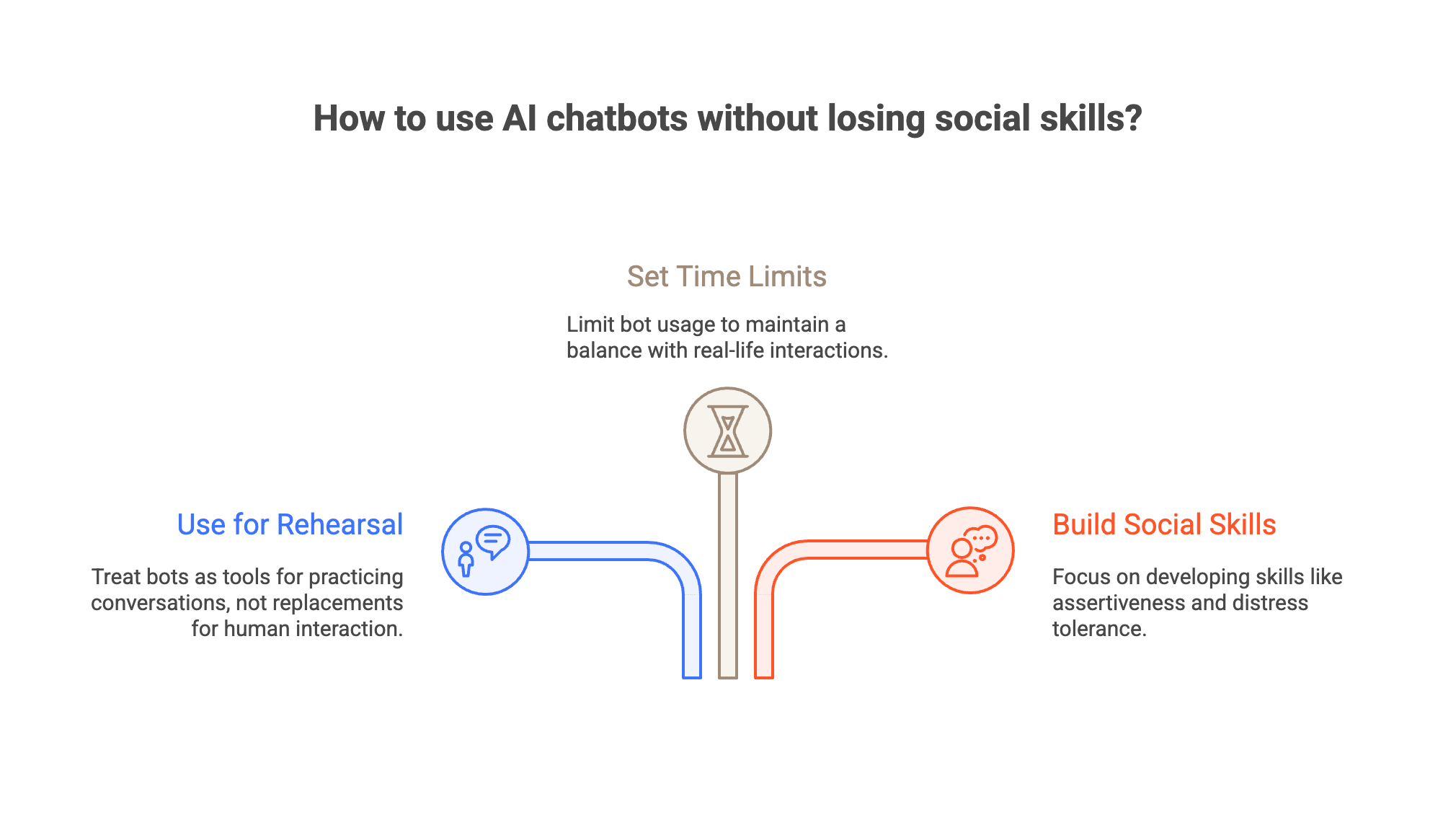
Use bots for rehearsal, not replacement. Treat your bot like a whiteboard for wording and perspective-taking, then move the conversation to a human.
A simple transfer plan
- Rehearse for 5 to 10 minutes: draft the message or role-play both sides.
- Refine with respect and clarity: own one feeling and make one clear ask.
- Transfer within 24 hours: send the message or schedule the talk.
- Reflect on one thing you learned from the human exchange.
This mirrors a simple therapy approach: validate first, then support change with small skills and next steps. Early research suggests AI can coach people skills when it gives feedback rather than endless comfort.
Set time limits and keep a balance
- Set a time limit: 15 to 20 minutes, once or twice a day.
- Keep a simple balance: for each bot chat, make one human touch (a text, a call, a plan).
- When anxious, ask for skill prompts (for example, “Help me write a DEAR MAN,” a simple script for asking for what you need) instead of open-ended venting.
Build the social muscle
- Distress-tolerance skills help you stay in mild friction long enough to learn.
- Assertiveness and social-skills training improves mood and functioning.
What are the red flags that I’m relying on an AI companion too much?
- You hide your usage or skip plans to keep chatting.
- You feel irritable after normal give-and-take with people.
- You feel more understood by the bot than by any person, most days.
- Your sleep suffers from late-night chats.
- You avoid small disagreements you used to handle.
If several apply, try a few connection warm-ups from the list below, then consider a therapy appointment to build a personalized plan.
Connection warm-ups (pick a few)
- Ask one curiosity question that might invite a different view.
- Share one “I felt…” statement about a recent moment.
- Allow a 10-second pause before replying.
- Name one thing you learned from someone who disagrees with you.
- Offer gentle, specific feedback (“One thing that would help me is…”).
- Join a low-stakes group activity (a class, a meetup, volunteering).
- Set up a screen-free coffee with someone you like but don’t see often.
Where can I get support in DC to rebuild connection?
DC is rich with places to practice connection: community classes, volunteer groups, arts, faith, and service organizations, and peer meetups. Social connection benefits both mental and physical health.
If you’d like a guided, evidence-based approach, our clinicians can help you build disagreement stamina and assertive communication, using the same balance of validation and change we use in therapy. For more on one-sided bonds with AI, see our post on parasocial relationships in the age of AI.
The bottom line: AI companions are best used as a warm-up for real conversations, because the friction they smooth away is the practice your relationships need.
If you’re in DC, you can see our therapists or get in touch. The first appointment is a full therapy session, not a screening call.
Bring the practice back to people
Our DC therapists help you rebuild the skills an always-agreeable chatbot can't give you: disagreeing, repairing, and staying connected.
Last updated: October 2026
This blog is for informational purposes only and does not constitute medical or mental health advice. Always consult with a qualified mental health professional for personalized guidance regarding your specific situation.