
Field Notes · Anxiety & Stress

Research On Who or What People Turn to When Stressed

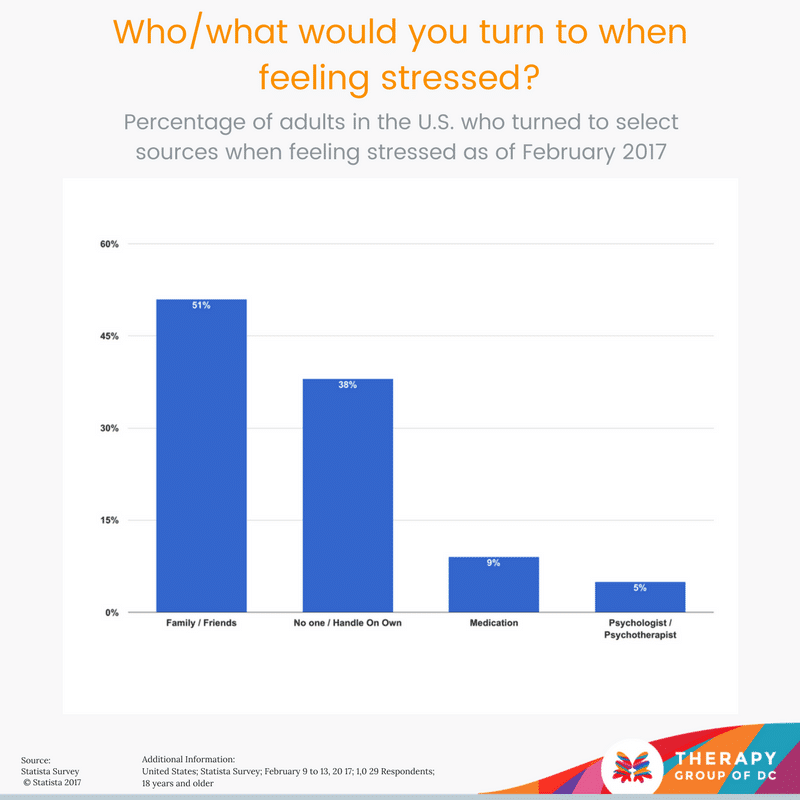
Stress is exceedingly common in work or life at one point or another. People deal with it in different ways, such as going it alone or seeking medication or therapy. We were curious to know more about the top ways that people deal with daily stress as we work to improve our ability to better help those who seek therapy in DC with us.  A recent survey by Statista sheds light on how people tackle stress.

Friends and Family Are Tops When Dealing with Stress

As you can see in the chart above, most people look to friends and family for support during times of stress. The survey revealed 51 percent of all individuals rely on these vital relationships, making their strength essential to coping with stress, and to mental health more broadly.

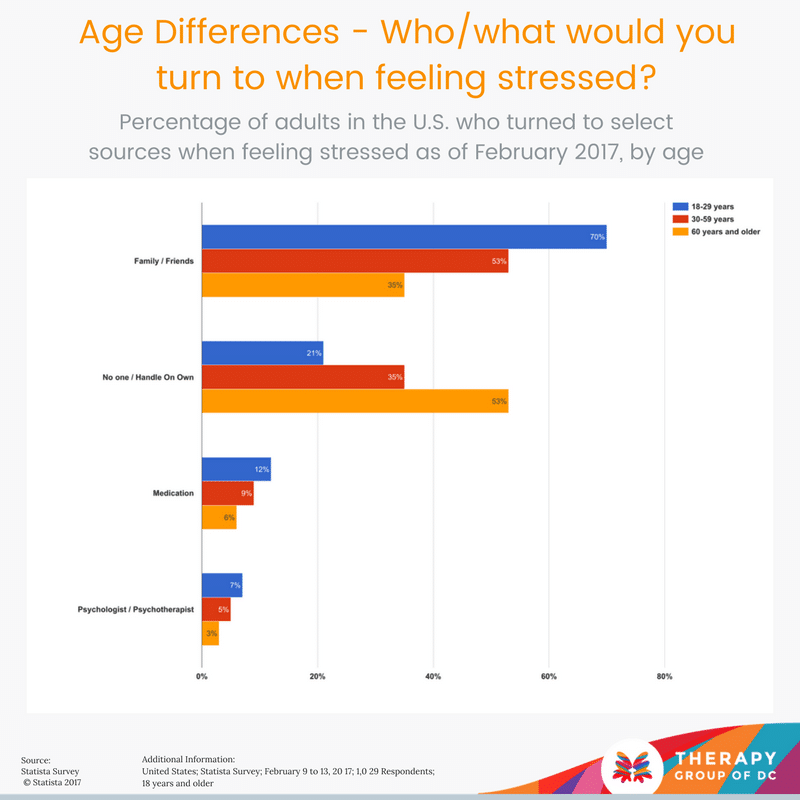
Interestingly, the reliance on close relationships depends on the age of those surveyed. Seventy percent of 18-29 year-olds go to those closest to them during challenging times. This is compared to 53 percent of 30-59 year-olds and 35 percent of those over the age of 60.

Although most middle-aged individuals choose close relationships over other forms of stress support, the pattern is the opposite for those 60 and older. A full 53 percent of that age group prefer to go it alone and depend on self-reliance instead of friends, medication, or psychotherapy.
Regardless of age, since the relationships with family and friends are the most common mechanism for off-setting stress, it’s vital to develop and protect healthy, long-lasting connections with others.

Self-Reliance

Self-reliance, the second most popular option overall, and particularly relied upon up by those 60 and older, has positive implications. It can signal confidence and belief in your ability to successfully handle difficult moments and situations. This concept is referred to as self-efficacy and is a good thing to cultivate.

On the other hand, using self-reliance to the extreme can be counter-productive and leave someone feeling isolated and alone and driven by myths about seeking help and therapy.


Ready for an appointment?

Medication and Therapy

Rounding out the list of top 4 options, survey respondents also sought prescribed medication or talk therapy to deal with stress. Nine percent of all respondents, regardless of age group, sought medication for stress, while five percent went to therapy. At a more detailed level, younger people tend to use these methods more often.

Reasons to Seek Therapy

These survey data reflect what we hope. That is, we hope that people have powerfully restorative close relationships and a strong belief in themselves to get them through rocky times.

Yet, we know that close relationships or even the sturdiest of self-confidence aren’t always sufficient to successfully deal with life’s struggles. Or, sometimes, those parts of life themselves need improvement. Contact us and let us know if we can be of help.

Ready when you are.

Booking a first session is simple, and there’s no pressure to have it all figured out first.

Privacy Policy

Therapy Group of DC · Effective September 30, 2026

The short version

  • The only place this website collects personal information is the appointment scheduling assistant — and only what you choose to share there.
  • We use two analytics tools to understand what gets read: Google Analytics (which sets this site’s only cookies) and Ahrefs Analytics (which sets none). Google Analytics is linked to our Google Ads account so we can see whether any ads we run lead to appointment requests; ad personalization is off.
  • We don’t run social media pixels or remarketing, and we don’t sell your information or use it to target ads to you. There are no forms quietly collecting your details.
  • Questions, or want something corrected or deleted?

What this policy covers

This policy covers this website — therapygroupdc.com. It is not the privacy notice for therapy itself: if you become a client, your care is protected by federal and district health-privacy law, and you’ll receive our Notice of Privacy Practices as part of getting started. Nothing you read or click on this website creates a therapy relationship.

What we collect, and why

What you send us. If you email us, call us, or use the scheduling assistant (the “Make Appointment” button), we receive what you choose to share — typically your name, contact details, and what you’re looking for. We use it for exactly one purpose: responding to you and arranging care. The scheduling assistant is operated for us by WithTherapy, our scheduling provider, and the information you enter there goes to our practice and to the systems we use to manage appointments.

How the site gets used. Like most websites, we use analytics to understand which pages people read and where visitors come from — that’s how we decide what to write next. Google Analytics sets this site’s only cookies (named _ga and _ga_ZL758R38PL) and collects usage data such as pages visited, approximate location, and device type. Ahrefs Analytics collects similar aggregate usage data and sets no cookies at all.

Google Ads measurement. Our Google Analytics account is linked to our Google Ads account so we can see whether any ads we run lead to appointment requests. Because of that link, Google’s tag contacts Google’s advertising servers when a visit starts, which lets Google read a Google advertising cookie if your browser already has one; and when someone starts an appointment request, Google Analytics passes that event — not your name or contact details — to Google Ads. We have turned off ad personalization and Google’s signed-in-user matching (Google signals), and we don’t use any of this to build a profile of you or to show you ads elsewhere.

Accessibility preferences. The accessibility widget (accessiBe) lets you adjust how the site displays. If you use it, it stores your display preferences in your browser so they hold between visits.

What we don’t do

  • No social media pixels or buttons, and no advertising tags beyond the Google Ads link described above.
  • No remarketing — we will never follow you around the internet.
  • No selling or renting your information, ever, and no using it to target ads to you.
  • No comment forms, pop-up surveys, or newsletter capture.
  • Reading about a topic here tells us nothing about who you are — analytics reaches us as aggregate counts, not identified people.

The services behind the site

ServiceWhat it doesTheir policy
WithTherapyOperates the appointment scheduling assistantwiththerapy.com/privacy
Google Analytics 4Usage analytics, linked to our Google Ads account for ad measurement (ad personalization off)policies.google.com/privacy
Google AdsReceives appointment-request events from Google Analytics so we can measure our own ads; loads nothing on the site itselfpolicies.google.com/privacy
Ahrefs AnalyticsCookieless usage analyticsahrefs.com/legal/privacy-policy
accessiBeAccessibility widgetaccessibe.com/privacy-notice
VimeoPlays the video on our homepagevimeo.com/legal/privacy/policy
Google FontsDelivers the font for the scheduling button (loaded by the scheduling assistant)policies.google.com/privacy
CloudflareSecurity and content deliverycloudflare.com/privacypolicy
WP EngineHosts the websitewpengine.com/legal/privacy

Cookies

This site sets two cookies, both from Google Analytics (_ga, _ga_ZL758R38PL), used to distinguish visits in aggregate statistics. If you arrive here by clicking one of our Google ads, the same tag also stores two cookies (_gcl_aw, _gcl_gs) for up to 90 days recording that click, so the visit can be credited to the ad. Google’s advertising servers may also read a Google advertising cookie already set in your browser by other Google sites; this site doesn’t set one. You can block or delete them in your browser settings without affecting how the site works, or use Google’s opt-out browser add-on. If you use the accessibility widget, your display preferences are stored in your own browser, not sent to us.

Your choices and rights

You can browse this site without providing any personal information at all. If you have shared something with us — through the scheduling assistant, by email, or by phone — you can ask us what we hold, ask us to correct it, or ask us to delete it, by writing to . We’ll respond to reasonable requests promptly. Deletion requests may be limited where health-record or other law requires us to retain information.

Security and children

We use standard protections — encrypted connections (HTTPS) everywhere, and reputable providers for hosting and scheduling — and we limit what we collect in the first place, which is the best protection there is. This website is meant for adults and is not directed at children under 13; we don’t knowingly collect information from them.

Changes

When this policy changes, we’ll update it here and change the effective date at the top. We won’t quietly expand what we collect.

Who we are

District Psychotherapy Group PLLC (Therapy Group of DC)
1350 Connecticut Avenue NW, Suite 800
Washington, DC 20036 (USA)

Privacy contact: