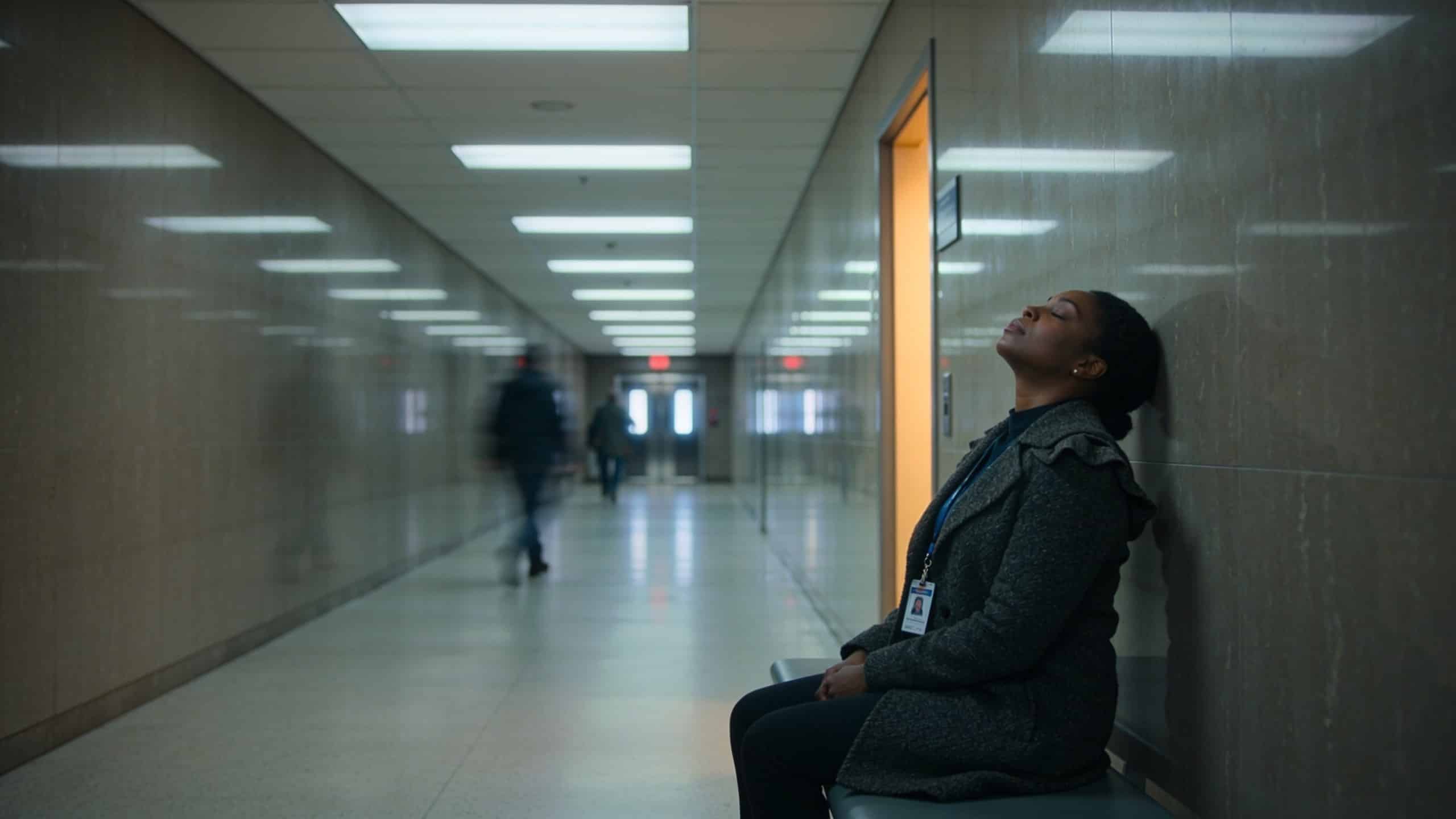

You read the fourth hardship case before 10 a.m. and felt nothing, and you decided that’s what compassion fatigue means: you’ve run out of compassion. You haven’t. Researchers who study empathy have argued that what fatigues isn’t compassion itself but the distress that comes from absorbing other people’s suffering day after day. If that is right, it is a different thing with a different way out.
The term compassion fatigue bundles two different things. One is burnout, which comes from the job itself. The other is secondary traumatic stress, the wear that comes from hearing about other people’s worst days over and over. The two usually rise and fall together: a 2025 review of 61 studies and nearly 34,000 health care providers found burnout and secondary traumatic stress tracking each other closely. That is why one name for both is convenient, and also why it gets in the way: each one needs a different fix.
If you’ve been scrolling lists of signs of compassion fatigue late at night, wondering whether you’ve turned into a worse person, here’s why the name matters. It puts the fault in your capacity to care, so the fix it suggests is caring less. Caring less doesn’t work, and it takes the good part of the work with it.
It isn’t compassion that wears you down. It’s carrying other people’s pain.
There are two different ways to feel another person’s pain, and researchers who study empathy have argued for keeping them apart. The first is empathy: you feel what they feel. Their fear becomes your fear, your chest tightens, and some part of you wants the feeling to stop. The second is compassion: you feel for them. You stay warm, you want things to go better for them, and you keep your footing while you do it.
The first one is the costly one. In one training study, a few days of practicing empathy left people feeling worse, and a few days of practicing compassion brought those negative feelings back down. Sharing pain is draining. Caring about it is not.
Empathy is the one that pushes you toward the exit. You wrap the call two minutes early. You skim the file instead of reading it. You stop asking the follow-up question because you don’t want the answer.
That slow retreat is what people mean when they say they have compassion fatigue. Nursing scholars have argued for years that the name is wrong: what runs out is not your compassion but your tolerance for absorbing other people’s distress.
Going numb has its own price. In one survey of medical physicists working in cancer care, the people who cared most about their patients felt more stress but were not more burned out, and they still found their work meaningful. The people who did worst were the ones who had trouble telling what they were feeling at all, a trait psychologists call alexithymia. They got less satisfaction from the work and more trauma symptoms from it. Numbing is protection of a kind, and it charges for it. Staying warm, without taking the pain on as your own, is the skill that holds up.
Four different experiences wearing one name
The phrase covers at least four experiences with different causes, and different causes need different fixes.
- Burnout. Exhaustion, cynicism, and the feeling that nothing you do lands, built up from chronic stress in the working conditions themselves. It isn’t exposure-specific. A benefits adjudicator with an impossible queue can be flattened by burnout without hearing a single traumatic story. Burnout therapy targets this layer.
- Secondary traumatic stress. Trauma-shaped symptoms from prolonged exposure to someone else’s trauma: intrusive images, avoidance, being on constant alert, trouble sleeping. It shows up as its own thing on the questionnaires, but it sits so close to burnout that the two are easy to confuse.
- Vicarious trauma. Slower changes in what you believe about safety, trust, and how people treat each other, also called vicarious traumatization. Some people notice it first in their personal relationships, when the people closest to them start sounding naive. This is the layer vicarious trauma therapy is built around.
- Moral injury. The distress of being made to act against your values, usually by a staffing, funding, or rationing decision. It points at the institution, not at you.
Blended into one phrase, all four sound like a personal deficiency. Pulled apart, three of them point at your working conditions, not at you.
And the “five stages of compassion fatigue” charts you’ll find online, the ones that end in total exhaustion, aren’t validated staging models. The common signs and physical symptoms they list are recognizable. Treat the sequence as a rough sketch, not a diagnosis, and don’t decide you’re at stage four. Where you land on a chart tells you less than what’s changed in your sleep, your dread, and your ability to care about anything after work. Those are the things worth bringing to someone.
People come in convinced they’ve turned callous. They describe the flatness as evidence of a character change. What we usually find is a person whose exposure outgrew their recovery time. The warmth is still there. It has been crowded out by a workload nobody designed with a human nervous system in mind.
It reaches well beyond health care
The idea grew up in nursing, and most people still picture nurses when they hear it. In Washington it reaches much further. Federal staff who administer hardship, benefits, and disaster programs. Agency and Hill offices where someone reads constituent mail all day, every envelope a person in trouble. Immigration and public-interest lawyers. Caseworkers, reporters, chaplains, dispatchers. High exposure comes standard with a lot of mission-driven jobs here, and nobody puts that in the position description.
In our Dupont Circle office, high exposure gets described as the price of admission. Clients name the caseload in the same breath as the mission, as if the two can’t be separated. We treat that assumption as the first thing worth examining, because a job you believe in can still be organized in a way that quietly wears you down.
Most of the hard numbers come from the helping professions. Among psychologists, social workers, and psychiatrists, reported high-burnout rates run from 21% to 67%. Women physicians show 20% to 60% higher rates than male colleagues, and it more often shows up as emotional exhaustion.
Two newer uses of the term deserve caution. In our offices we see partners and housemates of people in these jobs absorb the distress secondhand, through the nightly debrief at the kitchen table. Nobody has measured it yet. “Digital compassion fatigue,” the idea that doomscrolling through a feed full of other people’s suffering works like a caseload, is plausible and untested. The same goes for applying the term to unpaid family caregivers: it has been proposed on paper, and the research has not caught up.
When the work you believe in is wearing you down
You shouldn't have to choose between doing meaningful work and feeling like yourself at the end of the day. Our therapists work with DC professionals whose jobs put them close to other people's hardest moments.
Caring differently, not caring less
Caring differently is concrete. Three things to try this week, and not one of them asks you to feel less.
Catch the moment you switch from feeling for to feeling with
Say what the day did to you
Change one thing about the exposure, not just the recovery
The research behind all of this is encouraging and narrow. Across 21 workplace trials, loving-kindness and compassion meditation were linked to less burnout, less stress, and more self-compassion. Training that builds compassion moved burnout in the right direction, which is the opposite of what you would expect if compassion were what wore out. Workplace training in recognizing and managing emotions, your own and other people’s, produced moderate gains that were still there three months later, in every profession studied.
One caution. Those studies measured burnout and work stress, not compassion fatigue by name. Nobody has tested any of this as a treatment for compassion fatigue, or as a way to prevent it. What the studies do show is that these are learnable skills, and learning a skill with someone is what therapy is for.
With high-exposure professionals, sessions rarely start with coping skills. They start with what the week looked like, hour by hour, until the pattern shows. From there we work on two fronts: what you can do with your own reactions, and what you can change about the conditions producing them.
What the research can and can’t tell you yet
The research on treating compassion fatigue by name is thin, and almost none of it is randomized. Reviewers keep raising the same complaint about the term itself: different studies define it differently and measure it with questionnaires that overlap with burnout and trauma scales, so the results are hard to compare. When a wellness vendor tells you how to cure compassion fatigue in six weeks, that confidence isn’t coming from the evidence.
Burnout has much better research behind it, and it is a different target. Stress-management training for individual health care workers produces modest reductions in emotional exhaustion that last a few months, and programs that pair it with changes to the workplace do about twice as well. Professional coaching reduces exhaustion and the detached, cynical feeling toward patients that burnout brings, more so when it continues past a month.
A review of 23 studies of mindfulness-based stress reduction, the eight-week course, found its biggest effects on exhaustion and stress, with some improvement in self-compassion and sleep. Online acceptance and commitment therapy, across 11 randomized trials of working adults, produced modest improvements in work stress and burnout.
That is useful, but it is a long way from a cure for something every study defines a little differently.
Your workload is the variable, not your character
Physician burnout in the United States rose to 62.8% in 2021 and fell to 45.2% by 2023. Nothing in that swing is explained by a national change in self-care habits. Working conditions changed, and the numbers followed. The pandemic made the point plainly: people asked for personal protective equipment and adequate staffing, and the wellness programs offered instead rarely touched the workload.
A workplace’s attitude protects people on its own. In a study that followed 176 attorneys over time, firms where mental health was taken seriously produced less of the perfectionism that comes from feeling watched, and less of the physical and mental strain that follows it. Administrators usually notice burnout for their own reasons, turnover and errors, but the fix they reach for is the same one that helps you.
Individual factors matter too. In a group of women treated for stress-related exhaustion, perfectionism and compulsive overworking predicted how severe the burnout was, both at the start and seven years later. In helping professionals, a difficult childhood raised the risk of burnout, partly through how they relate to others and partly through feeling unsupported by a supervisor.
Those factors raise the risk. They don’t create the hazard, which comes with the job. Who ends up developing compassion fatigue has more to do with exposure and staffing than with grit, which is why serious prevention looks like caseload caps, rotation off the hardest queues, and real supervision. In therapy for professionals, that inventory is often where we start.
Waiting it out is not a plan. Burnout that nobody addresses tends to persist, in our experience for months and often years, and the people who recover are usually the ones whose conditions changed, not the ones who waited.
When it’s something other than compassion fatigue
Not everything that feels like compassion fatigue is compassion fatigue. Among 2,281 health care workers, 33% screened positive for both burnout and depression and 19% for burnout alone, and depression predicted suicide risk more strongly than burnout did. Distress in a high-exposure job should never be written off as part of the job without checking for depression. If you’re having suicidal thoughts, call or text 988, the Suicide and Crisis Lifeline, which is staffed around the clock.
If symptoms cross into PTSD (post-traumatic stress disorder) rather than occupational exhaustion, the picture changes and the evidence gets much stronger. A large review of 98 clinical trials found cognitive processing therapy, EMDR, narrative exposure therapy, cognitive therapy, prolonged exposure, and CBT all reduced PTSD symptoms meaningfully. Our trauma and PTSD therapy page describes the approaches our therapists use.
Psychodynamic and relational therapy is used in practice for the slower shifts that come with years of exposure: who you’ve become, what you now assume about people. Fewer trials have tested it. Fit with the person across from you matters more than the acronym.
The bottom line: what wears out isn’t your compassion, it’s your unprotected exposure, and the fix is caring differently plus changing conditions, not caring less.
If other people’s emotional pain is the raw material of your professional life, that’s worth bringing to a first session rather than managing alone for another year. Where trauma symptoms are part of the picture, the trauma-focused therapies above have the strongest track record, and for some people medication is part of the plan too. That’s a conversation with a prescriber, not a decision to make alone.
You don't have to keep absorbing it alone
If your work puts you next to other people's hardest days, our DC therapists can help you stay in it without losing yourself. The first session is a full session.
Last updated: October 2026
This blog is for informational purposes only and does not constitute medical or mental health advice. Always consult with a qualified mental health professional for personalized guidance regarding your specific situation.