Quiet Divorce in DC: When Your Marriage Becomes Another Work Project
Silent divorce (sometimes called quiet divorce) happens when couples remain legally married but live emotionally separate lives. You share the same home and calendar but the emotional connection that once defined your marriage has quietly disappeared. This pattern of emotional disengagement affects many couples, often developing gradually over years.
In Washington DC’s high-pressure environment, marriages can become another task to manage rather than a source of connection.
What Is Silent Divorce?

Silent divorce describes being legally married while experiencing complete emotional withdrawal from your partner. Unlike openly toxic relationships marked by frequent conflict, silent divorce feels quiet.
The earliest signs often appear in small ways. Conversations become transactional, focused on household chores, child custody logistics, or financial implications rather than feelings. Physical intimacy fades. The minimal communication you maintain serves practical purposes only. Recognizing these earliest signs of disconnection can help you address the problem before it deepens.
This emotional distance develops through John Gottman’s “Distance and Isolation Cascade”—a predictable pattern where small disconnections snowball into deep loneliness. Partners in a silent divorce often feel like roommates going through the motions of daily life without genuine connection.
In our DC practice, we often see high-achieving couples who excel in their careers but struggle to bring that same intentionality home. They’ve quietly quit their marriage the same way burned-out employees quietly quit their jobs—doing the bare minimum to avoid conflict while emotionally checking out.
How Silent Divorce Differs From Legal Separation
Unlike legal separation or legal divorce with formal proceedings and clear boundaries, silent divorce happens entirely within the marriage. Couples share the same home, present a united front to friends and family, and maintain the appearance of an intact marriage—without any of the emotional connection. You avoid the financial implications and complications of divorce proceedings but remain in a relationship that meets none of your emotional needs.
Is Silent Divorce Healthy?
No, silent divorce is not healthy for anyone involved—not for you, your spouse, or especially your children. While couples often stay in emotionally dead marriages believing they’re protecting their children from divorce trauma, research tells a different story.
Children are remarkably perceptive. They notice when parents avoid eye contact, when affection disappears, when conversations feel strained. Growing up witnessing emotional disconnection can teach children that maintaining emotional closeness isn’t possible in adult relationships.
The emotional toll extends to both partners. Living with someone who feels like a stranger erodes your mental health. The absence of physical intimacy, meaningful conversation, and emotional support can lead to:
- Chronic loneliness despite never being alone
- Decreased self-worth
- Anxiety about the relationship’s future
- Depression or emotional numbness
- Resentment that builds with each year
Research shows that secure emotional bonds between partners help both people manage stress and improve well-being. When that bond is absent, both partners suffer.
What Causes Silent Divorce?
Understanding what leads to silent divorce can help you recognize warning signs early. It develops through years of small disconnections and unaddressed conflicts. Several patterns commonly lead to this outcome:
The Four Horsemen arrive first. Relationship researcher John Gottman identified four communication patterns that tend to predict divorce: criticism, contempt, defensiveness, and stonewalling. When these become regular, emotional disengagement follows.
High expectations meet insufficient investment. Modern marriages face what psychologist Eli Finkel calls the “all-or-nothing” dilemma. Couples expect fulfillment, support, satisfaction, and growth. When work pressures and daily responsibilities consume your energy, little remains for these expectations.
Conflict avoidance becomes the norm. When one partner shuts down difficult conversations, the other stops trying. This quiet quitting of emotional engagement creates compounding distance.
Gender patterns emerge. Studies show women initiate approximately 70% of divorces, often after years trying to address problems their partner dismissed. Women detect emotional distance earlier and seek conversations more frequently. When met with silence, women often choose quietly quitting as self-protection.
Signs You’re in a Silent Divorce
Recognizing silent divorce can be difficult when changes happen gradually. These signs indicate emotional disengagement:
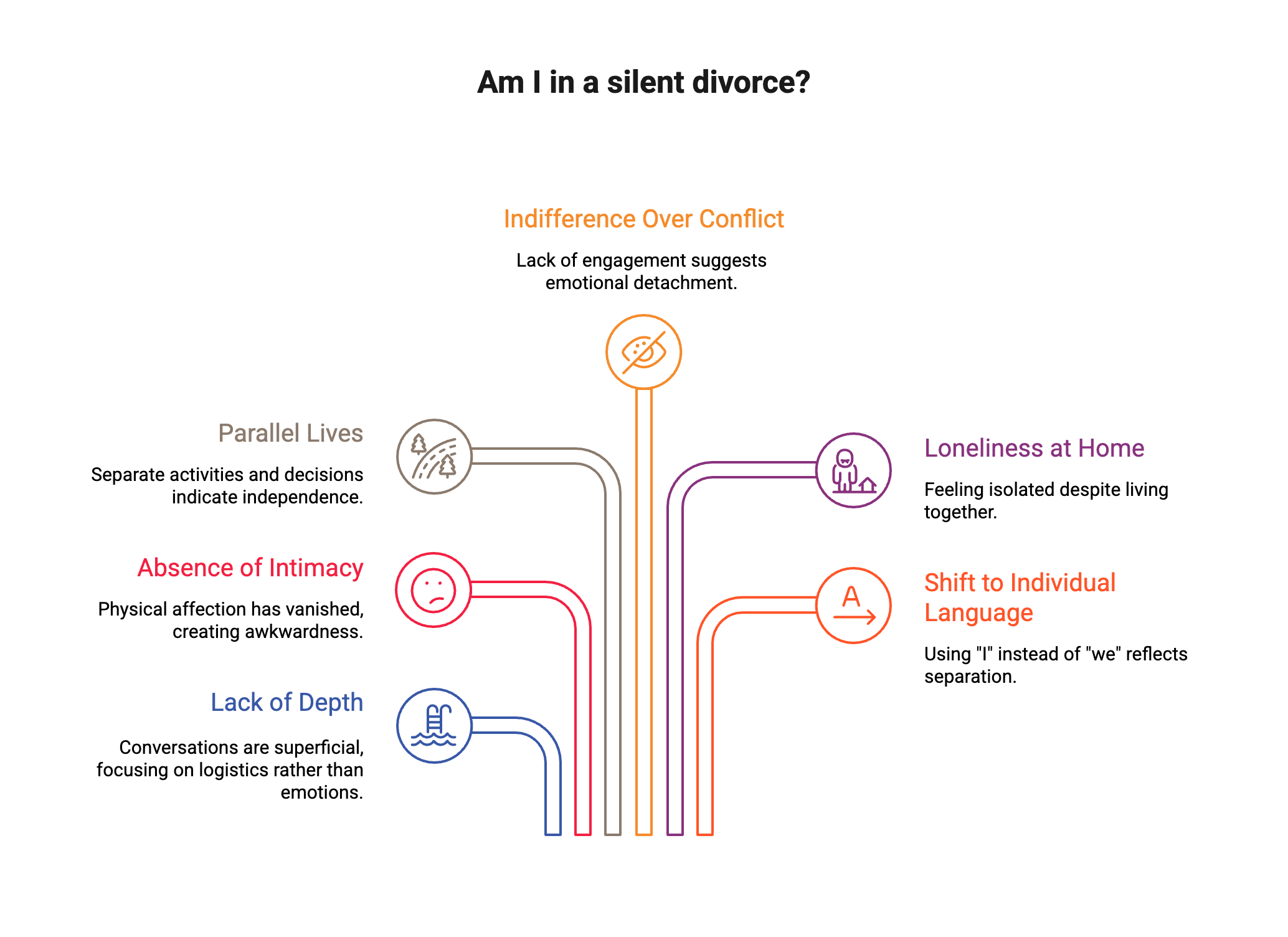
Your conversations lack depth. You discuss logistics—kids, dinner, bills—but never feelings, fears, or desires.
Physical intimacy has disappeared. You no longer hold hands, kiss goodbye, or touch casually. The absence of physical intimacy feels awkward rather than natural.
You lead parallel lives. Separate friend groups, hobbies, schedules. You make important decisions independently.
Conflict has been replaced by indifference. You rarely argue because neither cares enough to engage. Both partners are quietly quitting the emotional work.
You feel lonely at home. Despite living together, you experience deep loneliness.
The “we” has become “I.” You use individual language (“I’m planning”) instead of partnership language (“we’re thinking”).
How Long Can a Silent Divorce Last?
Silent divorce can persist for years or even decades—much longer than most people realize. Gottman’s research found that emotionally disengaged couples tend to divorce an average of 16 years after their wedding, compared to just 5.5 years for couples marked by high conflict. This extended timeline occurs because silent divorce feels less urgent than open conflict. There’s no crisis forcing a decision.
Some couples remain in this state indefinitely, continuing to live together and manage finances while experiencing no emotional connection. Fear of change, financial concerns, or worry about child custody can all keep people in emotionally dead marriages.
The danger is that the longer you remain disconnected, the harder it becomes to reconnect. These patterns of emotional withdrawal become deeply ingrained. You develop separate lives and coping mechanisms. Vulnerability with your spouse begins to feel foreign or threatening.
What Are the Rules for Silent Divorce?
There are no official “rules” because silent divorce exists in an ambiguous space between staying married and separating. However, couples often develop unspoken agreements:
Minimal communication. Conversations limited to essentials—children, finances, logistics.
Separate spaces. Different bedrooms or schedules that minimize contact.
Public unity. Maintaining appearances at gatherings while avoiding discussing the disconnection.
Emotional needs met elsewhere. Deep friendships, work focus, or simply functioning without intimacy.
These “rules” might reduce conflict but don’t address the core issue: deep disconnection affecting mental health and modeling dysfunction for children.
The 10-10-10 Rule for Divorce
The 10-10-10 rule asks you to consider how you’ll feel about a decision 10 minutes, 10 months, and 10 years from now. This framework can provide clarity when you’re uncertain about staying or pursuing legal separation.
In 10 minutes: Does staying bring relief or dread? Does considering separation feel terrifying or freeing?
In 10 months: Once the initial intensity settles, how will you likely feel? Will you have regrets?
In 10 years: Looking back, which choice aligns with the life you want to have lived?
This exercise doesn’t provide easy answers, but it helps you move from paralysis to clarity. The goal isn’t to rush decisions, but to recognize that remaining in silent divorce—quietly quitting your marriage year after year—is itself a choice with consequences.
Can Silent Divorce Be Reversed?
Yes, some couples can rebuild emotional connection after silent divorce—but it requires genuine commitment from both partners and often professional help. Evidence-based couple therapy has helped many couples improve their relationships, with success rates around 70-75% when both people fully engage.
The first step involves breaking the silence. One or both partners must name what’s happening: “We’re emotionally disconnected, and I want that to change.” This vulnerable moment often feels terrifying after years of avoidance, but it’s essential.
Rebuilding skills in emotional awareness comes next. Many people in long-term silent divorce have lost the ability to identify and express emotions. Therapy helps both people rediscover these capacities.
Learning responsive communication patterns becomes crucial. When your partner shares something vulnerable, how you respond matters enormously. Small actions—putting down your phone, making eye contact, saying “that sounds really hard”—rebuild trust over time.
Creating protected time for connection helps break patterns of parallel living. Even 15-20 minutes of focused conversation without distractions can make a difference.
We’ve worked with couples who successfully moved from silent divorce to genuine reconnection, but timing matters. Those who address the disconnection when it first becomes apparent have better outcomes than those who wait until one partner has completely emotionally detached. If you’re noticing signs of silent divorce, taking proactive steps now increases your chances of saving the relationship.
When Silent Divorce Ends in Legal Divorce
Not every silent divorce can or should be saved. Sometimes one partner has moved too far into emotional withdrawal for reconnection. Other times, underlying issues—untreated mental health conditions, addiction, or fundamental incompatibility—make staying together unhealthy.
If you decide to pursue legal divorce after years of silent separation, several factors will affect the divorce proceedings:
Child custody arrangements need formal structure. Establishing clear child custody schedules may feel jarring but necessary for everyone’s wellbeing.
Financial implications become real. Separating households means dividing assets and managing increased expenses.
Emotional processing looks different. Unlike divorces following dramatic conflict, ending a silent divorce can bring unexpected grief. You’re acknowledging you lost your spouse years ago while living in denial.
The one spouse who initiates legal proceedings after silent divorce is often the partner who’s done more emotional preparation. The other partner might feel blindsided, even though the relationship has been dead for years.
Moving Forward: Whether You Stay or Go
The realization that you’re in a silent divorce marks an important moment—you can no longer pretend the emotional distance doesn’t exist. Now you face a choice about your next steps.
If you’re committed to saving your marriage, seek help now. Marriage counseling, particularly Emotionally Focused Therapy, provides tools to help partners reconnect. Earlier intervention leads to better outcomes.
If you’re uncertain about whether you want to save the relationship, that’s okay. Individual therapy can help you gain clarity about what you truly want and need.
If you recognize that legal divorce is the healthiest path forward, working with both a therapist and a family law attorney can help you manage the emotional and practical aspects of ending your marriage.
Find Marriage Counseling Support in Washington DC
Whether you’re hoping to reconnect with your spouse or considering separation, you don’t have to face silent divorce alone. Our marriage counselors and individual therapists in Dupont Circle understand the unique pressures facing DC professionals and can provide clarity about your options.
This blog provides general information and discussions about mental health and related subjects. The content is not intended to be a substitute for professional medical advice, diagnosis, or treatment. Always seek the advice of your physician or other qualified health provider with any questions you may have regarding a medical condition.