

If you’ve ever watched one partner “forget” how to load the dishwasher correctly or suddenly become helpless at tasks they manage just fine at work, you may have encountered weaponized incompetence.
Weaponized incompetence is a behavioral pattern where a person feigns or exaggerates inability to complete basic tasks, using apparent incompetence as a strategy to avoid responsibility. If you’re on the receiving end of it, the question underneath is usually simpler than the term: is this deliberate, and am I entitled to be annoyed?
What Is Weaponized Incompetence?
Weaponized incompetence, sometimes called strategic incompetence, has three elements: performing a task poorly on purpose, claiming inability despite capability, and avoiding learning to escape ongoing responsibility for certain tasks. Unlike genuine difficulty with a skill, it involves a person who is capable but appears incompetent so someone else takes over.
The phrase itself spread through social media in the early 2020s. It is not a clinical diagnosis and appears in no diagnostic manual, which is worth saying plainly because readers often wonder whether they’ve found a real thing or an internet word. The underlying dynamic is much older, and workplace writers have described it as strategic incompetence for decades. What’s new is the name, not the behavior. Researchers have only recently started using the name too; a 2025 study of household labor, discussed below, uses the term directly.
Common Signs of Weaponized Incompetence
Selectivity is the defining feature. The behavior appears for specific tasks, not across all domains. Someone who manages complex spreadsheets at work but can’t operate the washing machine is showing avoidance rather than inability.
Repeated mistakes force someone else to take control. A partner consistently shrinks the laundry, overcooks every meal until he’s labeled a bad cook, or “forgets” which grocery store the family uses, until the other person takes over the household responsibilities. Each mistake becomes an excuse to hand the task back.
Resistance to learning reveals intent. Offered clear instructions, the person shows no interest. He doesn’t ask questions, take notes, or retain what he’s shown. Inconsistent performance completes the picture: capability appears occasionally, then disappears when capability would mean ongoing responsibility.
Over time the workload grows more unequal, attempts at an honest conversation produce defensiveness rather than change, and natural consequences like missed appointments or forgotten school events prompt little concern.
Genuine Inability, Learned Helplessness, and Strategic Incompetence
Three different things get confused here, and the distinction matters before you say anything.
Genuine inability is not selective. Someone who has truly never learned a skill struggles with it consistently and usually accepts help learning.
Learned helplessness is a real belief in one’s own incapacity, built through repeated failure. The person isn’t performing it. They believe it, and they generally suffer for it, which is the opposite of the relief that weaponized incompetence delivers.
Weaponized incompetence reinforces dependency instead of building skill. That’s the part that makes it self-perpetuating: every time the task gets handed back, the gap in capability grows more plausible.
Side by side, the differences are easier to see:
| Genuine inability | Learned helplessness | Weaponized incompetence | |
|---|---|---|---|
| Where it shows up | Across similar tasks | Across similar tasks | Only on tasks the person doesn’t want |
| How the person feels about it | Frustrated, open to learning | Discouraged, often ashamed | Comfortable, defensive when it’s raised |
| What tends to help | Teaching and practice | Small wins and encouragement | Clear ownership and follow-through |
Why Does Weaponized Incompetence Happen?
The roots lie in avoidance, learned behaviors, power dynamics, and fear of failure. Each one shifts more work onto whoever notices the gap first.
Avoidance and Learned Patterns
The primary motivation is a desire to escape unwanted tasks. Establish the pattern and people stop delegating to you.
A philosophical account of unequal domestic labor offers a subtler explanation worth sitting with. In Gendered affordance perception and unequal domestic labour, McClelland and Sliwa argue that men often don’t perceive the mess as an actionable task in the first place. The dishes aren’t being ignored so much as not registering as a thing to be done. That doesn’t excuse the imbalance, but it explains why one partner can honestly say they didn’t notice and be telling the truth.
Circumstance shapes it too. Research on work-family dynamics found gendered perceptions shaped how chores were divided during the pandemic, with men’s jobs framed as more demanding and women’s work seen as more flexible, justifying an unequal dynamic at home.
Many people showing this pattern learned it in childhood. Gender socialization plays a role: boys are taught to prioritize individual contributions while girls support group efforts, and men later expect domestic duties to be someone else’s department.
The Mental Load Behind It
What usually gets handed back isn’t the chore. It’s the thinking around the chore. In-depth interviews with 35 couples about how they divide household work found that the hidden part, which the researcher called cognitive labor, breaks into four steps: anticipating what’s needed, identifying the options, deciding, and then monitoring whether it got done. Women in that study did more of the anticipating and the monitoring, the two steps nobody sees.
That is exactly the work “just tell me what to do” moves back across the table. The tasks get done. The noticing, planning, and checking stay with one person.
It has a cost. In a survey of 393 mothers, those who felt they carried most of the responsibility for running the household, especially for their children’s well-being, reported lower well-being and less satisfaction with their relationships.
That finding says something useful for anyone hoping a raise, a cleaner, or a better schedule will settle the imbalance on its own. Those things help with the doing. The remembering usually needs a conversation.
Power Dynamics and Control
Weaponized incompetence can serve as a form of control, letting one person keep authority over how their own time is spent. The economics matter more than people expect. A 22-year study of 7,252 dual-earner couples found that carrying household labor negatively influenced women’s promotion prospects but not men’s, and that women fared worse in both male-breadwinning and female-breadwinning arrangements than in couples where earnings were balanced. Out-earning your partner does not protect you from the second shift.
Fear of Failure and Self-Doubt
Not all of it is manipulation. Some people fear criticism or failure, and self-doubt leads them to avoid tasks where they might be judged. For these individuals anxiety rather than calculation drives the behavior. Avoidant patterns learned early can do the same work, which is why avoidant attachment often shows up alongside this.
The distinction matters less than people assume. When someone says “I’ll probably just do it wrong,” he may believe it completely. His partner still ends up with the job.
The examples below come up again and again, in couples and well beyond them.
What Are Examples of Weaponized Incompetence?
Household Tasks and Chores
Household tasks are the most common arena. Someone claims not to know how to run an appliance he’s used before, or performs chores so poorly, shrinking the laundry, burning dinner, buying the wrong items at the grocery store, that his partner stops asking.
The laundry example makes the point. A partner who “accidentally” turns white shirts pink once made a mistake. A partner who ruins laundry every time is signaling he doesn’t want the task on his list.
The transfer usually happens in conversation, and it sounds like this:
“Can you handle the pediatrician appointment?”
“Sure, just tell me which one, what time, and what I’m supposed to ask.”
“Finding that out is the part that takes the time.”
“Well, you’re better at it.”
Nothing in that exchange is hostile. The task still moved back.
Childcare and Parenting
A parent might claim he can’t track the kids’ schedules or doesn’t know which pediatrician to call, despite managing complex projects at work. Over time the other parent becomes the sole keeper of medical history, school forms, permission slips, and birthday logistics, while the first positions himself as an occasional helper.
A telling example: when a father describes taking care of his own kids as “babysitting.” A parent cannot babysit his own children, but the word reflects how he actually experiences the task.
Emotional Labor in Relationships
Emotional labor creates another dimension. One partner consistently forgets important dates, avoids planning events, or claims to be “bad at” maintaining family relationships. The other handles all the emotional labor, from gift-buying to social coordination to keeping up with extended family members. Nobody can point to a burned dinner, but it’s emotionally draining all the same.
Beyond Couples: Roommates, Family, and Work
The pattern isn’t confined to heterosexual couples, which is a useful check on the assumption that it’s simply about men. It appears in same-sex couples, among roommates negotiating a shared kitchen, between adult siblings coordinating care for a parent, and at work. Women do it too. What the configurations share is not gender but structure: one person becomes the default manager, and everyone else becomes a helper.
At work it shows up as subpar output, missed deadlines, or claims of not understanding instructions that force coworkers to redo the task. Trust and psychological safety erode when one person consistently avoids responsibility, and in a high-pressure city like Washington DC, where long hours are normal and capable people absorb slack quietly, it produces burnout in the person picking it up. Documenting recurring issues matters more here than in a relationship, because the remedy runs through a manager rather than a conversation.
How to Tell If It’s Weaponized Incompetence
Communication Red Flags
Certain phrases are a red flag. Each one is an excuse designed to shift the work back:
- “You’re just better at it” positions one partner as naturally suited, implying it’d be inefficient to teach the other
- “I’ll probably just do it wrong” uses preemptive self-doubt to discourage delegation
- “Just tell me what to do” transfers the mental load while appearing cooperative
- “I thought you wanted to do it” reframes avoidance as deference
Using “help” to describe taking responsibility reflects the unequal dynamic. When someone says he’ll “help” with his own children or “help” with household chores, he’s positioning himself as an assistant rather than an equal partner.
Is It ADHD or Weaponized Incompetence?
This is a smart question, and the honest answer is that executive-function difficulty and avoidance can coexist in the same person. A diagnosis doesn’t automatically settle who does the dishes, and it isn’t a free pass or an accusation. Three things separate them in practice.
Selectivity. Weaponized incompetence fails at the task the person doesn’t want and holds steady at structurally identical tasks he does want. Executive dysfunction is less discriminating. If the same person who can’t manage the family calendar runs a fantasy football league with twelve moving parts, that’s a pattern worth naming.
Distress about the inconsistency. People with genuine executive-function difficulties are usually frustrated by the gap between what they intended and what they did. Someone using incompetence strategically is comfortable with it, and tends to get defensive rather than discouraged when it’s raised.
Response to structure. When a shared calendar or a written system gets built, does it get used? In our experience, executive-function difficulty usually eases once the structure is outside the person’s head. Avoidance tends to route around it.
The question we get asked most is whether it counts if they aren’t doing it on purpose. Clinically, intent is the hardest thing to establish and the least useful to argue about. We look instead at whether the pattern is selective, and at whether the person is troubled by their own inconsistency.
None of those three tests requires a verdict on motive, which is part of why they’re useful at home.
The Impact of Weaponized Incompetence on Mental Health
Research on household labor confirms that perceptions of unfair division relate to reduced relationship satisfaction. The mental load creates strain because it’s invisible, and others don’t see the planning it demands.
A pattern we notice in our practice is how resentment accumulates silently before it surfaces. Clients arrive with what looks like a sudden crisis, but the history usually shows years of invisible strain from tasks that kept getting handed back. The final straw is rarely about the unwashed dish.
The partner carrying it often experiences chronic stress and burnout, and may feel overwhelmed in ways that are hard to articulate. What accumulates is frustration, exhaustion, and a growing sense of being alone inside the relationship. That erosion has a name in couples work, and it looks a great deal like relationship burnout.
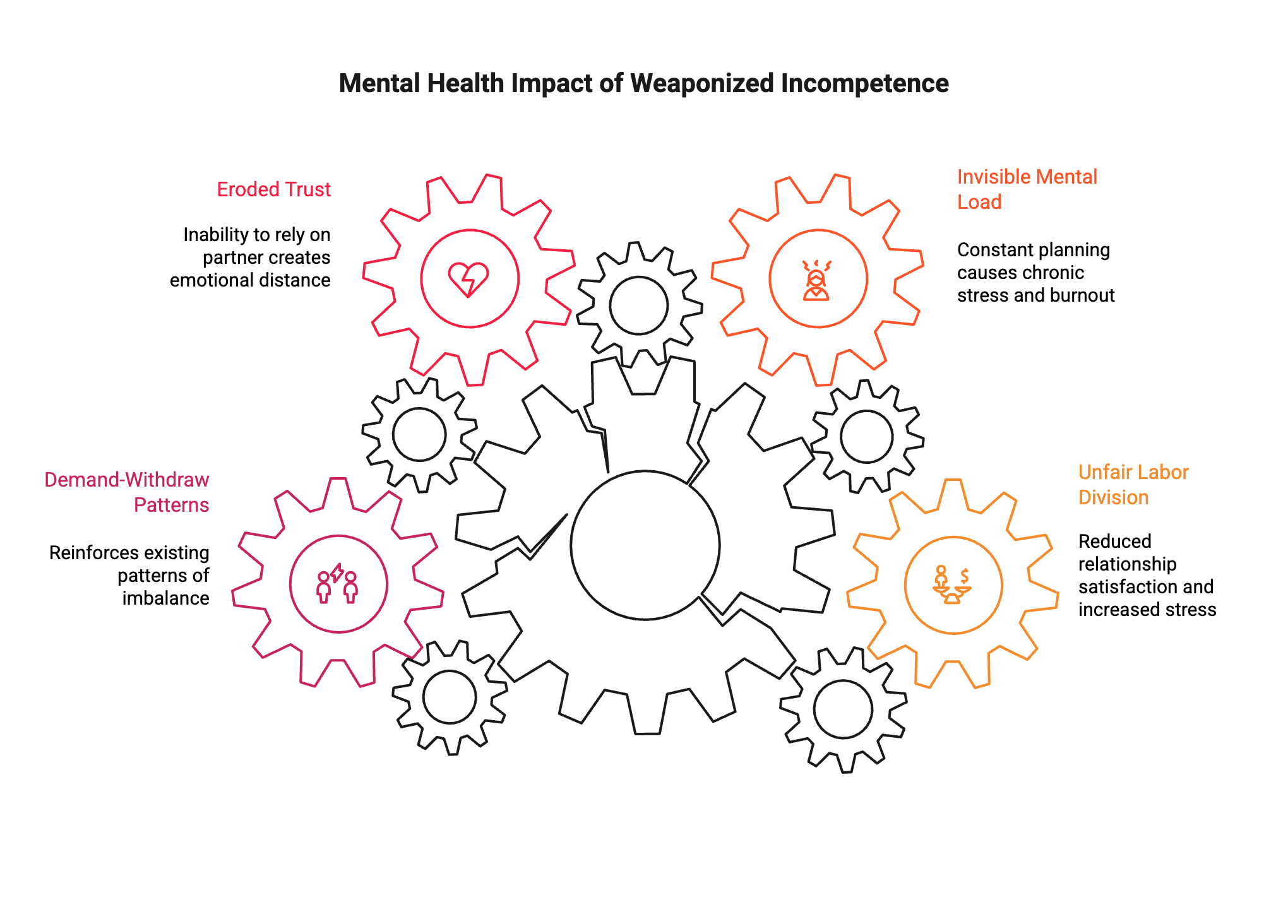
Distance follows. When one person realizes she cannot rely on her partner to manage basic tasks, something closes. Demand-withdraw patterns often develop, where one partner presses for change and the other goes quiet.
Is Weaponized Incompetence Abuse?
Usually not, and the distinction is worth holding carefully, because both halves are true. This is harmful and worth being angry about. It is also, in most cases, avoidance rather than a campaign against you.
It isn’t the same as gaslighting. Gaslighting targets your perception of reality, working to make you doubt what you saw or remember. Weaponized incompetence targets the task list. They can occur together, and when someone insists you never asked, that’s the point where one has become the other.
It can escalate into emotional manipulation. When someone repeatedly uses helplessness to avoid responsibility while criticizing his partner’s standards, the dynamic is no longer about chores. It becomes a way of controlling the pace and priorities of the relationship, and deeper issues often sit underneath. Where it pairs with charm in public and contempt in private, it’s worth reading about covert narcissism.
For most people reading this, though, the situation is the ordinary, exhausting kind, and it responds to a plan.
Tired of being the only one who notices?
Our DC therapists work with the person carrying the load, and with couples ready to redistribute it.
The plan has four parts, and the order matters.
How to Address Weaponized Incompetence
Changing this takes clear communication, the willingness to set boundaries, and follow-through. Four steps, in order.
Name one specific pattern
Naming it only works if the conversation ends somewhere specific, which is the next part.
Assign ownership, not help
Ownership holds only if you stop covering the gap when it slips.
Stop absorbing the consequence
None of that sticks if the underlying arrangement stays the same.
Renegotiate the whole list at once
The language you use during that renegotiation does more than people expect.
What helps in our experience is removing the word “help” from conversations about shared responsibilities. When partners shift from “Can you help with dinner?” to “It’s your night to handle dinner,” the dynamic changes. The word “help” keeps one person in charge of the list.
Behind the wording sits a bigger question: what counts as fair.
What a Fair Division Actually Looks Like
Fair rarely means identical. It means both people carry cognitive work, not just execution, and both notice things without being told.
One finding is more useful here than anything else in the research. The household-labor study cited earlier, which linked unfair division to lower satisfaction, also found that feeling appreciated buffers the effect. Couples who felt their contributions were seen reported meaningfully higher satisfaction even when the split stayed uneven. That isn’t permission to leave the imbalance in place. It does mean acknowledgment is doing real work, and that the redistribution and the appreciation have to happen together for either to hold.
Treatment Approaches and When to Seek Help
Couples therapy makes sense when both people want the arrangement to change and conversations at home keep ending in the same argument. It provides a neutral space to work on power imbalances, and Emotionally Focused Therapy in particular examines the attachment patterns underneath the standoff.
Individual therapy makes sense in two situations: when you need to work out what you’re willing to accept before negotiating, and when one person wants to understand why opting out became automatic. Psychodynamic work suits the second, since it examines what purpose the pattern serves.
Expect months rather than weeks. What reliably changes this is redistributed ownership plus sustained acknowledgment. What reliably doesn’t is one difficult conversation, or waiting for the other person to notice on their own.
The bottom line: weaponized incompetence moves the thinking, not just the chores, and it changes when ownership of the whole task, including the remembering, moves with it.
If you’re in DC, you can see our therapists or get in touch. The first appointment is a full therapy session, not a screening call. The goal isn’t winning the argument about the dishwasher. It’s getting to a Tuesday where nobody has to have it.
Stop being the only one keeping track
Our DC clinicians help couples redistribute the load, not just discuss it, and help the person carrying it decide what they're willing to keep carrying.
Last updated: October 2026
This blog is for informational purposes only and does not constitute medical or mental health advice. Always consult with a qualified mental health professional for personalized guidance regarding your specific situation.