Career Change in DC: From “I Feel Stuck” to Real Next Steps
Who this is for
You’re in DC, doing solid work, but the spark is gone. You want a career change without blowing up your life. Maybe you’re starting to feel the effects of job stress and burnout too. This guide gives you a simple plan that keeps stress manageable and momentum steady. Try stress‑management basics like routines, movement, and short mindfulness breaks to steady your nervous system while you plan; evidence from workplace stress interventions shows these simple steps help.
TL;DR: What are the first three moves?
- Name the problem. Are you facing burnout, a values misfit, or a growth ceiling? Getting the problem right makes changing careers less chaotic.
- Map transferable skills to 2–3 target roles. Translate your projects into job description language with clear outcomes and metrics.
- Run one low‑risk experiment this month. Try an informational interview, a 4–6 hour micro‑course, or a tiny portfolio project; even brief programs can help with improved stress and sleep.
Many people change careers because they are looking for personal fulfillment and a better alignment with their passions, making it crucial to identify what truly matters to you.
What does “feeling stuck” usually mean—burnout, misfit, or both?

Feeling stuck often blends overload and cynicism with values misalignment or stalled career progression. Work‑related conditions can raise mental‑health risks, so pairing your search with supportive habits is wise; see this synthesis on work‑related mental‑health risks and actions. When symptoms flare—poor sleep, low mood, foggy focus—start with right‑sized routines and boundaries, then explore options. Identifying and managing emotions during the transitional period is an essential part of the career change process, helping you stay grounded and focused.
How do I clarify my values and direction without navel‑gazing?
Try a 20‑minute values sprint:
- Write: list 8–10 things that matter (mission, learning, autonomy, schedule, work life balance, pay band, team culture).
- Rank: pick your top five; mark two non‑negotiables.
- Translate: turn each into a job criterion (e.g., “autonomy” → owns a project end‑to‑end; “learning” → funded training every 6 months).
- Hypothesis: “Given my criteria, I’m exploring [role] in [organization type] to deliver [outcome].”
Clear criteria reduce rumination and help you notice fit. Over time, targeted, skills‑focused changes at work support workplace well‑being improvements.
What are my transferable skills—and where do they fit?
Make a quick skill‑to‑role matrix:
- Inventory: list 5–7 projects with outcomes (saved time, improved quality, raised engagement). Pull the verbs and metrics.
- Translate: mirror the target field’s job description language so a recruiter sees the match.
- Map: current role → adjacent roles → new career paths where your transferable skills apply.
How do I test a new path without quitting my job?
Use low‑risk experiments to gather real‑world data before a leap:
- Informational interviews: ask about outcomes, tools, and day‑to‑day. Log what energizes you.
- Shadow/volunteer/board work: tiny slices of the work, not a second job.
- Micro‑courses (4–6 hours): pick one narrow skill this week.
- Portfolio mini‑projects: small, scoped artifacts that prove you can learn fast.
4‑week test plan
- Week 1: one informational interview.
- Week 2: one micro‑course.
- Week 3: one mini‑project.
- Week 4: reflect—did your energy rise or fall? Keep what worked; drop what didn’t. Small‑step problem‑solving builds coping skills; see research on coping/problem‑solving education.
What does a simple DC‑specific plan look like?
DC has a dense ecosystem—policy, NGOs, think tanks, tech, consulting, health, and research—where changing careers is common. Effective strategies for a career change in D.C. include leveraging local resources, networking, and upskilling to navigate a competitive market. Build a networking flywheel: 3 industry events, 2 warm intros, 1 follow‑up coffee per month. Use outcomes language (stakeholders, metrics, cross‑sector impact) to make your story land. Hunt for roles in public‑interest tech, data‑for‑policy teams, research and impact evaluation, health systems quality improvement, and civic innovation.
How do I tell a credible career‑change story on paper and in person?
- Resume summary: one‑line pitch tied to the target career path.
- Three proof points: quantified outcomes that mirror the job description.
- STAR‑ish bullets: situation → action → measurable result.
- Interview arc: why change, what transfers, how you learn fast, and proof you’ve already started (mini‑projects, coursework).
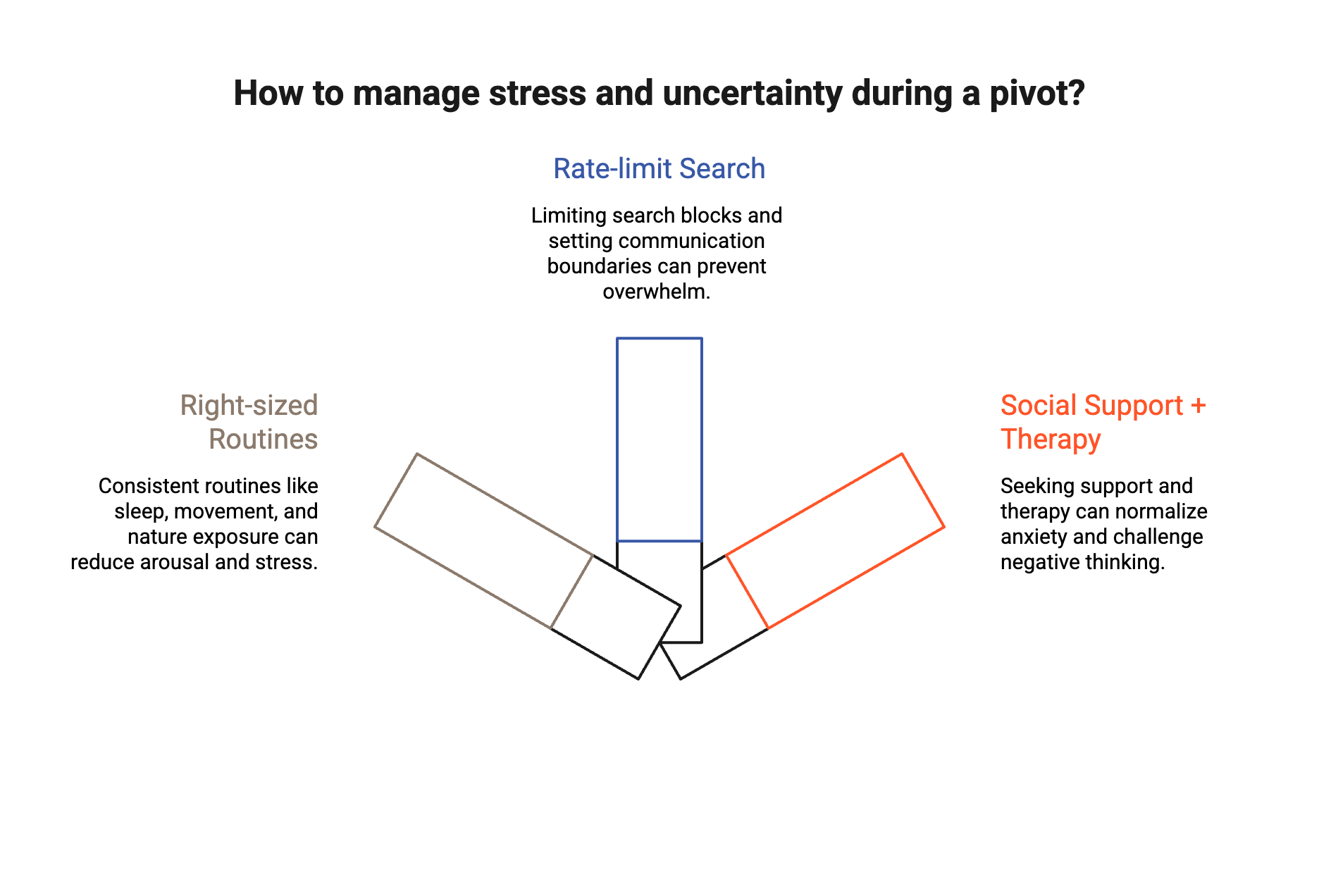
How do I manage stress and uncertainty during a pivot?
- Right‑sized routines: consistent sleep/wake, 20–30 minutes of movement most days, and brief mindfulness or time in nature to downshift arousal; both nature exposure and mindfulness can help.
- Rate‑limit the search: two focused blocks per week beat daily doom‑scrolling; use simple boundaries and safe practices for after‑hours communication.
- Social support + therapy: normalize anxiety, challenge all‑or‑nothing thinking, and use graded exposure for interviews and networking.
Being patient with yourself during a career transition is essential for long-term success and fulfillment, allowing you to adapt and grow at your own pace.
What timeline and budget should I expect?
- Timeline: a typical path is 3 months of explore/test → 3–6 months of transition (applications, interviews, ramp‑up).
- Upskilling budget: start with low‑cost steps (micro‑courses, mini‑projects) before pricier certifications or going back to school.
- Financial runway: build a cushion or use a phased transition to protect job satisfaction and stability.
When should I talk to a therapist in DC—and how can therapy or career counseling help?
Therapy helps you sort values vs. burnout, steady routines, and make decisions without spiraling. In sessions, we can build a stepwise plan, practice interview exposure, and challenge impostor thoughts—useful skills while switching careers. If you want a partner in the process, our team in Dupont Circle can pair therapeutic support with a practical action plan.
Conclusion: Your next right step
Re‑read the TL;DR and pick one action you can finish this week. Small, steady steps beat heroic sprints. If structure would help, we’re here in DC to support your career change—from feel stuck to next step.
Frequently Asked Questions About Career Change
How can I identify transferable skills when considering switching career paths?
Identifying transferable skills involves reviewing your past experiences and current role to pinpoint abilities such as problem-solving, leadership, and communication that can apply across various industries. Mapping these skills to the job descriptions of your desired field helps you understand where your strengths fit in a new career.
What practical steps should I take during the transition period to a rewarding career?
During the transition period, focus on setting clear long-term goals, researching educational requirements, attending industry events, and networking to gain valuable insights. Volunteering or taking online courses can also help you build experience and knowledge in your new field.
How important is financial stability when planning a career change?
Financial stability is crucial when switching careers as it allows you to manage potential pay cuts and invest in necessary education or training. Building a financial cushion before making the leap can reduce stress and give you the flexibility to pursue entry-level positions or internships in your new industry.
Can a career coach help me find the right track in a new field?
Yes, a career coach can provide personalized guidance, help you create a compelling story about your career progression, and assist in identifying opportunities that align with your personal values and long-term goals. They can also support you in navigating the job market and preparing for interviews.
How can networking accelerate my career shift?
Networking allows you to connect with professionals in your desired field, attend industry events, and conduct informational interviews. These interactions provide valuable information about job opportunities, company cultures, and skills in demand, helping you make informed decisions and build relationships that can lead to job offers.