Therapy for IMF Economists in DC: Managing High-Stakes Decision-Making Stress and Perfectionism
Working at the International Monetary Fund in Washington DC means making decisions that affect entire economies. Whether you’re managing country programs, analyzing sovereign debt crises, or preparing technical briefings for member nations, the pressure to be perfect is constant. For many IMF economists, this workplace stress goes beyond normal job demands—it can develop into occupational stress that affects mental health, decision-making quality, and overall well-being. If the high-stakes nature of your work is taking a personal toll, therapy for IMF economists can provide evidence-based support for managing both the stress and the perfectionism that often comes with it.
What Is High-Stakes Decision-Making?

High-stakes decisions involve significant consequences that are difficult or costly to reverse once made. In the context of IMF work, these decisions might include recommending fiscal policies during a debt crisis, structuring loan conditions for a struggling economy, or making technical assessments that influence billions in financial flows. The distinguishing feature isn’t just importance—it’s that outcomes are uncertain, consequences affect many people, and there’s limited room for error.
Research on decision making under stress shows that psychological stress changes how people think and make choices. Under pressure, decision makers may become more cautious, rely more heavily on mental shortcuts, or focus excessively on immediate consequences rather than long-term impacts. The way stress affects decision making depends on individual factors like how your body responds to stress hormones, the specific type of decision, and the context you’re working in.
For IMF economists, this creates a difficult cycle: the importance of your work creates stress, which can then compromise the quality of the very decisions you’re trying to make. Understanding this pattern is the first step toward managing it more effectively. Scientific evidence suggests that preparation and awareness of psychological factors can reduce the negative effects of stress on human decision making.
In our work with high-achieving professionals in DC, we consistently see a particular pattern: the same meticulous attention to detail that makes someone excellent at technical analysis can become a burden when applied to every aspect of work. Economists who can model complex fiscal scenarios often struggle to distinguish between decisions that truly require perfection and those that simply need to be good enough. This inability to calibrate standards situationally creates constant low-level stress that accumulates over time.
How Does Stress Influence Decision-Making?
Stress impairs decision-making by shifting cognitive processing from thoughtful, goal-directed analysis to faster, habit-based responses. When you’re under acute stress during mission work or country program negotiations, your brain prioritizes speed over accuracy. You might find yourself relying more on confirmation bias—seeking information that supports what you already believe—or depending too heavily on heuristics that can lead to errors in complex economic analysis.
The effects of psychological stress on decision making include:
- Changes in risk assessment
- Reduced ability to consider multiple perspectives simultaneously
- Increased focus on selective cues rather than comprehensive evaluation
During stressful working conditions, you may notice yourself making more impulsive choices or becoming overly conservative when innovative thinking is needed. Cognitive biases like confirmation bias are exacerbated by stress, leading to misjudgments in the decision making process.
This doesn’t mean you’re failing at your job. It means you’re human, and your brain is responding to perceived threat the way evolution designed it to. The challenge is that sovereign debt crises require exactly the kind of careful, multi-factor analysis that stress makes harder to access. Under stress, decision makers may excessively focus on immediate consequences rather than long-term impacts, which affects the quality of policy recommendations.
What Is Occupational Stress for Economists?
Occupational stress is a chronic condition associated with ongoing psychological pressure from your work environment. It’s different from the normal stress of a busy week—it’s the persistent feeling that your job demands exceed your resources to meet them, sustained over time. Learn more about the different types of stress and how they affect your well-being.
For economists at international financial institutions, professional stress often stems from:
- Limited opportunities for advancement or future employment prospects
- Conflicts between departments
- Intense scrutiny when working on country programs
The research shows that workplace conflicts may affect men in these roles particularly strongly, though stress impacts all genders. When you feel unsupported by supervisors or colleagues while managing psychologically demanding jobs, occupational stress increases. Job stress increases when workers feel they lack control over their work process or when management style creates uncertainty.
High job demands combined with low decision latitude—feeling like you have enormous responsibilities but limited control over how you meet them—creates what researchers call “job strain.” This pattern is common in IMF work, where you’re accountable for technical precision on issues with massive stakes, but you’re also operating within rigid institutional frameworks and political constraints. Stressful job conditions can lead to poor work performance and higher absenteeism over time.
What Are Common Symptoms of Occupational Stress?
The symptoms of occupational stress appear in three domains: physical health, mental health, and work performance.
Physically, you might experience:
- Headaches, digestive problems, muscle tension
- Trouble sleeping or changes in appetite
- Increased risk of health problems over time
Repeated stress responses can affect the body’s systems, including cardiovascular health. Job stress may contribute to developing psychological symptoms like persistent anxiety and low mood.
Psychologically, warning signs include persistent anxiety about work even during off-hours, difficulty concentrating, irritability, feeling emotionally drained, or losing interest in activities you used to enjoy. Many economists describe a sense of dread before missions or country reviews, or find themselves ruminating about technical details late into the night.
At work, you might notice declining performance despite working longer hours, increased absenteeism, or trouble making decisions that used to feel straightforward. The perfectionism that helped you succeed academically can intensify under stress, creating unrealistic standards that make every policy brief feel inadequate and every presentation feel high-risk.
If these symptoms sound familiar, you’re not alone. Occupational health research shows that work-related mental health conditions are common across demanding professions, and they respond well to intervention when addressed early.
Why Is Perfectionism So Common Among IMF Economists?
Perfectionism means setting extremely high standards for yourself and being overly critical when you don’t meet them. In international financial work, perfectionism often starts as an asset—attention to detail matters when you’re modeling fiscal sustainability or drafting loan conditions. But perfectionism becomes problematic when it shifts from striving for excellence to fearing any mistake, no matter how small.
The culture at institutions like the IMF can reinforce perfectionism. When your analyses inform decisions about national economies, when every technical note gets scrutinized by senior management, and when the consequences of errors feel enormous, it’s natural to become hypervigilant about being right. Add in the competitive environment, the pressure to publish in top journals, and the expectation of technical mastery across multiple domains, and perfectionism flourishes. Societal expectations for technical precision in international financial work create additional pressure.
Perfectionism correlates with anxiety, depression, burnout, and reduced well-being. It creates a constant state of stress that affects both decision making quality and mental health. Perfectionism responds well to treatment when addressed with evidence-based approaches.
What Treatments Work for Perfectionism and Stress?
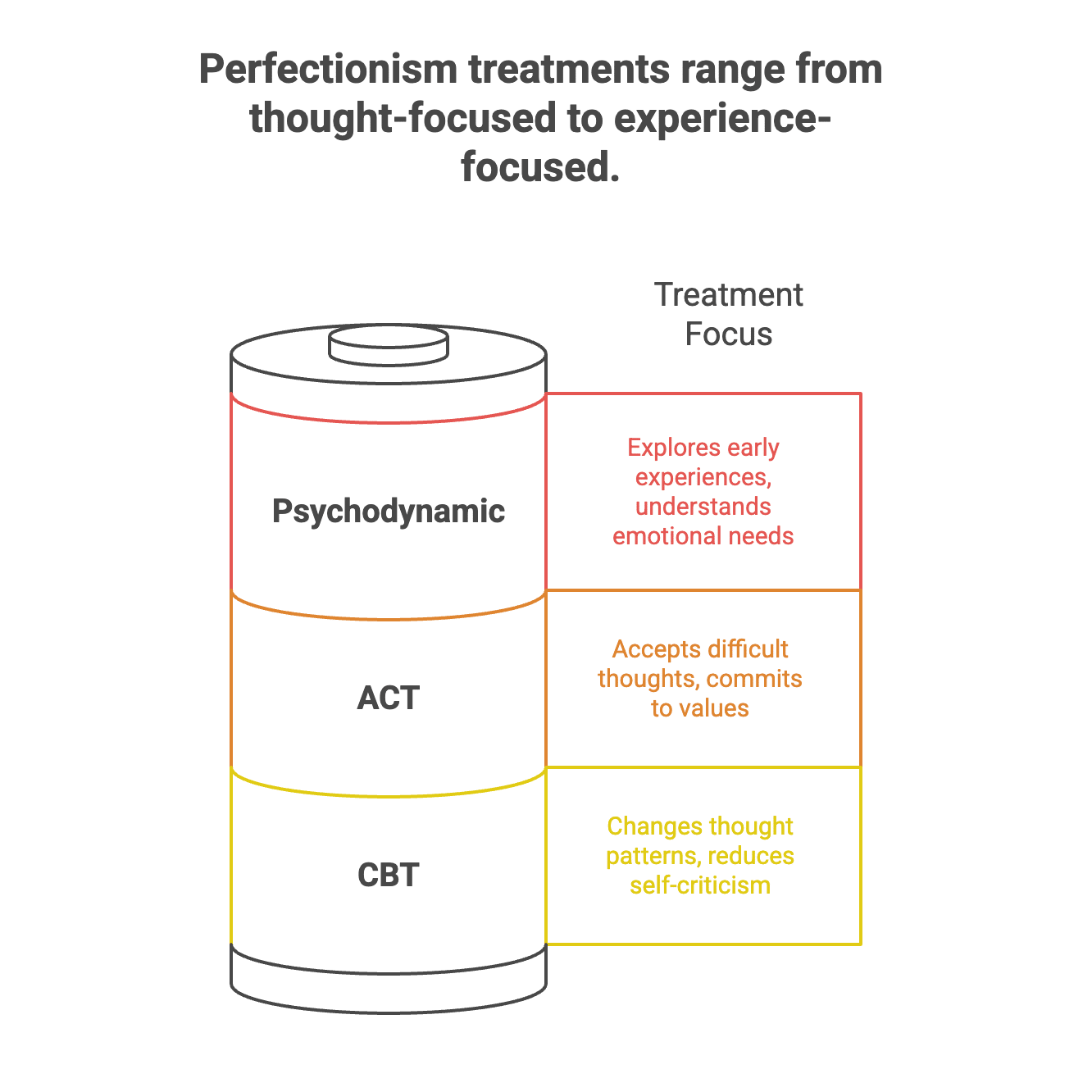
Cognitive-Behavioral Therapy (CBT) is well-researched and effective for treating perfectionism. CBT for perfectionism helps you recognize and change the thought patterns that maintain unrealistic standards and harsh self-criticism. In therapy, you’ll learn to identify perfectionist thinking—like believing that anything less than flawless work is failure, or that your worth depends on never making mistakes.
CBT for perfectionism can be delivered individually, in groups, or through online programs, all of which show significant reductions in perfectionism, anxiety, and depression. For busy professionals, the flexibility of different formats means you can find an approach that fits your schedule, whether that’s weekly sessions in Dupont Circle or guided self-help between missions.
Acceptance and Commitment Therapy (ACT) focuses on accepting difficult thoughts and feelings rather than fighting them, while committing to actions aligned with your values. ACT for perfectionism helps you maintain high professional standards without letting perfectionism control your emotional life or impair your decision making.
Psychodynamic therapy offers a different approach by exploring how early experiences and relationship patterns contribute to perfectionism. Group psychodynamic therapy has shown effectiveness for adults with perfectionism, helping people understand the deeper emotional needs that drive their need for flawlessness. This approach can be particularly valuable for economists whose perfectionism connects to identity, self-worth, or unresolved expectations from their academic or family history.
We often tell clients in our practice that choosing a therapy approach isn’t about finding the “perfect” treatment—which itself can be a perfectionist trap. CBT works efficiently for changing specific thought patterns, while psychodynamic therapy helps when perfectionism is deeply tied to identity or early relationships. ACT can be particularly useful for professionals who need to maintain high standards while reducing the emotional suffering that perfectionism creates. The most important factor is finding an approach and therapist that fit your specific needs and circumstances.
For stress management more broadly, workplace interventions that combine organizational changes with individual support show strong outcomes. This might include working with your supervisor to clarify job roles and define workers roles more clearly, adjusting workload expectations during intense mission periods, or using employee assistance programs alongside therapy. Employee assistance programs provide counseling for both work and personal problems and serve as a protective factor against job stress.
Effective intervention strategies to reduce job stress include job redesign, which is considered a primary prevention strategy. Organizations can implement stress prevention activities by improving communication to reduce uncertainty, providing management education on recognizing warning signs of stress, and establishing work schedules that allow for adequate recovery time. Stress prevention programs can reduce workplace stress when they address both individual coping and organizational factors.
Some approaches don’t help. Research on exposure-based treatments found that deliberately making mistakes as a treatment strategy may actually increase distress for people with perfectionism, rather than reducing it. Effective therapy focuses on changing your relationship with mistakes, not forcing yourself to make them.
What Can You Do Right Now?
While therapy provides the most comprehensive support for managing occupational stress and perfectionism, several strategies can help immediately:
Practice self-compassion. When you make an error in analysis or receive critical feedback, talk to yourself the way you’d talk to a respected colleague in the same situation. Self-criticism doesn’t improve performance—it just adds stress.
Set realistic standards. Not every briefing needs to be perfect. Some deliverables require precision; others need to be good enough and timely. Distinguishing between the two reduces unnecessary pressure.
Protect recovery time. High job demands require real rest. Exercise, sleep, and activities unrelated to economics aren’t luxuries—they’re essential for maintaining the cognitive function that high-stakes decision making requires. Worker health depends on adequate recovery between periods of intense demand.
Establish boundaries around work life. Preventing stress requires protecting time away from work demands. Even US workers in demanding roles benefit from clear separation between professional and personal time.
Seek support early. Don’t wait until occupational stress becomes severe. The evidence is clear that learning new ways to think about mistakes and self-worth leads to better well-being and reduced stress. Organizations that implement interventions early see better outcomes than those that wait until workers experience significant health problems.
We approach perfectionism in therapy with a clear understanding: the goal isn’t to eliminate high standards or reduce your professional excellence. Instead, we work to separate your self-worth from your performance, help you distinguish between contexts that truly require perfection and those that don’t, and build resilience for handling the inevitable mistakes that come with complex work. This allows you to maintain your effectiveness while reducing the constant stress and self-criticism that perfectionism creates.
Getting Started with Therapy in Dupont Circle
If workplace stress or perfectionism is affecting your quality of life or decision-making capacity, consider reaching out for professional support. The therapists at Therapy Group of DC understand the unique pressures facing international financial professionals in Washington. We work with clients managing high-stakes responsibilities, helping them develop healthier relationships with work stress while maintaining the high standards their careers require. Schedule an appointment to get started.
Disclaimer: This article is for educational purposes only and is not a substitute for professional medical advice, diagnosis, or treatment. Always seek the advice of your physician or qualified mental health provider with any questions you may have regarding a medical or mental health condition. If you are in crisis or experiencing thoughts of self-harm, please call 988 (Suicide and Crisis Lifeline) or go to your nearest emergency room.