Alexithymia, Plainly: Why Feelings Feel Fuzzy
Snapshot
Who this helps: If you feel something is off emotionally but can’t name it—or you love someone who seems that way—this is for you.
What we’ll cover: What alexithymia is, how it shows up day to day, starter skills, and how therapy at the Therapy Group of DC can help.
What Is Alexithymia?

Alexithymia means you have difficulty identifying and describing your emotions. This condition is sometimes referred to as emotional blindness, highlighting the challenge in recognizing and expressing feelings. The feelings are often there—the words are missing. Researchers describe it as a disconnect between emotion, language, and awareness, not a lack of caring. About 10% of the general population experiences alexithymia. For a clear overview, see an integrative review.
The alexithymia construct exists as a theoretical model that encompasses difficulties in emotional awareness, with multiple models—such as the Toronto model—providing frameworks for understanding it. It’s not a diagnosis on its own. It can show up alongside depression or anxiety, autism spectrum traits, trauma histories, or medical/neurologic issues.
Neurological disorders alexithymia is a recognized phenomenon, with alexithymia being common in conditions like traumatic brain injury and Parkinson’s disease. Developmental alexithymia is distinguished as a stable personality trait that emerges early in life, influenced by genetic factors, and contrasts with acquired forms that result from neurological injury or trauma.
Alexithymia is commonly linked with autism spectrum disorder (ASD), where about 50% of individuals with ASD show clinically significant alexithymia. A neuroscientific perspective maps how attention, interoception (body awareness), and emotion systems interact in alexithymia.
Quick Self‑Check (not a diagnosis)
- I often label myself as “I’m fine,” even when I feel off.
- I notice body sensations (tight chest, knots in my stomach), but can’t link them to a feeling.
- I struggle to explain what I need during conflict.
- Decisions feel foggy because my internal signals are hard to read.
- People say I’m distant or hard to read.
- I prefer facts and fixes over talking about feelings.
This checklist isn’t a diagnosis, just a starting mirror.
Why It Happens (and Common Mix‑Ups)
Overlap vs. identity. Alexithymia isn’t an illness by itself; it can co‑occur with other conditions or life experiences. That’s partly why it’s easy to miss. Alexithymia often co-occurs with affective disorders and mood disorders, such as depression and anxiety. Men may be more likely than women to experience alexithymia, according to some studies.
A large integrative review shows consistent links between alexithymia and difficulties in emotion processing across studies. There are different levels of alexithymia, and severity can vary among individuals, with higher levels linked to greater difficulties in emotional awareness.
Language matters. Many people with alexithymia have a smaller emotion vocabulary and lower emotional granularity—they can’t separate “tense,” “irritated,” and “afraid,” so everything blurs into “stress.” Many also display an externally oriented cognitive style, focusing more on external facts than on their internal emotional states. Meta‑analytic work supports this language hypothesis and calls for better assessment of emotion‑word skills.
Common confusions. Being private or stoic, cultural norms about emotional expression, chronic stress, or heavy burnout can look similar on the surface. A neuroscientific overview emphasizes how interoception (reading body signals) and attention shape whether feelings reach words.
How It Shows Up Day to Day
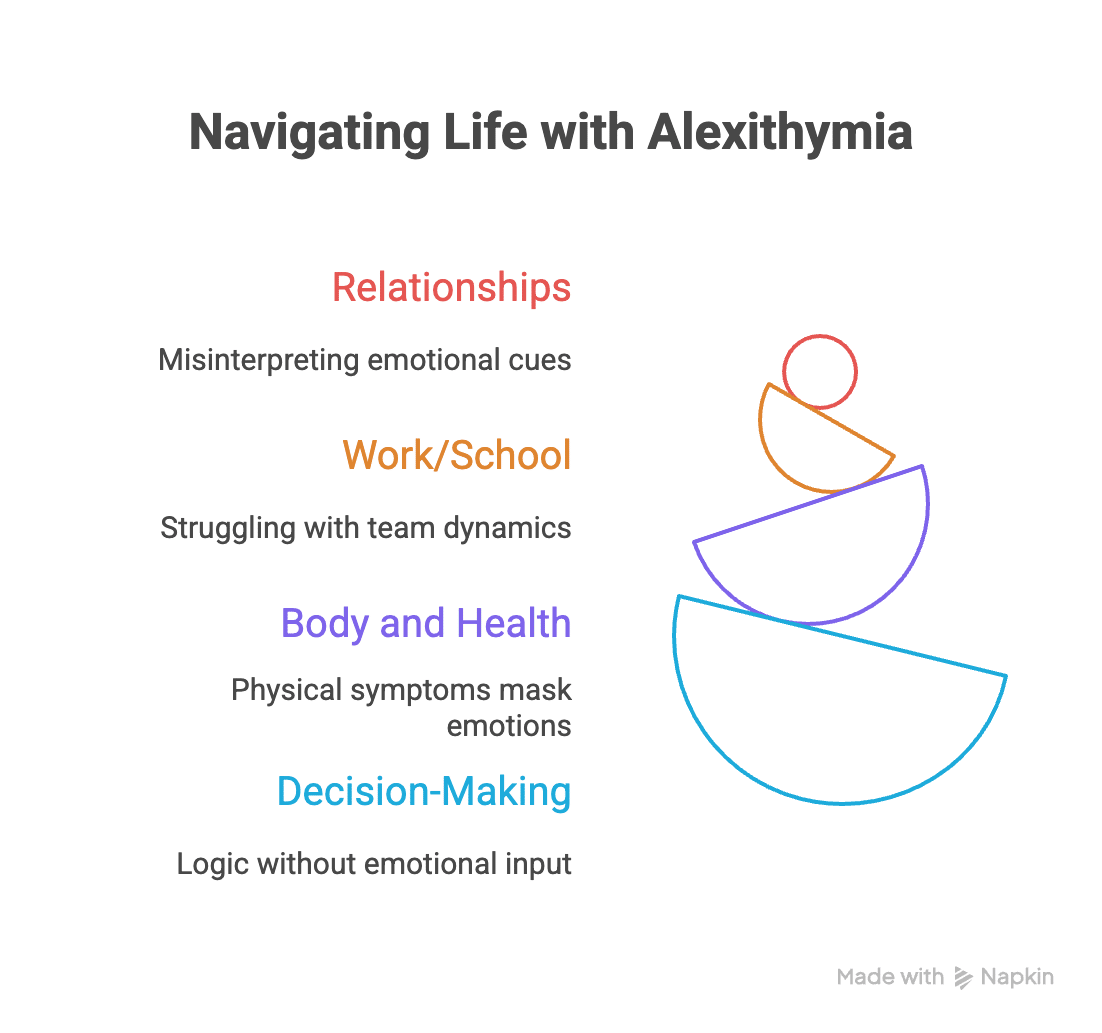
- Relationships: Vague answers (“nothing’s wrong”), shutdowns during conflict, or partners feeling ignored. These are translation problems, not proof you don’t care. People with alexithymia may also have difficulties with emotion recognition and interpreting facial expressions in social situations.
- Work/School: Harder time reading team dynamics, giving or receiving feedback, or choosing when options carry emotional tradeoffs.
- Body and Health: Headaches, GI issues, or a racing heart without a clear story; more reliance on physical clues than emotion labels. People with alexithymia may experience physical sensations and somatic symptoms linked to emotional distress, which can be part of psychosomatic disorders. Neural meta‑analysis shows altered activation in regions tied to emotion processing and regulation.
- Decision‑Making: Without clear emotion signals (fear, sadness, excitement), choices lean on logic alone—useful, but incomplete. Challenges in identifying own emotions and experiencing positive emotions can further impact decision-making and overall well-being.
In daily life, emotional responses may be blunted or hard to interpret, making it difficult to connect feelings to actions or situations.
Try‑This‑First Skills (10–15 minutes a day)
Keep it light and repeatable. Small reps beat big breakthroughs.
- Body → Word Bridge. Pick one sensation (tight chest, heavy shoulders). Guess 2–3 feelings it might signal. Check back later—what fits now?
- Emotion Word Bank. Print a 20‑word list (calm, tense, irritated, hopeful…). Circle one each day that fits, even loosely.
- 3×3 Journal. 3 sentences about what happened → 3 feelings guesses → 3 needs/next steps.
- After‑Action Debrief. After a tough moment, label: event → body → feeling → action. Two minutes, max.
- Partner/Friend Script. Swap “I’m fine” with: “Something’s up. I don’t have the words yet. I think it’s in the worry/anger family.”
Try practicing these skills right after emotionally salient events. This helps you better describe emotions as they arise.
Aim for consistency, not perfection. Think “training a translator,” not chasing insight.
When to Consider Therapy
- Conflicts repeat because you can’t say what’s wrong.
- Your body carries stress but you can’t connect it to feelings.
- You want closer relationships, but feelings talks end in confusion or shutdown.
- You’re navigating burnout, anxiety, trauma, or neurodiversity and need structured support for emotion skills.
How Therapy Helps (What We Do in Session)
- Guided reflection. Slow the story down and zoom in on micro‑moments to catch emotions in the wild.
- Interoception training. Map recurring body–emotion links so signals become legible.
- Language practice. Build a shared vocabulary; try out precise sentences and meanings in session.
- Mindfulness and grounding. Increase signal, reduce noise so subtle feelings aren’t drowned out.
- Therapy can help improve emotional processes by targeting the neural mechanisms involved in emotion recognition and regulation, and address reduced emotional awareness that often follows neurological disorders.
- Role‑play and repair. Rehearse scripts for conflict, asking for needs, and making decisions. Therapy can also address decreased emotional empathy in relationships, supporting better interpersonal understanding and connection.
Tracking Progress
- Use brief check‑ins and a validated alexithymia questionnaire to notice movement over time. You can also use an emotional awareness scale (such as the Levels of Emotional Awareness Scale) to track changes in emotional understanding.
- Wins look like: fewer “I’m fine”s, clearer needs, easier decisions, and fewer blow‑ups or shutdowns.
How Therapy Group of DC Can Support
- We work with adults and couples across DC, including high‑pressure professionals and students.
- Evidence‑based, depth‑oriented therapy that respects privacy, culture, neurodiversity, and lived experience.
- Flexible scheduling; out‑of‑network with superbills for reimbursement.
If alexithymia resonates, we can help you build a practical feelings‑to‑words toolkit—at your pace and in plain language.
Bottom Line
- You’re not emotionless—you’re missing a translator.
- With practice and support, you can turn fuzzy signals into clear words and closer relationships.
- Ready to start? Our team at the Therapy Group of DC is here to help.
Frequently Asked Questions about Alexithymia
What is the Toronto Alexithymia Scale (TAS-20)?
The Toronto Alexithymia Scale (TAS-20) is a widely used self-report questionnaire designed to measure alexithymia. The item Toronto Alexithymia Scale (TAS-20) is a standardized questionnaire used by mental health professionals to assess and identify symptoms of alexithymia. It assesses three core dimensions: difficulty identifying feelings, difficulty describing feelings, and externally oriented thinking. This scale helps researchers and clinicians evaluate the severity of alexithymia traits in individuals.
Can alexithymia be classified as a mental health disorder?
Alexithymia is not classified as a mental health disorder in the Diagnostic and Statistical Manual of Mental Disorders. Instead, it is considered a stable personality trait or dimensional construct that can co-occur with various psychiatric and neurological disorders, such as depression, anxiety disorders, and autism spectrum disorder.
How does alexithymia affect interpersonal relationships?
Individuals with alexithymia often experience challenges in emotional awareness and expressing emotions, which can lead to difficulties in maintaining interpersonal relationships. Reduced emotional empathy and problems with describing emotions may cause misunderstandings and social withdrawal.
What causes alexithymia?
Alexithymia is believed to result from a combination of genetic and environmental factors. Early childhood trauma, adverse environmental factors, and neurodevelopmental differences can contribute to the development of primary alexithymia, while acquired alexithymia may occur following brain injury or neurological disorders. Acquired alexithymia can occur as a result of brain injury or neurological disorders, leading to disrupted emotional awareness.
Is alexithymia linked to other mental health conditions?
Yes, alexithymia frequently co-occurs with various mental health conditions, including depression, post traumatic stress disorder (PTSD), eating disorders, anxiety disorders, depressive disorders, panic disorder, and emotional disorders. Its presence can complicate treatment outcomes and exacerbate symptoms in affected psychiatric and neurological populations.
Autistic people often experience co-occurring alexithymia and related emotional challenges, which can further impact emotional awareness, empathy, and social relationships.
What is the difference between primary and secondary alexithymia?
Primary alexithymia refers to a stable personality trait present from early life, often influenced by genetic and environmental factors. Secondary alexithymia is a temporary or situational condition that arises due to factors such as trauma, brain injury, or psychiatric illness, and may improve with treatment of the underlying cause.
How is alexithymia related to interoceptive awareness?
Alexithymia is associated with deficits in interoceptive awareness, which involves perceiving internal bodily sensations like heart rate and muscle tension. Impaired interoceptive awareness involving cardiac and other bodily sensations can hinder emotional processing and conscious emotional experience.
Can therapy help with alexithymia?
Therapeutic approaches focusing on emotion regulation, mindfulness, and building emotional vocabulary can help individuals with alexithymia improve their emotional awareness and expression. Although alexithymia itself is not a disorder, addressing co-occurring mental health conditions often leads to better outcomes.