The Psychology of Weaponized Incompetence: Why Smart People Play Dumb
If you’ve ever watched one partner “forget” how to load the dishwasher correctly or suddenly become helpless at tasks they manage just fine at work, you may have encountered weaponized incompetence. This guide explores the psychological dynamics behind strategic incompetence in relationships and workplaces. You’ll learn what weaponized incompetence is, why it happens, how to recognize the pattern, and evidence-based strategies to address it.
This guide is for partners, parents, or anyone who feels exhausted by repeated excuse-making or manipulative avoidance of responsibility in shared tasks. Recognizing weaponized incompetence is essential for restoring fairness and trust in both personal and professional relationships.
Weaponized incompetence refers to a behavioral pattern where someone feigns or exaggerates their inability to complete tasks, using their apparent incompetence as a strategy to avoid responsibility. This behavior is extremely common—research shows that women continue to shoulder a disproportionate amount of housework and childcare despite economic gains, and studies find that this inequitable distribution often goes unnoticed by male partners. Understanding weaponized incompetence can help you recognize power dynamics in your relationships and take steps to restore balance before resentment builds.
The concept gained widespread attention through social media discussions about household tasks and relationship fairness, but the behavior exists in both personal relationships and workplace settings. At its core, weaponized incompetence represents a manipulation tactic that shifts the mental load onto others—the emotional and cognitive labor required to manage household and family tasks.
What Is Weaponized Incompetence?

Weaponized incompetence is characterized by three core elements: deliberate poor performance, claimed inability despite capability, and systematic avoidance of learning to escape ongoing responsibility.
Weaponized incompetence is characterized by deliberately performing tasks poorly, claiming inability despite capability, or avoiding learning how to do certain tasks to escape ongoing responsibility. Unlike genuine difficulty with a skill, weaponized incompetence involves someone who is capable but chooses to appear incompetent to manipulate others into taking over.
The behavior makes itself evident through repeated “mistakes” that force someone else to take control. A person avoids responsibility by performing so poorly that others stop asking them to help. Someone might consistently shrink laundry, overcook meals, or “forget” important appointments until their partner takes over these tasks completely.
The key difference between strategic incompetence and actual inability lies in selectivity and resistance. The person typically demonstrates competence in other areas—particularly at work or in activities they enjoy. The incompetence appears selectively for specific tasks they want to avoid. When confronted, someone exhibiting this behavior pattern often resists learning or asking for clear instructions, signaling that avoidance rather than genuine struggle is the issue.
Research on cognitive labor reveals the invisible thinking work behind household management—identifying future needs, making decisions, and tracking progress. This mental load becomes particularly heavy when one person must manage both tasks and another person’s strategic incompetence. A 2024 study found that domestic cognitive labor functions as another form of “doing gender,” with mothers holding most daily family tasks while fathers handle episodic maintenance. Shadow management—where one employee absorbs another’s avoided responsibilities—represents the workplace version, increasing burnout among competent workers.
Understanding what weaponized incompetence looks like in practice helps identify when avoidance patterns have crossed into manipulation.
Why Does Weaponized Incompetence Happen?
The roots of weaponized incompetence lie in avoidance strategies, learned behaviors, power dynamics, and fear of failure—each contributing to patterns that shift responsibility onto others.
Avoidance and Learned Patterns
The primary motivation is a desire to escape unwanted tasks and mental load. By establishing a pattern of incompetence, the person creates a situation where others stop delegating to them. Research on work-family dynamics found that gendered perceptions about flexibility shaped labor division during the pandemic—men’s jobs were discussed as more demanding while women’s work was considered more flexible, justifying unequal task distribution.
Many people exhibiting weaponized incompetence learned these patterns in childhood. Gender socialization plays a significant role—boys are socialized to prioritize individual contributions while girls are taught to support group efforts. This early conditioning manifests as weaponized incompetence in adult relationships, where men unconsciously expect domestic management to be “women’s work.”
Power Dynamics and Control
Weaponized incompetence serves as a form of control by forcing others to take responsibility while the person maintains power over how their time is spent. Research shows that in heterosexual couples, household labor serves as a means of “doing gender”—affirming traditional masculinity through role performance. For some, avoiding domestic duties asserts masculine identity, particularly when earning power is lower than their partner’s.
Not all weaponized incompetence stems from manipulation—some people genuinely fear criticism or failure, leading them to avoid tasks where they might be judged. This defensive incompetence still produces the same result: shifting responsibility to others.
These underlying motivations shape how weaponized incompetence manifests in daily life, from household chores to workplace dynamics.
What Are Examples of Weaponized Incompetence?
Recognizing weaponized incompetence requires looking at patterns rather than isolated incidents. The behavior appears across relationship and workplace contexts with recognizable characteristics.
In Personal Relationships
Household tasks and childcare represent the most common arena. A partner claims they “don’t know how” to operate appliances they’ve used before or performs tasks so poorly (shrinking clothes, burning dinner) that their partner stops asking. In parenting, a father might claim he can’t track kids’ schedules or doesn’t know which pediatrician to call despite managing complex projects at work.
Emotional labor creates another dimension. One partner consistently “forgets” important dates, fails to plan social events, or claims they’re “bad at” maintaining family relationships. The other partner handles all gift-buying, card-sending, and social coordination—the invisible work that maintains connections.
Administrative tasks show the same pattern. A person claims confusion about bills, insurance, or paperwork, forcing their partner to become the household “administrator”—often the same person who manages complex documentation at their job.
In Workplace Settings
Task avoidance damages team dynamics. An employee repeatedly turns in subpar work, misses deadlines, or claims they “don’t understand” instructions, forcing managers or coworkers to redo their work. Research identifies this as the “curse of competence”—talented employees pick up slack, leading to burnout.
Strategic incompetence in collaborative work creates friction. Team members position themselves as unable to use certain software or complete specific tasks. Coworkers absorb this extra work to keep projects moving, creating resentment and workplace friction.
Recognizing these patterns is the first step; the next is distinguishing manipulation from genuine difficulty.
How to Tell If It’s Weaponized Incompetence
Several signs distinguish weaponized incompetence from genuine struggle with a task. The main characteristics include selectivity, resistance, and inconsistency.
Pattern Recognition
Selective incompetence appears as the defining feature. The behavior appears only for specific tasks, not across all domains. Someone who manages complex spreadsheets at work but can’t figure out the washing machine is exhibiting selective incompetence that signals avoidance rather than inability.
Resistance to learning reveals intent. When offered help or clear instructions, the person shows disinterest. They don’t ask questions or take notes. Their incompetence remains static despite opportunities to develop skill, suggesting the incompetence serves a purpose.
Inconsistent performance provides another clue. The person demonstrates capability occasionally but reverts to incompetence when it would result in ongoing responsibility. This pattern reveals that ability exists but is selectively deployed.
Communication Patterns
Certain phrases signal weaponized incompetence and shift responsibility:
- “You’re just better at it” positions the other person as naturally suited, implying it would be inefficient to learn
- “I’ll probably just do it wrong” uses pre-emptive self-deprecation to discourage delegation
- “Just tell me what to do” transfers the mental load while appearing cooperative
- “I thought you wanted to do it” reframes avoidance as deference
Using “help” to describe taking responsibility reflects unequal dynamics. When someone says they’ll “help” with their own children or “help” with shared household tasks, they’re positioning themselves as an assistant rather than an equal partner.
Behavioral Indicators
The behavior creates increasingly unequal workload distribution over time. Attempts to address the imbalance result in defensiveness or blame-shifting rather than genuine change. When natural consequences occur (missed appointments, incomplete tasks), the person shows little concern or urgency to prevent recurrence—they’ve successfully transferred responsibility to someone else.
These patterns create significant psychological consequences for everyone involved.
The Impact of Weaponized Incompetence on Mental Health
The psychological toll extends beyond day-to-day frustration to serious mental health consequences for both the person carrying the load and the relationship itself.
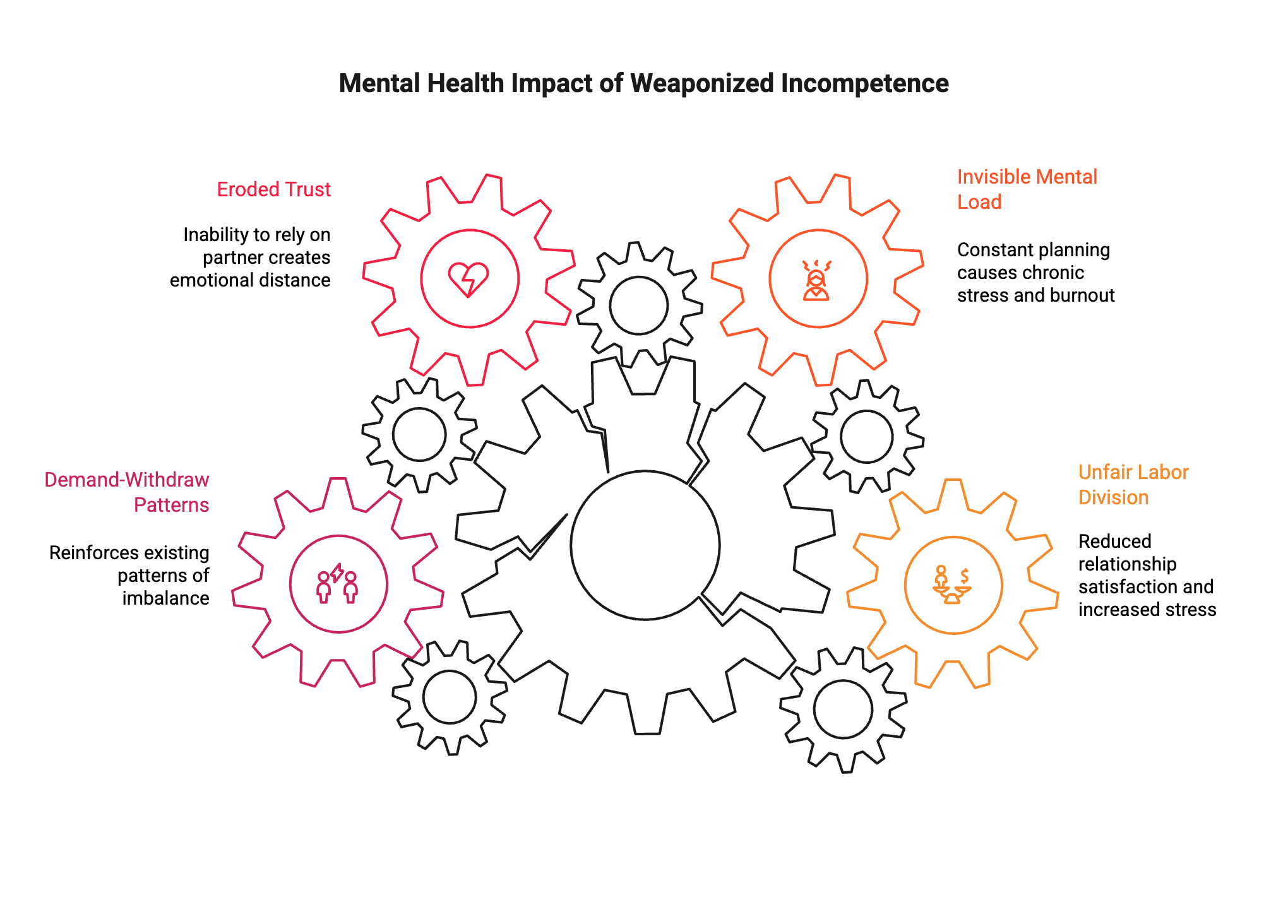
Research confirms that perceptions of unfair household labor division relate to reduced relationship satisfaction. The mental load creates particular strain because it’s invisible—others don’t see the constant planning and organizing required.
The person managing weaponized incompetence often experiences chronic stress and burnout from carrying both physical work and cognitive burden. Resentment accumulates and erodes relationship trust. Over time, feeling like the default parent or household manager breeds resentment that damages intimacy. Women carrying disproportionate mental load face lower career advancement—a 22-year study found household labor negatively influenced women’s (but not men’s) career promotion.
A pattern we notice in our practice is how resentment accumulates silently before exploding. Clients present with what seems like sudden crisis, but detailed history reveals years of weaponized incompetence creating invisible strain. The final straw is rarely about the unwashed dish—it’s about the accumulated weight of unacknowledged burden.
Weaponized incompetence damages trust fundamentally. When one partner realizes they cannot rely on the other to manage basic responsibilities, it creates emotional distance. In workplaces, it creates friction and contributes to employee burnout. Demand-withdraw communication patterns often develop—one partner demands change while the other withdraws, reinforcing existing patterns.
Addressing these dynamics requires direct confrontation and clear strategies.
How to Address Weaponized Incompetence
Confronting weaponized incompetence requires clear communication, firm boundary setting, and sometimes professional support. The approach differs between personal and workplace contexts.
In Personal Relationships
Name the pattern directly. Have a focused conversation about specific behavior: “I’ve noticed that when I ask you to handle doctor’s appointments, you say you’ll do it but then don’t follow through. This leaves me managing the kids’ healthcare again.”
Set clear expectations. Define task ownership explicitly. Rather than asking for “help,” establish that certain responsibilities belong to specific people. Create accountability systems like shared calendars that make responsibilities visible.
Allow natural consequences. Stop rescuing the person from their incompetence. If they don’t complete a task, let them experience the consequence (within reason).
Refuse to accept poor performance as unchangeable. When one partner claims they’re “just not good at” something, respond with: “That’s why practice matters. Here are resources to help you develop this skill.”
What helps in our experience is removing the word “help” from conversations about shared responsibilities. When partners shift from “Can you help with dinner?” to “It’s your night to handle dinner,” the dynamic changes. Language clarifies ownership and reduces the mental load.
In Workplace Settings
Organizations can address strategic incompetence through structured approaches. Establish clear performance expectations documented in job descriptions. When employees claim inability, provide specific training and set improvement timelines. Create accountability systems through regular check-ins and project management tools. Protect high-performing employees from absorbing others’ responsibilities to prevent burnout. If incompetence persists despite resources, address it as a performance issue.
When self-help strategies aren’t sufficient, professional intervention can provide tools and support for lasting change.
Treatment Approaches and When to Seek Help
Professional intervention can help address both the behavior and the relationship damage it creates. Multiple therapeutic approaches offer pathways to resolution.
Couples therapy provides a neutral space to address power imbalances and communication breakdowns. A therapist can help partners recognize patterns, understand underlying motivations, and develop more equitable systems. This becomes particularly valuable when conversations consistently devolve into conflict.
For individuals exhibiting weaponized incompetence due to anxiety or learned patterns, Cognitive Behavioral Therapy (CBT) addresses thought patterns that maintain avoidance. Emotionally Focused Therapy (EFT) examines how attachment patterns drive relationship dynamics. Psychodynamic Therapy explores how early experiences shaped current patterns for those whose behavior stems from childhood family dynamics.
In professional settings, coaching can help employees develop avoided skills, while mediation addresses damaged team dynamics.
What You Can Do About Weaponized Incompetence
If you’re experiencing weaponized incompetence, effective strategies include:
- Document patterns clearly through records of task distribution and repeated “mistakes”
- Set and maintain firm boundaries by refusing to accept poor performance or take over tasks that aren’t your responsibility
- Communicate directly about inequity by naming the behavior and expressing how it affects you
- Stop compensating for incompetence and allow natural consequences to occur
- Seek professional support when needed through therapy or workplace mediation
Addressing weaponized incompetence requires persistence and clear boundary setting, but relationships and workplaces can shift toward greater equity when patterns are confronted directly.
Ready to Address Relationship Imbalances?
If you’re struggling with weaponized incompetence in your relationship or need support managing the mental load, therapy can help. Our therapists specialize in couples dynamics, communication patterns, and relationship equity issues.
This blog provides general information and discussions about mental health and related subjects. The content is not intended to be a substitute for professional medical advice, diagnosis, or treatment. Always seek the advice of your physician or other qualified health provider with any questions you may have regarding a medical condition.