Recovering from Perfectionism: A Guide for High-Functioning Achievers

Recovering from perfectionism is possible—and you don’t have to sacrifice your high standards to do it. This guide is for high-achieving professionals in Washington, DC who recognize that their drive for excellence has become painful. You’ll learn the difference between healthy striving and maladaptive perfectionism, evidence-based treatment approaches, and how therapy can help you maintain success without suffering.
Perfectionism is more than wanting to do well. Perfectionism involves setting extremely high standards, harsh self-criticism when you don’t meet those standards, and constant worry about making mistakes. Research shows perfectionism is strongly linked to anxiety, depression, and burnout—yet many high-functioning individuals struggle alone, believing their perfectionist tendencies make them successful.
The truth is that perfectionism often holds you back more than it helps. Studies show that psychotherapy can significantly reduce perfectionism while improving quality of life, with 44-80% of people experiencing meaningful improvement after treatment. Recovering from perfectionism doesn’t mean lowering your standards—it means releasing the harsh self-criticism and impossible expectations that cause suffering.
Can You Recover from Perfectionism?

Yes, recovering from perfectionism is absolutely possible, and research shows that several types of psychotherapy produce significant, lasting improvements. Multiple randomized controlled trials demonstrate that people who complete treatment for perfectionism experience large reductions in perfectionistic thinking and behaviors maintained for months after therapy ends.
The most extensively studied approach is psychodynamic therapy for perfectionism, which focuses on understanding the deeper patterns and relationships that fuel your perfectionism. Research shows that both Dynamic-Relational Therapy and Psychodynamic Supportive Therapy produce significant improvements in perfectionism levels, with particular benefits for self-oriented perfectionism (the pressure you place on yourself) and reducing the tendency to hide imperfections from others.
Evidence-Based Treatment Approaches
Other approaches also show strong evidence. Cognitive behavioral therapy and acceptance and commitment therapy for perfectionism help you identify and change perfectionistic thoughts while accepting imperfection and focusing on what truly matters. Compassion-focused therapy specifically targets the shame and self-criticism that often accompany perfectionism.
What makes it possible to overcome perfectionism is that perfectionism isn’t a fixed personality trait—it’s a learned pattern. Many perfectionists fear that without harsh self-criticism, they’ll become lazy. Research shows the opposite: overcoming perfectionism often increases productivity because you’re no longer paralyzed by fear of failure.
Adaptive vs. Maladaptive Perfectionism
Not all perfectionism is harmful. Adaptive perfectionism (setting high but flexible standards) encourages growth. Adaptive perfectionists set high standards but adjust expectations based on the situation. They see making mistakes as part of the learning process and maintain self-worth independent of achievement.
Maladaptive perfectionism (rigid, self-critical standards) leads to stress, self-criticism, and burnout. Maladaptive perfectionists hold themselves to rigid standards with little regard for circumstances. They experience fear of failure intensely and often avoid tasks they fear they can’t complete perfectly. Their self-worth is tightly tied to achievement. The fear of failure is a significant factor that keeps perfectionists stuck—when you stop equating your self-worth with achievements, recovering from perfectionism becomes possible.
Maladaptive perfectionism often develops as a trauma response (a protective coping strategy) against the pain of perceived failure, blame, or shame. Perfectionism can create a cycle of self-criticism and low self-esteem that’s difficult to break without support.
Working with DC professionals, we see how perfectionism often masquerades as “high standards” in a city that rewards achievement. The shift happens when clients recognize that their harshest critic isn’t their boss or colleagues—it’s the voice inside their own head. Recovery means learning to pursue excellence from a place of self-respect rather than fear.
Understanding the difference between adaptive and maladaptive perfectionism is essential, but it’s equally important to recognize how perfectionism relates to other mental health conditions. This knowledge helps explain why professional treatment can be so effective.
What Mental Disorder Is Associated with Perfectionism?
Perfectionism isn’t a mental disorder itself, but it’s strongly linked to several mental health conditions and can significantly increase your risk of developing them. Understanding these connections helps explain why addressing perfectionism is so important for your mental and physical health.
Common Mental Health Conditions Linked to Perfectionism
Maladaptive perfectionism is closely associated with anxiety disorders, depression, obsessive-compulsive disorder, eating disorders, and burnout. The relationship with anxiety and mental health is particularly strong: perfectionism fuels anxiety through constant worry about making mistakes and fear of failure, while anxiety reinforces perfectionistic behaviors.
Perfectionism and obsessive-compulsive disorder (OCD) share several features, including rigid thinking patterns, difficulty tolerating uncertainty, and compulsive behaviors aimed at preventing feared outcomes. While not all perfectionists have OCD, perfectionistic tendencies are common in people with the disorder.
How Perfectionism Impacts Mental Health and Well-Being
When you consistently fall short of unrealistic expectations, the resulting self-criticism can lead to depression and low self-esteem. The chronic stress of maintaining impossibly high standards also leads many perfectionists to burnout—physical and emotional exhaustion that reduces effectiveness and drains joy.
Perfectionism can negatively impact your mental health and daily life. In a world that rewards achievement, it’s easy to confuse healthy striving with harmful perfectionism. The key difference is how perfectionism affects your well-being and ability to enjoy life beyond accomplishments.
We often work with high-achieving clients who don’t realize their anxiety is fueled by perfectionism. They’ll describe constant worry about work performance or relationship “mistakes,” not recognizing that the real problem isn’t the external demands—it’s the impossible internal standards they’re holding themselves to. Once we address the perfectionism, the anxiety often improves significantly.
Having perfectionist tendencies doesn’t mean you have a mental disorder. However, when perfectionism becomes maladaptive—causing significant distress or interfering with your functioning—professional support can make a substantial difference. Therapy addresses both the perfectionism and its associated mental health symptoms, helping you develop healthier patterns.
Once you understand how perfectionism affects your mental health, the next step is learning practical strategies to overcome it. Here’s how therapy helps you make lasting changes.
How to Fix Being a Perfectionist?
Overcoming perfectionism involves challenging unrealistic thoughts, setting realistic standards, and practicing self-compassion—and therapy provides the structure and support to make these changes last. While self-help strategies can be useful, research shows that working with a therapist trained in perfectionism treatment produces the most significant results.
To overcome perfectionism, recovery begins with recognizing perfectionistic thoughts and perfectionistic behaviors as they happen. Therapy helps you explore the root causes of your perfectionism, which often trace back to childhood experiences or cultural factors that taught you your worth depends on achievement.
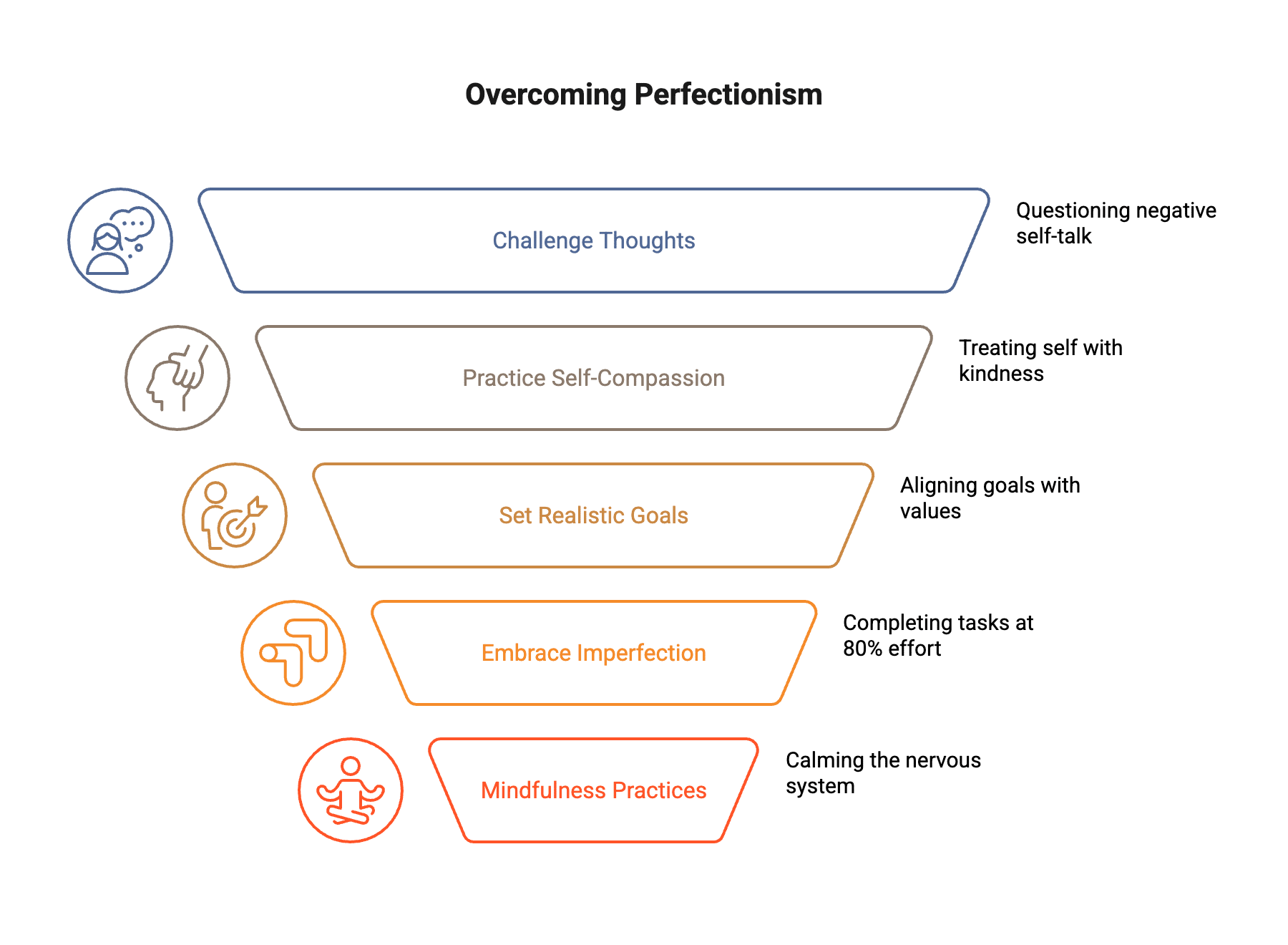
Core Strategies for Overcoming Perfectionism
The most effective coping strategies include:
Challenging perfectionistic thinking – Cognitive-behavioral approaches help you identify and question irrational thoughts like “If I make a mistake, it means I’m a failure.” Through therapy, you learn to examine these thoughts and develop more balanced perspectives, reducing negative self-talk.
Practicing self-compassion – Research shows that developing self-compassion significantly reduces perfectionism while improving well-being. Self-compassion involves treating yourself with kindness rather than harsh self-criticism. Many recovering perfectionists discover that self-compassion, not self-criticism, is what actually motivates them to do their best work.
Setting realistic goals – To overcome perfectionism, recovery means learning to set standards that challenge you without crushing you. Therapists help you identify your core values and set realistic goals that align with what truly matters—not what you think you “should” achieve based on your own expectations.
Embracing imperfection gradually – Overcoming perfectionism requires experiencing imperfection and surviving it. This might mean intentionally completing tasks at 80% effort to desensitize yourself to the fear of making mistakes, recognizing that making mistakes is part of the learning process.
Many perfectionists live with a chronically activated nervous system, always alert to potential errors. Mindfulness practices help reduce anxiety and improve awareness of perfectionistic thoughts while calming your nervous system.
In our DC practice, we notice that many clients initially resist the idea of “practicing imperfection.” They fear they’ll lose their edge or become complacent. What they discover is that releasing perfectionism actually frees up energy they were wasting on self-criticism and anxiety—energy they can redirect toward meaningful work and relationships.
Perfectionism often robs you of joy and creativity. When your focus shifts from avoiding shame to pursuing growth, embracing imperfection leads to a more fulfilling life. Focusing on improvement rather than perfection creates space for creativity and genuine satisfaction.
These strategies work best when you have a practical framework for daily application. One helpful approach is the 70/30 rule, which gives you a concrete way to practice releasing perfectionism in your everyday life.
What Is the 70/30 Rule of Perfectionism?
The 70/30 rule suggests that aiming for 70% effort on most tasks leaves 30% capacity for what truly matters—it’s a practical strategy for perfectionism recovery to challenge all-or-nothing thinking. While this isn’t an official clinical term, the principle addresses a core problem: treating every task as equally important.
How to Apply the 70/30 Rule
The rule encourages you to prioritize intentionally. In DC’s achievement-oriented culture, this might mean recognizing that the presentation to your director deserves more attention than formatting an internal email.
Deliberately completing some tasks at 70-80% of what you’d consider perfect helps desensitize you to the fear of not achieving perfection. By applying this rule, you free up resources for what aligns with your values.
Many recovering perfectionists struggle with anxiety when they deliberately do less than their best. Therapy helps you identify which tasks genuinely deserve full effort and work through the anxiety that arises.
The goal isn’t mediocrity—it’s sustainable excellence and maintaining high standards in areas that align with your values. When you overcome maladaptive perfectionism, you often become more effective because you’re not paralyzed by fear of failure.
While these strategies and concepts are helpful, lasting change typically requires professional support. Here’s how to get started with therapy for perfectionism in DC.
Getting Professional Support in DC
If perfectionism is affecting your life and well-being, therapy offers a path forward. The therapists at Therapy Group of DC specialize in treating perfectionism using evidence-based approaches including psychodynamic therapy, CBT, and ACT.
What to Expect from Therapy for Perfectionism
What to expect from therapy: significant decreases in unrealistic standards and self-judgment, improvements in anxiety and depression, better relationships, improved self-esteem and well-being, and increased self-compassion that allows you to pursue excellence from self-respect rather than fear.
Perfectionism recovery is possible through evidence-based treatment, and you don’t have to do it alone.
Ready to Get Started?
If you’re a high-achieving professional in DC struggling with perfectionism or anxiety, our therapists can help. We understand the pressures of working in a city where achievement is currency—and we know how to help you succeed without sacrificing your well-being.
This blog provides general information and discussions about mental health and related subjects. The content is not intended to be a substitute for professional medical advice, diagnosis, or treatment. Always seek the advice of your physician or other qualified health provider with any questions you may have regarding a medical condition.